Human Fears, Volume 2 — Part I
Christmas 2023 First Edition
I Guess It Doesn’t Matter Anyway
Childhood fears do not usually remain as fears for an entire lifetime. Almost all of them, i.e. the fear of ghosts, and the fear of the dark, and the fear of the unknown, and the vast majority of all the rest of childhood fears, are left in the rearview mirror by age ten or eleven or twelve or thirteen or fourteen or fifteen or sixteen. By those ages, the severity of the fears diminish, lessening into childhood ‘concerns‘. Eventually the fears dissolve altogether and are no longer insufferable. Escaped down the dark drain, never to be encountered again. Thankfully!
The primary exception, of course, is the mind-trapping Fear of Death. That fear seems to linger. It haunts us for the longest time. Until the pain of aging with bone issues and muscle issues and heart issues and mind erosion and disease allow us to accept and even look forward to death.
But as for the process of ridding one’s self from those childhood fears, let’s take a closer look at dinosaurs, as just one example. The precocious young child and the older brown-eyed doofus usually shed their fear of dinosaurs by the time they reach eight years old or pre-teens. Streaks of chocolate from pocket candy may still be on their dress. Still, the pressure released by overcoming the fear of dinosaurs is enormous, and occurs only after the child is certain that no dinosaur is going to suddenly appear from around the corner at the end of the block… spot them through smell or sight or motion, race toward them with unimagined thunder and acceleration, instantly attack them viciously, toss them skyward like a blank-eyed rag doll, thundering and roaring throughout, snorting, and more snorting, squiggly arms moving uncontrollably like spinning tassels, then snatch the falling limp child in their jaws, immediately stopping his or her descent back toward earth, and ending it all with chomp, chomp, chomp… swallow. The normal child knows this is not going to happen. Can’t even imagine it happening. Pretty darn sure. High chance of not happening. 92% minimum. Pin it at the cusp of an ‘A‘ on a standard school test. And you can’t get higher than a grade of ‘A‘. So. There’s that. That’s how you know if something is a sure thing when you’re eight years old. Like they do it at school. That’s how you measure things at eight years old because you haven’t yet even begun to learn that it’s okay to key into what your gut is telling you. It’s one of the best decision centers you’ve got. Unless you got a bum gut. Unless you can’t count on your gut reaction. There should be a medical condition for someone that can’t trust their gut.
You’d have to go to some homeopathic witch doctor with a phd to take care of that lack of belief in your gut. If you’re gut isn’t a reliable decision center, you need to see a shrink. White lab coat shrink, not a bone through the nose shrink. At least as a first shot. Leave the septum whole; un-punctured. What are you gonna do with the dismembered septum piece, anyway? Toss it in the trash? But we are way off track right now. Let’s return.
Losing one’s fear of dinosaurs is only one of the childhood fears necessary to be left behind for there to be a successful transition from childhood into Life’s Next Biggest Challenge. Namely: the teeth-straightened, post-braces, Discovery Years: the Teen Years. One or two studies have already been published about the teen years if you want to carry on the search. The teen years can be dominated by personal growth, new hair and kissing. That’s when that stuff gets its start. Unless the individual is a late-bloomer. That’s kinda a breed all its own. They don’t have an official club, per se, but they know and everyone else knows, who’s in it.
Tyrannosaurus Rex was without question the most awesome critter that ever plundered earth. That is, until Chicxulub burst through earth’s atmosphere 65+ million years ago, at 27,000 miles per hour, smashing into the waters outside of today’s verdant Mexican Yucatan peninsula. Fingers point to this event as that which precipitated the Big Extinction. Starting with instant-searing incineration. Super crispy dinosaur torso remnants littering the countryside. Note: It is the dinosaur scales which contain the important minerals and nutrients: super loaded with b-keratin! And gluten free.
Soon afterward, within what is now known as the Jurassic month, roughly 32 twenty-two hour days, many more T-Rexes suffocated to become stiff as rigor mortis from breathing the air that was overwhelmed by sulphur. Dinosaurs dead as doornails. Now Charles Dickens, in A Christmas Carol, in the opening scene uses the expression ‘dead as doornails’ and argues, I think successfully, that ‘coffin-nails’ would be the deadest nails but left the expression alone, sticking with ‘dead as doornails’. Some of the T-Rex deaths may have been complications due to heart failure or confusion due to sadness. As well as undiagnosed depression.
Finally, the earth cooled down around the entirety of the globe due to the thick blanket of dinosaur ash and peninsular debris and fire smoke that blocked incoming warm sunlight. Earth chilled. Not in a good way. In a bad way. T-Rexes hidden in caves and closets caught colds and died. The original bird flu. From sniffles to death; every last one of them. Doubled-over in pain, and died. No more T-Rexes. Along with 75% of all the other species on earth. All gone. That’s what Chicxulub did. Quite an impact for a puny 3.1069 mile wide asteroid patrolling the solar system at 27,000 miles per hour.
Deimos, the smaller of the two moons that orbit Mars, is only 7.8 miles wide and shaped like a Yukon gold potato. Phobos, the larger Mars moon, is only 13.8 miles wide. Its shape more closely resembles the russet potato without the eyes, and has an unmeasured glycemic index.
Chicxulub struck earth millions of years before Jesus walked around on the planet. So we know that Jewsus, correction, Jesus, was not directly impacted by the careening Chicxulub. Now whether or not Jesus had an impact on Chicxulub?, that I don’t know.
More broadly, I don’t even know if Jesus could impact any events that happened before he walked around. Before he strapped the sandals onto his five-toed feet and walked between oversized stone blocks, carving his way this way and that, on his way to primary school in the Holy Land. Practicing his Hebrew… ma’ nishtano halilo hazeh…
Catholics seem to proscribe to this form of thinking. They believe Jesus is god and knows everything and created light. At least that’s what Joe, a golf buddy who grew up Catholic, told me. I had asked him about Jesus’ range of influence when we were standing on the putting green of the 2nd hole at Foxtail Golf Club. That’s when I wondered if Jesus could have had, or had, an impact on Chicxulub. Maybe he ignored Chicxulub or maybe there was an oversight. I didn’t know. I know some things, but I didn’t know that.
Joe was lining up a short uphill putt for double bogey. He was raised in Ireland but the intonation of his voice was adjusted Sausalito. He held his Costco putter out at arm’s length, skwooshed up his face, squinted with one eye, bent his creaky knees, and looked at the putter’s shining shaft. Cocked his head, too. It’s a familiar pre-putting routine that I’d seen on teevee a hundred times. The golf announcers fail to fully explain what the heck the pro golfers are actually doing when they do this. I don’t think Joe had any idea what they were doing, either. If asked, he’d give an answer cuz liked to talk, but his putting results doesn’t often show any indication that he knows what he’s doing. The length of this putt was two and a half feet. If that. I will agree that it was a little longer than a tap in. But it was close to being in the gimmie range; just outside of it. Joe missed the two foot double bogey putt to the left, circled the cup, and tapped in for a triple bogey 7. ‘Didn’t turn at all,’ was his comment.
Anyway, I had not ever considered the vastness of Jesus’ range of influence beforehand, and so that’s why I asked Joe. Not that he’s any sort of an expert. I didn’t really expect to get an answer. To my surprise, Joe responded almost immediately after his triple bogey tap in and said that Jesus impacts everything in the past, present, and future. Joe was real definitive, although I had my doubts. I wondered why Jesus had never induced a positive impact on my golf game. Maybe just help me learn how to line up a putt. Joe could use the help, too. Regardless, or irregardless (which means the same thing as ‘regardless’ for some damn cockamamie reason), no matter how you look at it, no matter what your perspective, both Chicxulub and Jesus had big impacts. Two huge impactors.
The biggest difference between these famous, historical impactors is that one of them has a name you can pronounce, Jesus; while the other name, Chicxulub, is not pronounceable without coaching lessons. It’s a weird name that looks like Scrabble tiles randomly selected from the grey pouch and placed directly onto the Scrabble rack. It had been an unlucky draw for the tile grabber who pulled out two ‘C’s and a ‘U’… never mind the second ‘U’, which should never have made it out of the bag in the first place, as seven letters is the maximum allowed in Scrabble.
Today’s Tyrannosaurus Rexes aren’t stomping around. And they aren’t escaping the museums of Natural History that curate them… except, perhaps, by moving van. Actually I have no idea how a Museum of Natural History moves a Tyrannosaurus Rex. Probably a lot of bubble wrap, would be my guess. Like if a T-Rex is temporarily gifted to another museum for a big bonanza or an official opening or something spectacularly similar. But they aren’t loaned out for common graduation ceremonies. Nor to Pickleball tournament championships. Not yet, anyway.

Having the T-Rex in the picture above re-erected in a different museum’s atrium would beg for a super serious series of advanced advertisements with a litany of information about its likes and dislikes and tendencies and frailties, along with copious warnings. And info like if it liked fruit. If you placed two bowls of fruit in front of him (or her), perhaps a ripened honeydew on the left and a lemon-fragrant Buddhas hand on the right, which bowl would he (or she) tear into first? Would the color of the bowl make any difference? And would all the T-Rexes favor the same fruit over the other… or does it come down to individual taste? Did they feast on goat as depicted in the movies? Were all T-Rexes left-handed, like Sandy Koufax?
The fantastic advertisement flyers, plastered with terrifying fotos, stapled to intersections and bulletin boards around town, would have to include a paragraph of mouse print at the bottom for legal ass-covering which no one reads.
If the big bone head with tyrannical teeth and the squiggly arms were transported in an extra large box abundantly stamped FRAGILE on the outside, like six times, I wonder if the movers would simply ignore the FRAGILE warning stamps. Like the luggage loaders at the airport seem to do. Go ahead. Just throw my shit onto the conveyor belt. Missed? Damn. Try again! Two Points! Same thing at UPS. And FedEx. But especially the Amazon delivery muscle boy. As well as the bagger at the Mollie Stone grocery store who just yesterday, in the early afternoon, I’d say just before 2:00p, put the yellow seedless watermelon that I had thumb thumped and picked out in the misting produce section, right on top of the delicately frosted angel food cake sampler that I had selectively chosen after scrutinizing more than half of them in the adjoining bakery section. Using eye-measurements, I had chosen the tallest, fluffiest angel cake with the thickest frosted coating. It looked delicious. It was the one with the pink frosting with criss-crossing lines of sky blue. When I got home, the entire cake had suffered a pancaking down to barely an inch tall. The frosted gourmet coating covered the large bag of also demolished potato chips. Don’t they train these people?
Fortunately, I had smartly removed from any sort of packing disaster the chocolate glazed doughnut for immediate bolus-forming, finger-licking consumption. Actually, I had saved both of the chocolate glazed doughnuts. Two hands. Two doughnuts. It’s a personal motto.
The protected bear claw was backup, in case, well, you know. The bear claw was an insurance policy. An impulsive insurance policy. So was the long john which could have used a bigger blast of custard filling. And some of the chocolate crown of the long john was already hard and fell on the supermarket floor after taking the first bite before the automatic doors had fully opened. That’s happened to me many times and I was quite accustomed to it. Although it always made me a little bit sad to see a bald spot on my long john. Even today I prefer my long john to have a full head of sculpted chocolate.
Childhood fears that do tend to stick around, albeit lessened, that devolve to become ‘concerns’, can actually be just as devastating as their original fears. Like tarantulas, for example. Fear of those creepy things doesn’t disappear with age… but it lessens. Or might lessen. Same with concerns of black widow spiders, and for many people, snakes. But concerns can intensify with age, too. It’s a mishmash. There is no definitive word on this. We all gotta do what we gotta do. That’s science invading human behavior. Not something our Four Fathers wanted when forming our country. Were there really only four? And if George Washington is the father of our country, is his sister our country’s aunt? George had many sisters… are they all our country’s aunts? No one has been talking about this. They never completely explain this stuff. It’s typically short of full disclosure, making many of us carry the burden of discovery for our entire lives. And then many of us die with much of this stuff left unanswered. Maybe you find out later.
When a person reaches fifty years old or sixty years old or even seventy years old, new concerns may fill black voids left behind by previously overcome childhood fears. These replacement ‘old age’ concerns can disrupt and consume an old person’s life… to the extent that the person has any life left. These concerns can become, and do become, Issues. You can’t dump them. You can’t stop thinking about them. If allowed to pester the person’s final years, months or days, these issues will do so. Issues love to pester and can even dominate. Old Age Issues are generally ‘real‘, whereas childhood fears often lived within forming imaginations.
Senility Issues are often medical in nature. That’s the issue in a nutshell. The crux. They involve pending death. Called ‘doom’.
When I am old, these issues can happen.
When I am old, one of these issues will end my life.
This alphabetical list recognizes just some of the issues that confront the aging adult. One issue per letter, starting with letter, ‘A‘.
Alphabetical ‘Runner’s Up Issues’ appear at the bottom of this treatment. Following the letter ‘Z‘, pronounced ‘Zed’ by Canadians. Canadians aren’t good rhymers and yet they believe that This Land Is Your Land was written by a Canuck. They even have the lyrics. Which do rhyme, so you know it’s not their original song.
This land is your land
This land is my land
From Bonavista
To Vancouver Island
From the Arctic Circle
To the Great Lake waters
This land was made for you and me

A: Alzheimer’s Disease
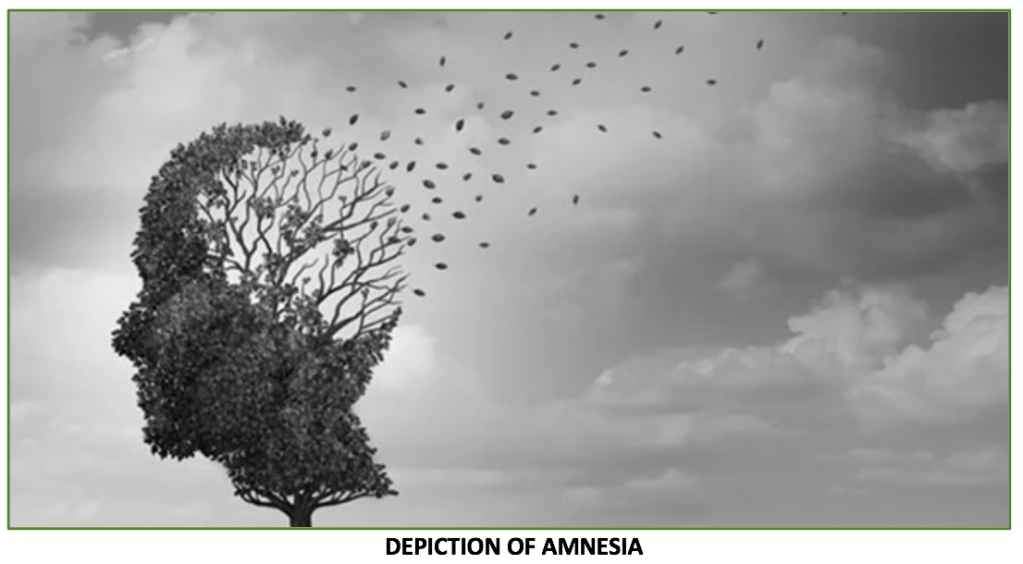
Amnesia is a symptom characterized by memory loss. Sometimes temporary. But can be permanent. Sometimes it manifests itself as confusion. It can occur from trauma to the head or to the brain… or it can occur from high fever, some illnesses, drugs, alcohol and even stress. And can show up in mild form from simply a lack of sleep. Some forms of amnesia cripple the victim such that the person cannot form new memories.
Sometimes, in different types of extreme cases, a person will not be able to recall certain memories for the rest of their lives. It is a dark and lonely affliction. ‘Amnesia’ is used here as a general term for memory loss; a general description. And included within it, Alzheimer’s disease. Which is a form of dementia. Which is not called ‘dementia’ anymore. It has a new, less demeaning, name: cognitive decline. Which for me is just as demeaning… maybe more demeaning. And harder to remember.
The word ‘Dementia’ used to be a general term meaning that the person that had this affliction is a little whacky. A little goofy. A nut case. But, also, likable. Nothing that serious. It was a commonly used term by neighbors without the medical diagnostic backdrop to support it. Then it changed to have a bigger meaning. More pejorative. Still with occasional playfulness. The guy is ‘demented’. Nothing specific. But ‘Cognitive Decline’ sounds more serious and to my mind means the person’s brain is truly suffering. The brain’s capabilities are diminishing. A kind of suffocation is occurring somehow by something. And there is no playfulness about it any longer.
Amnesia, in its many disguises, is also more prevalent when we reach an advanced age.
When we are born, most of us tunnel through the birth canal or we are c-sectioned, and we enter the bright and shiny world alone. Usually. Unless the baby is one of two babies; which we call twins. Or unless the baby is one of three babies; triplets. Or in the odd case of the Octagon Mom’s children, one of eight, called octuplets. A term more often applied to beagle puppies and hamster litters. But these multiple human birth anomalies are only about 3%-4% of all human baby births. Which means approximately 96%-97% of human babies born are what statisticians call ‘single drops’. Doctors call single drop deliveries, uniparous. The Cantrell sisters aren’t uniparous. That’s fine. That’s fine. They don’t need to be. They don’t need to be. They are doing just fine as twins. They are doing just fine as twins.
After we enter this world uniparous, however, we are immediately dependent upon others; most naturally beginning with our biologic mothers. Within whose womb we had our first swim and were nurtured. Then, in a few years, we transform into social animalia. Social beings. From bonding with our mothers until we die, we are, most of us, socially active. But more importantly psychologically, we are socially dependent. After we die, we no longer participate in active social circles. That may just be a belief. That’s what I believe.
We are born alone, and we die alone (our death is not shared actuarily with others), and in between, we live our lives, and share our lives, with others. We surround ourselves with others. We are enveloped by others. Including the FOREVER stamp. We need others physically, emotionally, spiritually, financially, and psychologically, for love, for safety, for a feeling of belonging, for lots of cash, and for self-esteem. And sometimes to just get through the day. Some people even replace human beings as their solace, and find their personal socialization with a pet. They might choose to get a dog, for example. That was MaryClare’s choice. She chose small dogs, like real small, like less than 8 pounds small. Something like that. A real real small replacement, tiny, human being. But many of those tiny dogs think that they are Dobermans.
Amnesia, and specifically Alzheimer’s disease, can rob those unfortunate enough to be afflicted with it, of the real relationships they had with other persons. Even loved ones. Especially loved ones. The result for the person afflicted is that the critical social aspect of their lives, the relationships that they had formed and depended on, the relationships that were needed for that person’s well-being, are cut short, or cut off.
Whereas many people have an understandable fear of death, amnesia is itself a type of death. Just as dying leaves us alone, amnesia, and Alzheimer’s disease, leaves the afflicted person alone. Or lonely. The words share the same root, so they are interchangeable. It’s a rule.
Bob Willard’s father, Jack Willard, became afflicted and was diagnosed as having Alzheimer’s disease. I visited him, along with Bob, in southeastern Colorado, in Walsenburg, when he was thus afflicted. He no longer knew (seemed to remember) that his wife, Thelma, Bob’s mom, had died a couple of years earlier. Jack and Thelma had been married for 60 years. When visiting him with Bob, his father repeated, every few minutes, that Thelma was at the store, and would be home soon. He didn’t seem to know that he wasn’t at home. He didn’t know he was living in a medical, Alzheimer’s (old timers) facility, in Walsenburg. He didn’t really remember Thelma. His thoughts were caught in a loop. A short loop. He repeated the same things. Some of which was not accurate or not possible. But real to him. What Jack still had was an emotional connection to Thelma. An emotional memory. I think emotional memory for an Alzheimer’s patient is like a song to a stutterer. Stutterers can sing fine, they just can’t speak without the machine gun delivery. Singing and speaking use different connections in the brain.
Jack Willard seemed like he remembered me, but he would ask Bob, sitting right there next to me, ‘Is that Sam?’. Bob would answer the same questions from his father, with patience and a calmness. As though all was okay, but knowing that little of his father’s condition was okay. His father’s loss of memory was selective and erratic. I never knew, and Bob never really figured out, whether or not his father knew that his memory had fractured. Or to what extent. That it was on the fritz. That it was unlikely to return. Someone knows the answer to that one. I don’t, certainly. But apparently, like many things, those unlucky enough to have Alzheimer’s Disease have good days and bad days, remembering one day, out of reach the next. And generally, those afflicted do know that there is something amiss with them. They know something is ‘different’.
Losing your memory, or portions of it, seems like it should be a torment. It wasn’t obvious how tormented Bob’s father’s life had become. Living substantively within his own confused mind. He did not act tormented. I had my tormented antennae turned up high, but received no signal. But I am an untrained observer. A bystander. Bob Willard’s father died September 8, 2011. Eight years later, Bob, himself, was diagnosed with dementia, at age 68. He was uncontrollably distraught upon receiving the shaky news. It reminded Bob of his father’s condition, yet the diagnosis occurred 15-20 years earlier in Bob’s life, than it had been diagnosed in Bob’s father’s life. Bob told me that his diagnosis was called: dementia. That’s what he said. The new nomenclature of ‘cognitive decline’ had not yet reached Grand Junction, Colorado, where Bob ‘lived’. Where Bob paid taxes. The professionals in Grand Junction still called the condition ‘dementia’. A scan of Bob’s brain revealed noticeable shrinkage, but it was his dramatic change in behavior that caused the actual diagnosis. Behaviors like not being able to button his shirt without struggle. Only some of the times. Being a button-down shirt guy his whole life, he shifted to tees. At 250+ pounds, tees were not becoming. Bob looked like a totally different person wearing t-shirts. He looked goofy in them.
Bob Willard, my friend, died at age 69. His mother had lived to age 84, dying July 11, 2008. His father passed over in 2011, age 92, outliving Bob’s time on earth by 23 years. 92 years old is a ripe age, and coincidentally, the age that my own mother died… but she had no noticeable cognitive decline. Her mind was as sharp as a needle until the end.
The synapses in my mom’s brain were significantly functional, possibly because she was always reading, always learning, constantly engaging her synapses with new thoughts, and perspectives. Her death was due to her heart plugging. The doctors could not detect a pulse an hour or two before she crossed the finish line.
Can you actually die from Alzheimer’s disease? Yep. Most common way to die from Alzheimer’s is swallowing food down your windpipe, and you stop breathing. It is not uncommon for someone with Alzheimer’s disease to develop difficulty swallowing. When the carnival hot dog or deli doughnut is stuck in your windpipe, going down the wrong alleyway, headed for your lungs, it can be more than just unfortunate. It can also be called aspiration pneumonia. That’s one way to die from Alzheimer’s.
In a circuitously connected way, my own mother died due to a preventative aspirational pneumonia recommendation from a doctor. I was there. Apparently, there was concern for my mother’s health by some of the doctors in my mom’s hospital room following what I could only guess was a minor stroke. I flew down the next day, and when I saw her in her hospital bed, she seemed fine. She couldn’t lift her left leg as high as her right leg, but she said she felt fine. No big deal. She couldn’t lift her left arm as high as the right arm, either. She and I were talking and I didn’t notice anything peculiar. I didn’t know why the doctors were doing what they were doing while I watched them do it, but they hooked up a camera down my mom’s throat, and gave her small pieces of mashed-up banana to eat. I could see the banana bolus go down her pipe on the screen. I thought that the chewed food continued on properly, and I thought that was good. Plus, my mom wasn’t choking or anything. And her eyes weren’t watering. And she was breathing fine. I happened to know that she didn’t like bananas, but she didn’t complain about it.
The physician’s diagnosis was that my mom couldn’t swallow reliably. They were looking at the same monitoring screen that I was looking at. It was black and white. It looked similar to looking at an ultrasound screen of a baby, except in the center of the screen was a throat swallowing, and you could see the food go through the tube like traveling down a laundry shoot. Her throat was contracting; not solely reliant on gravity. In this way, the throat diverges from the laundry shoot. Throats depend on peristalsis. Laundry shoots have no such dependence.
Detour: No baby I ever saw looked like its sonogram picture. Many adults grow up and remain recognizable from what they looked like when they were kids. The change in appearance from kid to adult is a lot less than the change in appearance from sonogram baby to birth announcement baby. You can draw a straight line of resemblance from kid to adult. Not so with the sonogram baby. I still can’t match the sonogram pictures of my own kids to the kids themselves. Makes me wonder if my kids were switched at birth.
Truth be told, sonogram photos don’t look anything like any birth babies I ever saw. However, there is an inconsistency. I guess from about a couple of weeks after masterfully climaxing ‘the dirty deed’, until birth, the in-utero baby is more correctly called a fetus. Not really called a ‘baby’. Or for snobby people with Derby hats and for women with animal print coats, their royal mixture of spooge is called a ‘foetus’. It is the inserted ‘o’ in foetus that gives it royalty. But still, we generally refer to the fetus or foetus as a ‘baby’ when we are at neighborhood pot luck parties. And also when speaking directly to the expectant mother. No one asks the mom-to-be, ‘How is the little fetus?’ Or. ‘Anything new with your foetus?’
So the physicians told my mom, because in their opinion she couldn’t swallow food correctly, that she was going to have to be fed through a tube inserted into her stomach. For about six months. She said, ‘Forget that’ (to herself), and checked out two days later. Not out of the hospital. Out of life. She was 92. A warm Sunday afternoon. Some doctors ran in with the paddles to jolt her heart, but I interrupted and said, ‘No. She doesn’t want that. She told me to not let you keep her alive.’ And so they didn’t. No bantering back and forth. No discussion. She died a minute or thereabouts later, and her face puffed up like a balloon a bit, then her eyes got real big like they could pop out of her head like corks out of a bottle of champagne and ricochet off the ceiling. But they didn’t. They remained in her head, where I’d always known them to be.
My aunt and I left my mom’s death room a couple of minutes later. We didn’t announce our departure to anyone. We didn’t say goodbye to the paddle doctors. We didn’t thank them. Once we got to the car, we realized that we had left my mom’s wedding ring on her sausage ring finger, so we went back, and walked down the hospital hallway to the room my mom had been occupying, and she was still there staring straight ahead at the ceiling with no sight, and Aunt Dorothy removed the ring. At 86 years old, Aunt Dorothy was my mom’s youngest sister. They were great friends their entire lives. They were always there for one another. That was nice.
It was at Aunt Dorothy’s house thirty years earlier that Bob Willard and I scarfed down a pound of raw bacon, eating what we thought was the best corned beef either one of us had ever had. Not that we were corned beef experts. That honor probably resides with Denny Blum. But we were stoned on many joints of weed at Aunt Dorothy’s house. Actually, we were so stoned we couldn’t even read the label on the bacon package. Aunt Dorothy never found out about it… and wouldn’t have cared, would be my guess. Aunt Dorothy was cool. She was like my mom.
B: Bone Fractures

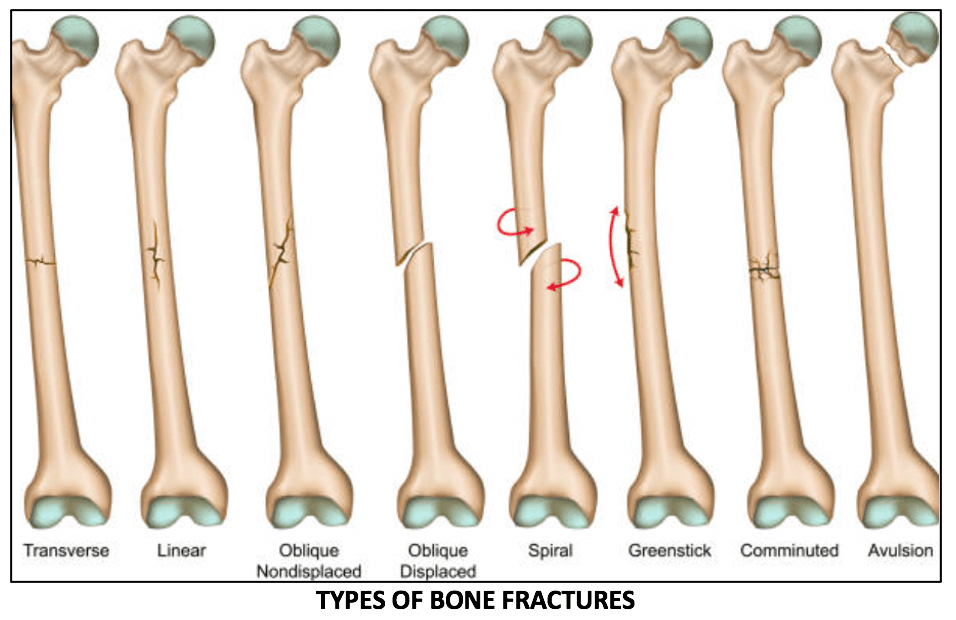
Many seniors fixate on the possibility of falling. Breaking an arm, or a leg, or worse; hitting their head, cracking it open, and dying in a pool of brain blood and slippery floor goo. It’s straight forward. Balance becomes noticeably compromised as we age. It just does. It’s part of the Trojan horse called ‘life’. Slipping in the bathtub is a well-known problem. There’s a famous commercial where an old lady falls, and calls out, lying on the carpet, ‘Help. Help. I’ve fallen. And I can’t get up!’ You’ve seen it. They played it on teevee all the time years ago. But there was a lesser known Jewish version, not aired quite as much, where the tragically fallen Jewish mother, lying on the carpet, calls out, ‘Help. Help. I’ve fallen. And I can’t get up! And my son is a disappointment!’
To compound the problem of falling and breaking a bone is the scientifically identified and supported fact that the bones of senior citizens are more prone to break because they lose their strength. Bones become brittle. They become calcium-lite. If some pastry chef made calcium-enhanced doughnuts, the whole broken bones issue due to falling would be cured within one generation. It’s a money maker. That’s not just my opinion. It is the findings of the American Medical-Doughnut Compendium.
The human body has 206 bones. As do gorillas. Robert Gregory (human) and Koko (gorilla) have the same number of bones in their bodies. Pythons have more bones than humans. Pythons, then, also have more bones than gorillas. If you add together all of the subcutaneous bones of Robert Gregory and all of the bones under the much thicker skin of Koko the Gorilla, 206 + 206, pythons still have more bones. In fact, pythons that are 20 feet in length, or longer, have 1800+ bones. That’s a lot of bones. If a human person that is employed as a laboratory ‘bone counter’ gets distracted trying to count all the bones of a captured Burmese python, and feels forced to start the count over again, it’s a real time sucker. It’s too much. It’s too much. No other animal has as many bones as a python.

It is my recommendation to members of the bone counting industry that happen to get ‘lost in count’ while counting python bones, just pretend to complete the python bone count, and make up a number, like 1612 bones. Or count six inches of python bone, then multiply that six inch count by the number of feet that the python is measured to be, then take that result (product) and multiply by 2. For example, if there are 40 bones counted in six inches of a Burmese python, and the Burmese python is 9 feet long, the total bones would be (roughly), 40 x 9 x 2 = 720 bones. That’s just about right.
The common garden snail, we learned in ‘Childhood Fears – Great White Sharks‘, has 14,000 teeth, but teeth aren’t bone. Snails have no bones. Neither do jellyfish. And there are a whole lot of other animals that don’t have any bones. But humans do. And so, Bone Fractures makes this list. If this were a list of issues constructed by a garden snail, ‘Bone Fractures ‘ would not be on it. Common garden snails, of any age, would probably choose ‘Big Shoes‘ for their letter ‘B‘ choice of issue. That’s what common garden snails worry about. They also worry about rats and raccoons. (Common garden snails would have a difficult choice to make for the letter, ‘R‘.) And garden snails worry about salt, but for different reasons than why humans worry about salt. Salt to a snail is like water splashed on the Wicked Witch of the West.

When a python breaks a bone, no one cares. We usually don’t even know about it. When an older adult breaks a bone, it can be devastating. Or worse. If it’s a hip that breaks, especially if it’s an old female hip, that feminine person could be in deep do-do, or could be deep in do-do, depending on how you turn the phrase where you grew up. In both cases, it is not a place to want to be. We learn that as kids. And it doesn’t change. Deep do-do is always wanting to be avoided.
You come to learn that you are on the wrong end of a situation when someone of authority says, ‘You are in deep do-do’. Or, ‘You are deep in do-do.’ My childhood physician never said either one of those things to me. He gave me no advance warning. No nod of the head. No nothing. He just pulled out the long needle, about the length of Seattle’s Space Needle, and chased me around the doctor’s office, until he had me cornered. With my mom buttressing him on one side, and the nurses forcefully banging on the examination room door, it was my time to get a booster shot. It was at that time that I was steeped in deep booster do-do.
A hip fracture in older adults can result in poor outcomes, even increasing the risk of death; the final deep do-do. There are a number of factors that play a role; including age, sex at birth, and any extenuating health issues that the person was confronting prior to the hip fracture. And that list of extenuating health issue possibilities can be quite long; like if the person has diabetes, or is frail to begin with, or the blood pumper in their chest isn’t so good, or about 206 other possibilities. The flu. Gum disease. Stuff like that… and worse.
If you break your tailbone, that’s a real bummer. With or without the pun. It’s a bummer. Bummer’s aren’t good. They are generally a lesser form of deep do-do. The reason that it is a particular bummer, breaking your tailbone, is that there is no way for an orthopedic surgeon to really ‘set’ your tailbone; to hold your tailbone in place while it heals.
Joint fractures are particular tricky to deal with, too, whether it be a broken ankle, a cracked knee, a splintered wrist, or a shattered elbow. Cracking your skull isn’t good, either. None of it is good. The largest bone in the human body, the femur, the bone connecting your knee to your waist, is a particularly painful bone to break, as it requires a lot of force for it to s-n-a-p. It requires a lot of trauma. Unless the person has advanced osteoporosis, the bone disease where the person loses bone density, and their bones turn into a kind of sponge cake. Not a Sara Lee. Non-edible sponge cake. People, usually old people, that get osteoporosis, are much more likely to break a bone. Osteoporosis is much more prevalent in women than in men, by a factor of 4x. It has something to do with menopause, which, like ‘threading’, isn’t something men are allowed to know anything about. You’d think it would be called womenopause. And you would be right.
When an actor like Douglas Fairbanks, Jr. or a performing super-musician like Bill Frisell are told to ‘Break a leg’, it isn’t said with malicious intent. It is surprisingly a way of saying, ‘Good luck’. The phrase references early days of theater when the stage had a ‘leg line’ drawn on it. Way back in the 1800’s. Unpaid performers stayed behind the ‘leg line’. Once invited to cross the ‘leg line’, to get paid, the expression ‘Break a leg’ became the call for that to happen. It all got worked out.
C: Cancer

We referenced it earlier, but when your doctor opens a serious diagnostic conversation with you, while you are sitting in your underpants on the examination table if you are a guy, by saying, ‘You are in deep do-do.’, your first thought is, ‘I have cancer. I’m going to die.’ Perhaps that is two thoughts. But rather than tackle this obvious alphabetical choice, the biggest elephant in the room, ‘Cancer‘, as our letter, ‘C‘, let’s take a quick break from golden years gloom, have some real fun, and insert an issue that is common for parents of young kids: chickenpox. In fact, the picture above is that of a chickenpox virus. It’s not a raspberry blowup of a cancer cell.
Chickenpox is a highly contagious kid’s disease. Basically every kid got it, or was vaccinated against it, but today it is a bit controversial. Many parents still hope that their kids get chickenpox, so they can build strong antibodies against it 12 different ways. And some parents hope their kids don’t get it at all. And don’t want their kids to get the chickenpox vaccine, which became available in 1995. I don’t know any of those parents. Or I don’t know if I know any of those parents.
Chickenpox is sometimes spelled in two words. Those two words are: ‘chicken’ and ‘pox’. Separated by one tap of the spacebar. Which is another word that is sometimes spelled in two words. Those two words are: ‘space’ and ‘bar’. Separated by a tap of the, uh, spacebar or space bar.
If you didn’t contract chickenpox as a kid, it’s a more serious problem if you contract it as an adult. The same virus that constitutes chickenpox, can declare itself as ‘shingles’ as an adult. And shingles is not something you want to wrestle with, if you can at all avoid it. So you will want to get a vaccine against shingles beginning when you attend your 42nd Year High School Reunion. For some of you who blew off your 42nd Year High School Reunion, another way to think of it, is age 60.
Shingles is no fun. It’s all pain. Blisters, and a lot more pain. I know a kid that got shingles in his early 30’s, including inside his ear, and contemplated ending it all, the pain was so oppressive. Can last for weeks. This kid was hospitalized for days. In Puerto Rico. His mother was in tears in Miami.
Scientists have analyzed the evolution of the chickenpox/shingles virus. As opposed to a flu virus which can change and mutate thirty-five times a year because of it being an unstable single-stranded RNA virus, the chickenpox/shingles virus is very stable, maybe mutating once every 400 years. Its composition is double-stranded DNA.
The evolutionary analysis indicates that the viruses that eventually lead to chickenpox and shingles (varicella-zoster) existed during the Jurassic period, 200 million years ago. That’s when dinosaurs ate pork sausage! This shingles thing is twice as old as Ben Franklin! And its age, prevalence, and stability should be a lightning rod for you to get the vaccine.
Here’s some mumbo-jumbo medical hoo-hoo on shingles: Vesiculopapular diseases that mimic chickenpox include disseminated herpes simplex virus infection, and enterovirus disease. Dermatomal vesicular disease can be caused by herpes simplex virus and can be recurrent.
If you have disagreements with, or don’t fully understand, the copied-and-pasted, mumbo-jumbo above, presented in a lovely periwinkle blue, please contact our recently-promoted, Sr. Office Manager, Dorothy. Dorothy, as some of you will recall, recently gave birth to a terrific, baby girl whom they named Kira, and we are happy to pass on to you, Our Readers, that Kira has not yet contracted chickenpox. Hopefully she will in five years. Not fifty.

D: Diabetes
I have diabetes. II Type. I don’t know what people think of me in that regard. Most people I know don’t even know that I have it. And I don’t know if they have it! Or what they have, if they even have anything. No one tells. Or at least, No one tells ME.
There should be one day a year, say July 22, when everyone beyond a certain age wears a special Reveal Day shirt or blouse with a list of their medical ailments printed on the back. In real clear, big type. No funny-business, no phony-baloney. And no malarkey. And no unreadable fonts!
The first year of implementation will uncover some bugs that will need correction for year two. That’s the expectation. Below are the Reveal Day rules at launch:
On the front of the shirt/blouse, the person’s age is to be printed in football jersey block letters. On the back, a person’s top five medical ailments, which may include major surgeries, are to be listed vertically. That’s it for the hard-fast rules. Simple. Just two. Then we get into the nitty-gritty. We need to weed out the imposters.
Those of us not yet aged 50 years old need not participate in Reveal Day. If you are in your 50s to mid-60s, it’s a volunteer program. Anyone aged 65 is encouraged to participate. However, for those age 66 or 67+, Reveal Day is targeted at you. It’s a Public Service and any costs associated with Reveal Day should be a tax write-off. Youngsters throwing frisbees and Gen Z’s playing Facebook need to be able to see what diseases and ailments are bringing down the old fogies. Maybe they’ll learn something.
Reveal Day will find lots of 70s to 75s, and fewer 76s to 80s printed on the front of the Reveal Shirts and Reveal Blouses. At 81, the number of these informative classy shirts and blouses drops significantly. There will not be found many 96s on the front of the Reveals, as most people will have croaked by then.
Reader from Tulsa: Thank you for taking my question. I will try to be quick as a cat’s ass. So, if I turn 74 years old after July 22 this year, do I have to purchase two shirts? One with 73, for my age before my birthday, and one with 74, for after my birthday?
Response to Tulsa Reader: Thank you for your question. All participants need only purchase one shirt, or blouse, per year. Just put the age you will be on July 22, Reveal Day, for that year. Additionally, as a help to you all, you may even order a shirt or blouse from us directly. We will handle all the lettering, front and back. Be sure to fill out Form 7/22 completely, including your Top 5 ailments. And include your shipping address. For those of you on budget who wish to fill out release form IT-3219, we will do the printing on the shirts and blouses FREE of CHARGE. And we’ll throw in the shipping FREE of CHARGE, too! For everyone else, the charge for this service is a modest $15.
Reader from Tulsa: That is fantastic! I can’t believe it. Can you sew my name on the back with a slight arc? I like the arc-look, personally. It just looks more snappy and really classy. Also, to show school spirit, do you recommend that everyone should get a shirt that is their high school colors?
Response to Tulsan: We are not supporting names on the back of the shirts or blouses in our Reveal Day inaugural year. But we like your attitude. The age numbers on the back of the shirt, or blouse, will be 9″ tall by 4 7/8″ wide. As for the color, your suggestion of wearing high school colors certainly has a sentimentality to it, a loyalty component, but this isn’t an exercise that is connected to high school. Plus, home-schooled fogies typically don’t have school colors. However, if this program elevates off the ground in conjunction with high school reunions, we should allow the reunion organizers for their school, and for reunion organizers for all schools across the country, to make their own shirt color recommendations. Again, thank you for your questions.
The top five medical ailments for a living, breathing 96 year old are probably, in this order:
1 – Approaching 96
2 – Reaching 96
3 – Being 96
4 – Remaining 96
5 – 10 Years of Incontinence
To be clear, the back of the shirt or blouse must display the ‘top‘ of the top five. The ballbusters. The ‘Holy Shits’ of ailments or surgeries. Maybe ’10 Years of Incontinence’ should jump to the pole position.
To follow are a couple of implementation examples for Reveal Day shirts and blouses:
If a person is known to have heart disease, this is just an example, yet heart disease is not included on that person’s list of ailments, prominently displayed across their chest, that’s a violation. And if that person, instead, included ailments like ‘tarry stools’, or ‘knock kneed’ on their shirt list, even if tarry stools or knock kneed were listed in the #5 – Last Position, then that is a violation. If you have heart disease, put it on your shirt. If you have lupus, put it on your shirt. If you are on dialysis, put it on your shirt. Any kind of cancer? Put it on your shirt. Cataracts? Up to you. Incontinence? We don’t want to know. Okay. Maybe #5, the last entry, unless you’re 96 years old or older.
Below is an example of an acceptable list to put on the back of a shirt or blouse:
1 – Diabetes Mellitus
2 – High Blood Pressure
3 – Elevated Cholesterol
4 – Gum Disease
5 – Lactose Intolerant
That’s a valid ailment list right there. Unless we know that the person also has Bone Cancer. Which would have to be listed higher on the list than ‘Gum Disease’. And, in this Bone Cancer case, ‘Lactose Intolerant’ wouldn’t even be included on the shirt. Lactose Intolerance would remain a secretly guarded unknown for that person. Also, medical big shot words, like Hypercholesterolemia, in place of Elevated Cholesterol, are taboo. It’s gotta be straight English that a normal cowboy would understand. Or at least that a normal smart cowboy would understand. Maybe not a Wyoming cowboy. Nor a South Dakota cowboy. We aren’t aiming for crayon cowboys. Think about aiming for a Mormon Cowboy when you compose your list.
Here’s an example of an unacceptable list of ailments on a shirt or blouse:
1 – Steatopygia
2 – Hemorrhoids
3 – Fear of Clowns
4 – Dry Eyes
5 – Smelly Toe Jam
1 – Steatopygia is not well-known, so it is voided due to it not being Mormon Cowboy language. It means an accumulation of excessive fat in the keister. A somewhat rare condition that has been given a name which is rarely encountered.
2 – Hemorrhoids could make someone’s list, but probably not #2. Even though some wise-ass would argue that #2 is the best location for Hemorrhoids.
3 – Fear of Clowns shows poor understanding as to what we’re trying to communicate here.
4 – Dry Eyes isn’t bad ass enough to make the list.
5 – Smelly Toe Jam is also probably not bad ass enough to make a person’s list, but #5 is really a spot for everyone to include whatever they want, so, actually, #5 is the only entry position on this list that would qualify. Consider #5 as a Free Square, like a Bingo center-square.
If Reveal Day takes the path down the high school reunion route, I nominate Forever Head Girl, Cathy Cantrell, to head up this Class of ’69 effort for our East High School. Thanks, Cathy. You have always been our finest. If you would like to pass this particular hot potato to Head Boy Runner-Up, Dennis Blum, to test his mettle, I remain anxious to see all our classmates shirts. At the very least, the creation, and wearing of Reveal Day shirts should be a requirement for all who attend the 55th East High School Reunion for the Class of ’69. It will give us an additional insight into who, or what, we all have become.
Note: For classmates who have had an organ removed, we will accept those entries as valid. ‘Tonsil’s Removed’ will be rejected as an entry, however. Following internal panel discussions, and review, we are accepting ‘Appendix Removed’. But to be clear, generally we are looking for current ailments. Not adolescent successful operations. Also, by a vote of 5 to 2, sexually transmitted diseases (STD’s), like herpes, do not have to be listed. We understand that privacy matters when it comes to sexually transmitted diseases.
Lastly, if you are an ‘anti-vaxxer’, then Anti-vaxxer should definitely be on your list, only in spot #5, since you’ve probably got other ailments to choose from to put into positions #1 – #4. Like bird flu (since you don’t vaccinate), and covid-22 (since you don’t vaccinate), and shingle blisters (since you don’t vaccinate), and tuberculosis (since you don’t vaccinate), and polio (since you don’t vaccinate), and poor cognitive skills (since you’re an idiot). I know. It’s unfair to help the anti-vaxxers create their list of ailments, but I think we all want to know who are the Republicans and who are the normal people.
I don’t blab about having II Type. When invited to dinner at a neighbor’s house, I don’t say to the chef, ‘Just so you know! I have diabetes! SO… make sure there aren’t too many carbohydrates, and not too much red wine, because red wine has a lot of sugar in it. A lot more sugar than people realize. And also. No grapefruit, because I have to take a statin, because of the diabetes II Type, and because doctors said ‘No grapefruit‘, and because when I asked why, they said it was because grapefruit is the only thing that interrupts the statin.’
I can safely include this rather personal information here, even with the impressive volume of readers that we have in this exclusive Reader’s Club. But, apparently, diabetes is all the rage. I only mention that I am thus afflicted to add personal validity to this alphabetic entry for the letter, ‘D‘. Tons of people have diabetes. Here’s what it does to its victims, in simple Mormon Cowboy English, as far as I understand diabetes, and Mormons and English:
Diabetes is the name applied to the diagnosis of a person’s blood sugar level being too high. It makes their blood thicker, and more sludgy, than it should be. Which makes it more difficult for the heart to pump the blood through the 60,000 miles of adult circulatory system tubing. This puts additional stress on the heart, which wears it down even quicker, and makes circulating your blood even tougher still… and incomplete. Toes turn blue, then black, and get cut off.
That’s Mormon Cowboy diabetes description at its finest. Fits loosely — like a newly purchased Mormon Cowboy string bolo tie. [When initially typing the word ‘Mormon’, it came out ‘Moron’. I don’t know why that happened.]
Below is a video of one diabetic man’s experiments with popular fruits. It’s a goody as far as fruits are concerned. It’s a good guide!
Additional smart foods for diabetics to eat are discussed below.
Here’s the list of ‘10 healthy foods for diabetics to eat‘ from the video above: Avocado, Beans/Lentils, Brown Rice, Ceylon Cinnamon, Dark Chocolate, Eggs, Green Vegetables, Nuts/Seeds, Olive Oil, Peanut Butter.

E: Evangelical Cults
I did not come up with a make-sense, suitable ‘E‘ entry for our topic of old age Issues. At least not with the amount of time that I allowed myself. ‘E‘ isn’t the best letter in our alphabet even though it dominates as far as usage. Over 11% of all the words in our language have the letter ‘e‘ somewhere in the spelling of the word. Followed by ‘A‘ at nearly 8.5%. ‘U‘ is actually more frequently used than either ‘C‘ or ‘M‘, which just seems wrong.
Elephantiasis is not something we worry about here in North America, so that wasn’t going to fly as our ‘E‘ entry, although I always found elephantiasis to be interesting, and unbelievable, and ridiculous, and amazing… like dinosaurs. And, of course, it’s transmitted through mosquito bites, but only if the girl mosquito doing the biting had ingested the elephantiasis parasite.

Why experts say mosquitoes ‘bite’ is a conundrum. Not a snare drum. Nor a tom-tom. Bongos? No. It’s a conundrum. What girl mosquitoes do is stick their needle-noses into the pores of your skin, tap into a vein, or an artery, and slurp. Their needle-nose is like a straw poking into a melted Slurpee. Like a Slurpee that climbs up the straw via capillary action. Slurpees make use of sucking on the other end, usually from the inside of the mouth of a human.
I took a lot of biology courses in college. Well, just exactly the minimum amount to get a Bachelors Degree in Biology. A Bee Dee Bee. Which the school shortened to a Bee Ay. Which I thought was a lot of Bee Es. One of the classes I took was called, ‘Animal Behaviors’. Or something equivalent. We didn’t have to learn the exact title of our classes. Anyway, the teacher said that every animal in the animal kingdom had at lease one good thing that it did in the world, or for the world… except for the mosquito. Every fish, and every mammal, and every amphibian, and every reptile, and every insect except the mosquito, had been recognized, listed, and catalogued as contributing, in a positive way, to the state of its habitat. Except one. There was nothing good that they could detect, witness, imagine, exaggerate, or hope for, when it came to the mosquito. Basically they were saying that the mosquito was a shit animal.
Of all the millions and millions and millions of different animals that Noah rescued, transported, and saved from extinction (I am not a Noah savant), the one animal he should have left behind was the mosquito. I do not argue against that. Whatever bloke Noah had assigned to monitor the boarding of the ark did a poor job. I will not accept that had he known, had Noah known, had it been brought to his attention, had someone had the balls to tap him on the shoulder, or knock on his captain’s cabin door on the ark, even if it would interrupt a soiree with one of the other female animals (typically a mammal), I just don’t believe that he would have allowed the mosquito to hang around, nonchalantly flit onto the ark, and ride to destiny’s safety, tweeting ‘la-la-la-la-la’, as though the mosquito was a little special pussy cat, or a mid-coast family’s favorite Golden hamster. Of course the cutest of all the mid-coast family hamsters is the Winter White Dwarf hamster. That’s the cutest hamster. Everybody says it.
Now here’s a question that I have. Did Noah have to allow a Golden hamster and a Winter White Dwarf hamster on his biblical boat? In other words, did all the different hamster species require admission? Expanding the inquiry, did Noah have to transport a white human family and a black human family and a yellow human family? And all of the other lesser important colored families? This happens to be one of my troubles with this stuff. It isn’t fully explained. Not for dumb-old me. They don’t divulge everything. And as for the different colored families, were the white family’s the newest color? Did racism start on the boat?!! Or was that already a ‘thing’?
Actually, I do know some things about Noah. I was too quick to dismiss myself a couple paragraphs earlier, but that paragraph has been written, and burned into the computer monitor, so this is an update as to what I know about Noah. He looks a lot like Santa Claus’ brother. Big white beard. He had blue eyes. Loved pancakes. Had the calloused hands of a construction worker. Didn’t use aloe. Never even considered aloe. Has been speculated that he was allergic, but not proven. Did not use dentifrice. And his fingernails were not professionally manicured. In fact, he chewed his fingernails. (A lot of the books don’t know some of this stuff.) He was not carefully circumcised. It was a rushed job…. having the biblical stuff to attend to, starting real early. Circumcisions were performed at age 17 in biblical days.
I also know, for a fact, from religious experience, that Noah is one of the first stories in the Jewish Pentatuche. Go ahead and doubt the spelling of Pentatuche. It has little red squiggly lines under it, and I tried a bunch of different combos. I know it’s one of the first stories because my haftarah was titled, Noah, and I had my bar mitzvah early in the new year. Noah is the second haftarah of the year: week two of fifty-two. So, I was up on stage, on Saturday, October 10, 1964, singing the Noah story, in my best Hebraic soprano, having no idea what I was singing, or that it was even about anything, because it was in Hebrew, and no one in the synagogue knew any Hebrew.
Except for the word ‘hamentoshen’, which might not even be Hebrew. If it is Hebrew, it means three-corner, hat-shaped fruit cookie. Or three-corner, hat-shaped poppyseed scone for our northern border Canadian bosom buddies. It has two meanings. I don’t think ‘macaroon’ is Hebrew, but there were lot of them around at holiday time. That pinpoints just how much fun Jewish holidays were. There were macaroons. Woo hoo. The epitome of Jewish holidays! Both my parents had dentures, so they didn’t eat macaroons. But my father loved coconut. He had that going for him.
My brother had to get permission from the high school football coach to miss that Saturday afternoon’s high school football game; the Saturday of my Opus Performance, October 10, 1964. He was on the football team as a middle offensive lineman. My mom thought my brother should be present to witness my finest Hebrew, but I didn’t care if he was there. However, I didn’t get in the middle of it. I secretly figured it was God’s payback because I had to listen to my brother practice his trombone in the kitchen breakfast nook. It was rare. For sure. ‘Boom – boom.’ That what about it.
I’m not saying my brother practiced his trombone weekly or anything. Sometimes, a few times during the school year, never in the summer, he’d yell out to my mom, ‘Mom. Do you know where the trombone is?’ The fact that he didn’t call it ‘his‘ trombone was telling. My mom didn’t play trombone. My dad didn’t play trombone. My dad wouldn’t know how to hold it. I never touched the thing. I’d just get in trouble if the trombone slide slid off and bounced down the stairs and it got bent or mangled.
I don’t know whose trombone my brother thought he was playing. When my brother would reluctantly practice ‘the’ trombone, my dad would shut the door to the teevee room, and he almost never shut the door to the teevee room. But you couldn’t fully escape the boom-boom-slide-boom of the out-of-tune trombone. We tried. Believe me. We did what we could. We asked him not to play it while we were watching teevee. He didn’t fight back. He didn’t wanna play it. He didn’t wanna hear himself butcher the notes. He was a smart guy. His couldn’t deceive his own ears.
Talk about watching teevee, I was watching a calliope of TED Talks on my computer, and copied a url to include a different sort of ‘E‘ for this entry: Evangelical Cults. Popcorn allowed. There are two talks, by two girls, who grew up in Evangelical Cults, in different parts of the planet. They didn’t even know each other. See you on the other side. At ‘F‘. ‘F‘ is going to be a doozy. But these girls have stories to tell. Their life stories.
Well done! Great presentation. Now let’s turn it up a couple notches. Evangelical Cult girl #2, an escapee from New Zealand. Again, see you at ‘F‘.
F: Financial Failure
Welcome to the ‘F‘ doozy. Actually, it’s a double doozy: Financial Failure.
Only 21 letters left to go, counting ‘F‘. I always liked the letter ‘F‘, except on my report cards. I still feel that way. ‘F‘ is an impressive, stoic letter. But 6th in the order of the alphabet? Does it really belong that far down the list? Are all of the five letters that precede it better letters? No, they aren’t. Do you really think that ‘D‘ is the fourth best letter in our alphabet? I don’t. I’ll admit it. I put ‘D‘ one notch above ‘U‘ in the letter bin; ‘U‘ the little-buddy letter to ‘Q‘. ‘U‘ is barely a standalone. Same can be said of ‘Q‘, which is why there are so few words starting with ‘Q‘, and why there are so few words starting with ‘U‘. No one wants to use those letters. Either one would be better suited to be the last letter in our 26-letter alphabet, not whatever position they hold now. At least being the 21st letter, where ‘U‘ currently resides, shows some level of proper disrespect. Just not enough. But ‘Q‘ being 17th? Please let’s rethink this. ‘S‘ at 19th? Really? I can see an argument for it being #1.
And one more thing. ‘W‘ should be pronounced ‘double-vee’. That’s what it is, after all. It doesn’t look like two ‘U‘s next to each other. Every child in America spots that their first day in school. How could the alphabet decision makers have screwed that up? Why is this pronunciation assault allowed to go on and on and on and on. Year after year after year after year. We all know the pronunciation is wrong. It’s no secret. ‘Double-U‘? Give me a break. Let’s get this thing corrected before the last one of us says sayonara.
Anyway, let’s discuss our ‘F‘ entry: Financial Failure. The litany of screw-ups formulating our alphabet is not the purpose here.
We are repeatedly instructed to save our money for when we get old. ‘Getting old’ being code for: we aren’t wanted in the workplace anymore. When we can’t earn a salary any longer because we work too slowly. We will still need money in our purses beyond the monthly government financial payouts. We have all heard it: ‘Social Security will only partially help pay the bills. Do not rely on Social Security alone to pay for everything when you get old.’
Of course the amount of financial savings needed to retire is personal, dependent on age, lifestyle, location, projected lifespan, and health… as well as what kind of kids you may have raised. If you raised ungrateful, non-giving schlubs, you need your own money. If you raised grateful, giving angels, but they married selfish, non-giving pariah spouses, you need your own money. And if you didn’t save enough money, you are in danger of experiencing Financial Failure. This is one of the more embarrassing failures that can happen to an older person. Additionally, it is a considerable hardship. Being broke.
There is a rule of thumb, from so-called ‘financial experts’, that a person who retires at age 60 should have savings of 6 to 11 times their last year’s salary. That’s not very specific. That’s not what I would expect as advice from a financial ‘expert’. Plus, it seems to be vastly too little, unless, maybe, that person is accurately diagnosed to begin their dirt nap at age 72. Standing naked before the pearly gates in just 12 years with no money in your pockets because you don’t have any pockets because you’re naked.
If a person followed the advise of the ‘experts’ and saved 11 times their final salary by age 60, and if their final year’s salary at age 59 was $120,000; then math shows they have $1,320,000 in their pocket. (The $120,000 final salary number includes all vacation time/holiday pay owed that was never ‘used’, as well as any bonus money owed/accrued, if the person was in any type of bonus plan where this is relevant.) If they go on to live to age 72, twelve years from age 60, then they can spend $110,000 a year. This assumes no gain from investments, and no loss from investments. They didn’t pocket another wad of dough by selling their palace, and downsizing. They had already done that. So they get to spend $9167 per month. That might work for you. Let’s say that by adding $2000 per month from Social Security, it bristles out to $11,167 per month. That’s okay. These is just numbers.
The question becomes: What happens if in six years, when the person is 66, on their way to their age 72 dirt nap, they change their mind, and decide that they want to live another 15 years? That’s living until they are 81, rather than the age of 72. In this expanded-lifespan scenario of nine additional years of life, the original $1,320,000 savings had shrunk to $660,000 after six years, and they are left with $660,000 to last 15 more years + $2200 per month (cost of living raise) from Social Security. That’s a drop from $11,500 per month, to ~$6000 per month ($5867 per month). Some people can be happy with that. A lot of people won’t be smiling. If that person encounters any unplanned, unavoidable large expense, the situation deteriorates.
Juggling money vs end of life calculations is not a science.
It’s a calculated guess. It’s not art.
I was one of the first ‘producers’ in the video game industry to get paid royalties. I was an employee at a company named Accolade. The royalties were based on the sales of the games I produced. The royalties never added up to a lot of money, but it was a fun challenge just to see if I could get it to happen. It set me apart. Separated me from the crowd of maybe twenty video game producers in the country. It was all pretty new.
Only a few years later, I left Accolade to go to Electronic Arts. Electronic Arts (or EA as it is known) was another video game/computer game company… and significantly the most successful one literally in the world. Highest revenues and all that. There are lots of reasons for it. Part of the decision I wrestled with regarding leaving Accolade was the consideration as to how to replace the loss of those royalties, however slight. No one was getting paid royalties at Electronic Arts as an employee. Instead, you were granted stock options. Turned out better.
But I want to introduce this other guy. This other producer at Accolade. His first name was Shelley, which I thought of as primarily a girl’s name at the time. I had never met a man named Shelley before. And in fact, there was a third producer at Accolade, also named Shelley, and she was a girl. Male Shelley got a royalty plan at Accolade a year after I negotiated my royalty plan. I didn’t know his royalty plan numbers. I don’t know the A-Z’s of his ‘deal’, but mine was 2% of sales of the first 100,000 units, then 2.5% for all units sold above 100,000. Accolade didn’t have a high volume of sales for any of their titles. They were a distant fourth, or tenth, from the leader, which was the aforementioned Electronic Arts. Activision was probably #2 in revenue at the time, but even revenues at Activision were a long way from Electronic Arts. Atari was still in the game, but this was after their high water marks in the early 80s. The royalty checks I earned at Accolade ranged from $4000 – $8000 per quarter. Usually it was around $5500. Which doesn’t make a person rich, but it’s a cool thing to get. It’s not, in of itself, a life changer. But it was a good feeling, getting royalties. Made you work harder, supposedly. That was the sell, but I worked hard regardless.
For some reason for which I was not privy but had heard rumblings, Shelley, the male producer, got fed up with Accolade for something petty; the test group devoted more time to testing my products than his. So he gave notice that he was leaving the company at the end of March. Maybe he thought they would give him more testing resources to try to keep him. But they didn’t. They accepted his resignation. He had quit. I asked him why he didn’t delay quitting until April 15, a date after he would receive his 1st Quarter royalty check. March 31 was before we would get our royalty checks. The royalty checks came on April 10. Male Shelley didn’t know the date of his royalty payment. This was the first shocking financial failure I had witnessed. Male Shelley believed that he would get his royalty payment even though he wouldn’t be an employee any longer. He was wrong. He didn’t read his own royalty deal. Reading matters. Timing matters, too, often when it comes to financial success.
At different points in my adult working life, for some reason, ‘investment experts’ reached out to me. Wanting my ‘business’. They wanted to manage my money. To me, it was as though they wanted to plan out my life. I didn’t even know all the things they wanted to do to for me. I didn’t know any of these people. I didn’t trust them. Blind calls. They were strangers. I presumed they must do well enough, doing their job, earning a living. Yet that wasn’t enough to convince me to open my wallet to them.
So I asked them to show me their personal tax returns before I would agree to their involvement in my finances, so I could see how well they were doing. I felt that that would be the best way for me to learn about their capabilities as an ‘investment expert’. After all, they wanted me to reveal to them all of my assets and accumulations, and all my debts, which was a much, much larger ask of me from them, than my asking them to share just one or two years of their tax returns. They wanted to know my lifetime of assets and accumulations, as well as my current debts. None of these ‘investment experts’ agreed to show me their tax returns. None of them. Big surprise. And none of them got my business.
Crossing your fingers is NOT a viable financial investment strategy.
The above insight is an Ans Lemons quote. Not a household name guy of German descent. According to Lemons, if your gut feeling about your own personal investments fall under the ‘hope’ umbrella, with your fingers crossed, then you’re gambling. A gambler’s foolery; uh, folly. You could be on the fast track to Financial Failure. So if your investment strategy includes crossing your fingers, put yourself in timeout in the corner and wait for something better.
Recent surveys reveal that 37% of American retirees have no savings. $00.00. That stat doesn’t even mention debt. It’s just bank account stuff. This means that 63% of retirees do have a savings account. Hurrah! How much? Not enough. According to a 2023 survey, only 14% of Americans have $100,000, or more, saved in retirement accounts. In fact, about 78% of Americans have $50,000 or less saved for old age.
These numbers are ugly, and paint a picture of a post-WWII generation that consistently spent to their means (little debt), or spent beyond their means (bigger debt), while they were working… and when they grew old, were reduced to sponging off of their family, their friends, and the social network handouts (like food stamps, and unemployment insurance checks). This group doesn’t pay for medical insurance, and doesn’t pay for their medical prescriptions – so they forgo even getting their prescriptions filled. They don’t even go to the doctor when it is necessary. Unless it’s the ER room, even if it isn’t urgent.
Their diet becomes unhealthy, or had been consistently unhealthy throughout many years, eating a lot of carbohydrates, driving up their blood sugar levels, gaining too much weight. Drinking high fructose corn syrup. And too many of them vote for elected officials that don’t do enough to promote the programs they need to get back on track.
Spending to, or beyond, your means, is a common problem. And will continue to be so without a change in behavior. Put some of your money into an account you can’t touch.
How could you, or them, have become a millionaire, rather than a financial doofus? That’s a frequently asked question posed by Lemons. Well, let’s review some information regarding Americans that did become millionaires:
1 – There are close to 5,400,000 millionaires in the US (~2% of adults)
2 – Half of those millionaires own a business, or are self-employed
3 – Only 20% of millionaires inherited their wealth
4 – Most millionaires are still working: ~80%
5 – Average age of millionaires: 60
6 – Average age becoming a millionaire: 55
There are a lot of implications here. 98% of the working class aren’t millionaires. So you don’t need to beat yourself up if you didn’t become a millionaire. You don’t have to have come from wealthy parents to become a millionaire: that’s only ~20% of millionaires. And reaching lofty financial goals, on average, occurs well into your 50s and 60s. As shown, the average age of becoming a millionaire is 55. That means there are a whole lot of millionaires that became millionaires after age 55.
But if you missed that boat, what do you do about it now?
Below is one of many TED Talks that discusses poverty, as well as some programs to help those in need. To briefly interrupt, I had first included a TED Talk within the letter ‘A‘, entry: Alzheimer’s Disease. TED Talks are conference talks originally taking place only in the US and Canada. The topics are about everything you can think of… and the speakers are hand-selected, excellent speakers, experts in their field. They are now held frequently throughout the world; last count in 150 countries. There have been over 13,000 TED Talks. The talks are restricted to 18 minutes, but it’s not a hard rule.
If you are financially ‘lite’, or financially ‘tight’, investigate the benefits available to you. And it’s never too late to begin to save your money.
The above prophetic bullshit probably doesn’t apply to Old Age Financial Failure.
Side Salad: Below is the most-watched TED Talk ever, given by Sir Ken Robinson. His ‘talk’ is not about Financial Failure. It’s about education. It’s 1 of 13,000+ TED Talks (so far) and counting. He died recently, but each of his TED Talks (he did three) are entertaining, humorous, and come with special insights into education… each worth watching. When combined, Sir Ken Robinson’s three TED Talks have been viewed over 21,000,000 times. There’s a simple explanation for that. He’s Sir Ken Robinson. He’s the best.
Following this absolutely wonderful presentation, which has been included specifically for two exceptional educators, twins Carol and Cathy, listed alphabetically and by age, we will continue on to the entry for the letter, ‘G‘. ‘Gout’ was not chosen. You’ll have to write that one yourself. It deserves attention. I guess. I don’t know anything about it.
If you need to schwitz, do a schwitz. It’s a good time for it.
Then watch Sir Ken Robinson.
FYI: Only five letters remain to plant your flag at the midpoint summit of Final Seesaw, Part I.
G: Graves’ Disease
Graves’ disease is an autoimmune disorder. It occurs substantially more often in women than in men. To the ratio of 5 to 1. This is a striking ratio and is patently attributed to the fact that women have a more robust immune system than men. Makes sense. They have to. And they do. They are the ones that develop the fetus or fetuses (not ‘feti’) for nine months and give birth. Not one man that I have ever met has ever done that. Only the female of our species has the ability to have/make/create a child in order to continue our species.
Autoimmune disorders are conditions when your body’s immune system, i.e. antibodies, attack healthy portions of your body. There are lots of autoimmune disorders available. Over 100 to pick from. Ya. I know. You’re not supposed to end a sentence with a preposition. Ending a paragraph with one is worse, so I wrote this meaningless addition.
There are primarily just two common autoimmune disorders that attack your thyroid gland. The name of one of them is Graves’ disease, and it is an affliction due to an overactive thyroid; hyperthyroidism. One unpleasant symptom of Graves’ disease (hyperthyroidism) can be enlarged, bulging eyes. Bug eyes. But not always.
Below is a quite rare case of bug eyes only caught on camera by the Outer Limits film crew decades ago while filming an episode. It may have been 1963. That’s what can happen in case you catch Graves’ disease. You probably noticed that ‘Graves” is capitalized and has an apostrophe at the end. It’s annoying, I agree with you. But it’s not so-named because of Peter Graves who starred in teevee’s Mission: Impossible. It’s from a different cat. It’s from a different Graves’ who had an apostrophe at the end of his name, I’m guessing.

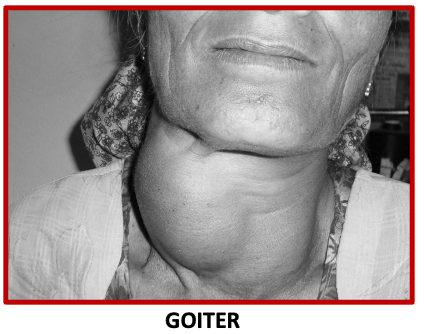
The other common thyroid autoimmune disease is called Hashimoto’s disease, associated with hypothyroidism: an under-performing thyroid. An unfortunate symptom of Hashimoto’s disease can also be an undeniable bulging lump in your neck, the thyroid itself, called goiter. Below is an extreme case captured by an iPhone 2.
Your thyroid is a small gland about 2″ wide as an adult. It shrinks as you get older and older and is located in the base of your neck, front side, facing forward. Below your Adam’s apple, or larynx (aka voice box). Your thyroid has two halves, left and right, called lobes. When spread out on an examination table, they look like hamster lungs… to the untrained eye. Never seen hamster lungs? Really? Never? How about two attached turkey livers before being flash saute’d at 325˚F in a Ghee oil bath of French tarragon flakes and Spanish dill? And a small dipping dish of peppers on the side is Optional.
When your termagant stepmother with the crooked nose drove you to your doctor’s appointment for your annual physical examination, and the doctor felt around the front of your neck with inquisitive, tickling fingers, the fingers were checking your thyroid for undesired blossoming, called swelling. For some reason, the doctors didn’t want children to know what they were doing when they did this. They don’t tell you. Yet, it is one of the more benign things that a doctor does during the examination.
It is easier for doctors to feel your neck, ergo thyroid gland, for a few seconds rather than it is for them, for example, to stare up your nose, which seems gross, with that circular mirror thing dangling off their forehead. Staring up into the nose of their patients is the #1 complaint that kids name for not wanting to become a doctor. It’s what did it for me. I don’t even enjoy looking up my own nose for Christ sake. But I do look up it. But I don’t like to for Christ sake. I usually look up it while hidden away in the bathroom with the door closed, and locked, when no one else is home, and there are no deliveries scheduled that I know of. Here’s another thing that checking your thyroid for unwanted swelling is easier for the doctor to do. And that’s checking your ear holes for unwanted nests, sores, infection and pluggage. Peering into ears requires professional medical lighting equipment; whereas fingering your neck requires no special lighting equipment. Although the ceiling lights are generally turned on during the entirety of the pediatric examination.
The doctors also don’t tell the kids why they are looking up kid’s noses during the examination. All we could figure was that they were engaged in a silent booger count. They don’t even let it out of the bag what an acceptable booger count is. I always prayed for zero but other kids thought that five a side was okay. I don’t know of any kid that ever came away with a high booger count that got to miss school because of it. If I coulda missed Miss Somma’s 2nd Grade English class even one day because of a one-time, elevated booger count, I would have taken that. Never seen that situation in a teevee show or in a movie, though. As I recall, there was one movie that did show an up-the-nose procedure. Tough guy Arnold is the only human that could pull it off. Or pull it out. No doctors were involved. Arnold never needed the caressing sausage fingers of no stinking doctors feeling around his throat.
Some endocrinologist experts describe your thyroid as being butterfly-shaped. Others say it is bowtie-shaped. Either way, it’s an important gland (aren’t they all?) that plays a critical role regulating your metabolism (how your body uses energy), and your heart rate. And other stuff, too. Small stuff like proper brain function, nerve integrity pathways and bone development. You know. Small stuff.
Describing the thyroid as looking butterfly-shaped is not to be confused with the beauty of, say, the colorful Monarch butterfly or the sophistication of the Tiger Swallowtail. The thyroid is a gland in your neck without the freedom allowed a wonderfully fluttering insect with six legs and scaly wings. Some crude biologists describe the butterfly as a ‘worm with wings’. I don’t mind that. Thyroid glands don’t flutter and have no known aviation skills.

Iodine is an essential mineral residing in your thyroid, and its measured levels play a direct role in the presence of Graves’ disease. Too much iodine in your system is its problem and a common cause of bulging eyes, or ‘bug eyes’, also called exophthalmos. While iodine deficiency is a common cause of goiter. The body uses iodine to produce thyroid hormones. If you do not have enough iodine in your diet, the thyroid grows larger capturing and storing all the iodine it can, so it can make the right amount of thyroid hormone. Your body can’t make iodine. This was a clear design oversight. You have to eat iodine. It comes in food. Not all food, though. Can’t get all chalked up on iodine by eating a dozen glazed donuts. Unless it’s an iodine glaze. Iodized salt has iodine. So do eggs, tuna, milk, yogurt, prunes, and lima beans. These aren’t rare foods. They aren’t difficult to find or difficult to trap or difficult to capture. You don’t have to go out into the wild and set traps and slink downwind real quiet behind a bush. Many grocery stores have these things. One food that is particularly high in iodine is nori seaweed. But unless you’re living on a coastline somewhere, or pretty much anywhere in Japan, it’s not so easy to shop for nori seaweed. It’s becoming more available. Nori seaweed is so rich in iodine that none of the known crustaceans that normally snack on the Nori seaweed have been found to have goiter. And seaweed doesn’t have eyes so it’s autoimmune to bug eyes.
As a service to you, below are additional fun autoimmune diseases presented in chart form. One is in a circular form. The other columnar. There are some redundancies.

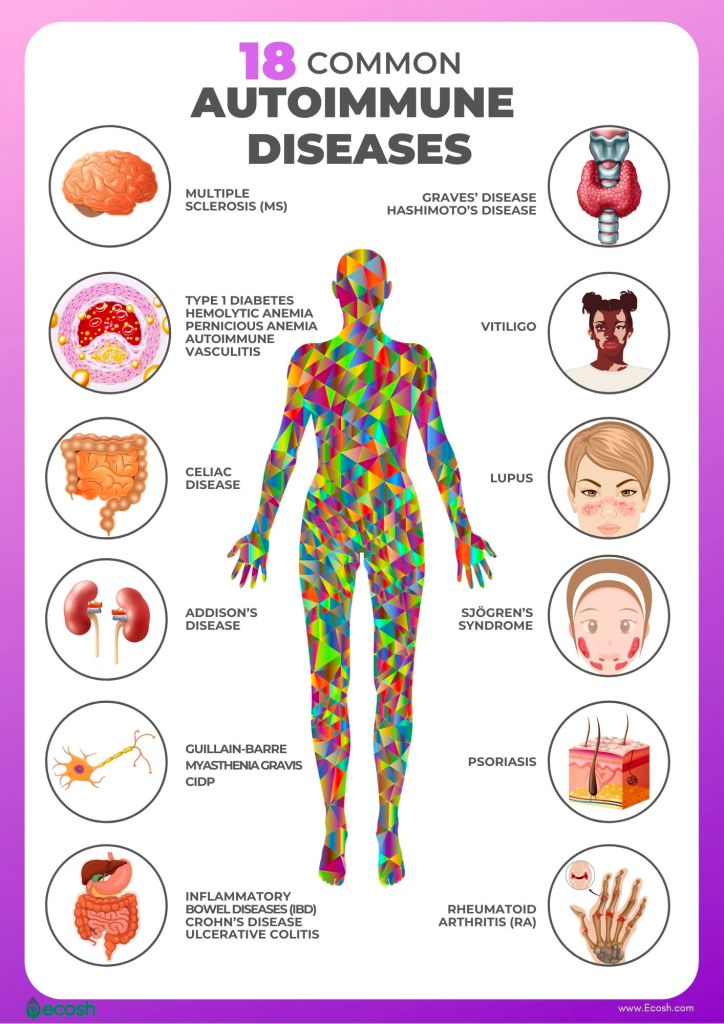
H: Help vs Harm
There are times in everyone’s life when controversy bangs at the door, or uncertainty causes confounding confusion, or tragedy changes the course of the path you thought you were following. I consider being dumped by a girlfriend to be a tragedy. I don’t feel that ‘tragedy’ is too harsh a word. This is all just normal fare that comes with the territory of living. It is there for all of us. No one is immune. No one is spared. No one gets to the end of the road, the final stop sign, without driving through dust, and steering around debris, and coughing, and stopping, and stalling, or swerving, sometimes suddenly. Some of these threats, and indeed they can be called ‘threats’, because they feel threatening, can be foreseen, and predicted. However, many seemingly materialize out of thin air.
What is important is how a person reacts to these challenges when they occur. How they cope. How they predict, when prediction is possible.
The list of the variety of these challenging occasions is endless. And they are personal. Those individual challenges that rear their head to confront Johnny, often aren’t the same challenges that rear their head to confront Susie. And it usually isn’t a male vs female thing. Bad things happen to all people. But none of the challenges are unique as individual episodes. Someone has gone through that exact particular trying time before. Sometimes these trying times, these tests, seems endless. And pile up.
Lucy Hone’s Ted Talk above was voted as one the top 20 Ted Talks of the Year, for 2020. It’s not the most flamboyant Ted Talk ever presented. But her third secret, asking oneself if what you are doing, or about to do, is helping… or harming, is an immensely powerful tool. It allows the person utilizing it to have an instant discussion with your gut. Let me explain.
There are a few ways to analyze a situation. As humans, we come with a few ‘centers’ from which to make the analysis, and make decisions. Of course, the primary analytical center that makes decisions is the brain. It does calculations. It is an adding machine. It takes in, and manipulates, the raw data. The lists that you develop to analyze a situation are analyzed by the brain. It concludes with coldly calculated answers, and decisions. The heart, on the other hand, is another ‘center’ for decision making. It determines which person a person falls in love with. And who to forgive. You don’t fall in love with someone by calculation analysis. That’s the brain failing. Falling in love is the heart’s domain. Here the heart that succeeds. Yet another ‘center’ for decision making is the groin. It either does, or does not, do a good job handling desirous lust. It doesn’t involve itself with anything else. But it kinda does a questionable job quite often. ‘Lust’ is one of the seven deadly sins as defined by Pope Gregory I in the sixth century. Lust has been a problem for decades, and centuries, and millennia. Goes back to the cave. The last, and in my experience, the most reliable analytical, decision ‘center’, is your gut. Your gut knows. Your gut doesn’t deceive you.
The gut is the analysis center to use to decide if what you are doing, or are about to do, or that you see a loved one do, or is about to do, is helpful, or harmful. Take the example of changing careers. Your brain can add up all the numbers; the change in salary, an estimate of the time required to do the new job, the amount of travel time away from home. All spreadsheet stuff. If the numbers don’t add up, you forget about that new job, and look elsewhere. But if the numbers seem to add up (your brain has a tendency to rationalize away unhelpful data), you need to still allow your gut to get involved in the decision making. Your brain does the hard evidence construction, deconstruction, and analysis… but your gut knows if the job is right for you.
I’ve switched companies to do a similar job, at a higher salary, and a bigger financial package, and yet, I was less happy. My gut knew there could would be a problem that my brain couldn’t detect. Because the problem wasn’t quantifiable. People need to realize that it is perfectly fine to allow your gut to make final decisions. It is your gut that knows if what you are doing is helping you, or harming you. It’s more than just intuition. It’s experience analysis. Your brain says to go ahead, and place one more bet; it’s only one more after all. It’s an addition thing of just +1. Your brain says it’s ok to have one more drink; it’s only one more, after all. It’s an addition thing of just +1. But if you allow your gut to decide, it makes the right choice every time. If you ask yourself if placing that one more bet, or buying that one more drink, is helpful to you, or harmful to you, it knows. Every time.
The power of ‘listening to your gut’ is undervalued. Your gut knows the danger signs that your brain ignores. Your brain does math. Your heart does love. Your groin does lust. Your gut does truth.
I: Investments
Investments are those things that we purchase with money that we hope increase in value over time. So that we can then have more money. To buy more investments. To make more money. Investments are something that many old people, the wrinklers, the hair-losers, fixate about. They make plans for the success based of their investments. The are dependent on them. One bad year can put them back five years. It happens. It’s part of how it all works.
There are many, many investment instruments, or mediums. Here are some of the common ones: stocks (partial ownership in a business), government bonds (fixed loans to the government with scheduled payouts), corporate bonds (fixed loans to a corporation with scheduled payouts), mutual funds (pooled money from many investors to purchase stocks (typically)), Certificate of Deposits (bank deposits for a fixed term (terms vary from months to years) with fixed interest payouts), real estate (land purchases, as well as buildings on the land, and the hidden treasures underground – pretty much never to be discovered), art (paintings, sculpture), collectables (Ty Cobb baseball cards, high-quality/low-volume musical instruments, cool stamps, Megalodon teeth), annuities (long term contract investment with life insurance companies: some people call them ‘devil companies’). Add to the list if you would like to do so.
The type of investment that a person has purchased can either be worrisome for the investor, or the investor can be worry free… depending on the investment instrument, and the personality of the investor. Bonds, for example, are known fixed entities that are relatively risk-free. The investor knows, in advance, what the return on the investment is going to be. Stocks? Not so much.
Some smart people purchased investments that allow them to freely play a board game like, say, Parcheesi, without worry. They are able to just focus, and play full-attention Parcheesi. No financial concerns at all. They tend to be stunning Parcheesi players. Thursday night might be their regular ‘Parcheesi‘ night. They drive to the game, arrive early, and have a confident, wry smile dangling from their lips. The belt on their pants is loose enough for calisthenic exercise. They are carefree. They are all Parcheesi.
Others play Parcheesi with a bit of trepidation, worrying during each roll of the dice about their investment choices. They are not 100% focused on Parcheesi, and make bad Parcheesi moves. Even experienced Parcheesi players make repeated beginner’s, poor Parcheesi moves when they are distracted by their investments. For example, rather than moving one of their pieces to create a Parcheesi blockade, the powerful doubling of two of their pieces on one square, they make a bonehead move, due to poor investment choices they made years ago, that still irritates. And so they lose at Parcheesi, and don’t get to triumphantly scream, ‘Parcheesi‘, at the end, if that’s what Parcheesi winners do. I don’t remember all the do’s, and no do’s, to Parcheesi.

I have friends, well, one friend that I can think of, that checks his laundry list of twenty, or so, stock purchases, each morning, to see how he is ‘doing’. How his life is going. How his life is progressing. The twenty stocks are his ‘portfolio’, which is a fancy word that implies that he has ‘arrived in life’, that he has ‘made it’, since he has what is called a ‘portfolio’. My friend frets over his stock investment choices that have curdled; have turned sour. Or as a farmer who grows arugula would say, his investment has ‘gone to seed’. If he is the type of farmer that tends to twist his head and hide his eyes from failure, he just might use the term, ‘dwindled’. He wonders whether or not ‘today’ is the right day to sell his failure, even at a loss. Which means, to him, that that particular stock purchase was a loser, and by association, he is a loser. Sound familiar?
Most of us have heard of Warren Buffett. Here’s a refresher: He lives in Omaha, Nebraska. Owns his home. Outright. No mortgage. Wears glasses. Does not have a Parcheesi reputation. Does any of that ring a bell? Is he coming into focus? Just because I write this stuff while I am stoned, doesn’t mean you need to read it stoned. But it would probably help. Immensely, through this part. Anyway, need more on Buffett? He’s a Denver Broncos fan. Still no capisce? Really? Need more?He started an investment business, called Berkshire Hathaway, a long time ago. Did okay with it. Today’s estimate is that he has a net worth of about $105,000,000,000… pronounced, ‘one hundred five billion US American dollars’. That makes him the 5th richest person in the world, pronounced, ‘earth’. He’s also known as the ‘Oracle of Omaha’. That guy. Heard of him? He invests in companies, things he calls, ‘businesses’. He’s not a real estate guy, per se. Might have a real cool comic book collection, but he hasn’t let on to it, if it exists. Think of him primarily as a stock guy.
Warren Buffett has a lot of videos you can watch. Here’s one with a catchy title: Getting Rich Is Easy. Click on the white arrow in the red rectangle. You may learn something about his philosophy, and approach, to the subject of our letter, ‘I‘, entry: Investments. After all, he’s the benchmark.
Here’s the stock investment strategy that we’ve all heard. It’s catchy: Buy low. Sell high. But I never followed it with any particular degree of lasting success. It’s too simple. It needs more detail, more granularity… like how high? And what happens if when your investment doesn’t seem to care that it is you who is the Investor, is not impressed that it’s you, after all, and its value dives lower than the price you paid for it? This is when you are ‘underwater’. Which is a term that implies not much oxygen for support; to breathe. People underwater flail. That’s not a good investing demeanor.
Here is a few words on when to sell a stock. It’s narration is summarized by some Swedish guy, but in English, so don’t freak out, yet the concepts are from, you guessed it, Mr. Buffett. No. Not Jimmy. We’re sticking with Warren. And for those of you who snickered at the mention of Jimmy, Jimmy is no Warren, but the vice versa is true, too. Jimmy did okay for himself. Although he only amassed a modest $830,000,000. That’s pronounced, ‘eight hundred thirty million kangaroos’. No, US American dollars. Here’s to Jimmy. And to think that not a penny of it was from me.
To wrap up letter ‘I‘, we can simply quote old reliable, Nas Lemons:
Happy Investing, Winning Parcheesi
J: Joint Replacement
Hip replacement is serious but only takes about eight weeks for a full recovery; as long as there are no complications. Sometimes the surgery doesn’t ‘take’. Elbow replacement can take a few months to a year from which to recover. Not real common, but elbow replacement does occur. It doesn’t get much press coverage. Wrist replacement requires six to twelve weeks to recover. But we aren’t going to spend even one paragraph on that joint replacement. We are going to focus on knee replacement surgery.
Now days, there are lots of knee replacement surgeries. Baby boomers have reached that age. Knees become worn out. Too much pain to work them any longer. There are currently over 600,000 knee replacements performed in the US per year (2022)… anticipated to reach over 3,000,000 knee replacements per year by 2030. Big number. Big, huge number. It’s called Total Knee Arthroplasty (TKA). It’s joint replacement. Mobility saving. Lifestyle preserving. Reduced pain. And it takes up to a year for a full, active recovery.
I don’t see how the US can increase knee replacement surgeries by a factor of 5X in eight years. Can you? That’s a rhetorical question. Properly used.
It is, indeed, time to consider jumping in line now, for a knee replacement, and signing up early. Even if you don’t kneed it. Get the ball rolling. Start kicking the can down the road. Bad metaphor. I can imagine that there is going to be a waiting time of at least two years: maybe three years! Maybe four! In fact, by the time I complete this writing, which could be 2024, the number of annual knee replacement surgeries in the USofA will need to increase to over 1,000,000.
As the video above shows, knee replacement surgery doesn’t typically replace the entire knee. Instead, the rotten parts of the knee are sawed off with special knee cutting saws, and then new metal knee hardware that won’t rust is screwed into the remaining bone. It takes about six to eight weeks for the healing of the bone. For a complex human joint like a knee, it is a remarkably straight forward operation. So we have some extra time.
I don’t know if the screws used in knee replacement are slotted screw heads (the most common screw you’ve all seen 1,000,000 times), Phillips head screws (the ‘X’ head), Robertson’s head screws (square heads becoming more known in the USofAmerica; and what instantly became a favorite screw for me), or the star-shaped head, called a Torx head screw. So I looked it up, like an unpaid professional researcher, and it appears that surgeons are using modified stainless steel, or titanium, slotted screws.
Most of you won’t even know what a Robertson’s head screw is. You should. They are the best. Period. Watch a live Canadian gloat about the Robertson Screw in the video below. It may be the only Canadian video you will ever see without any reference to hockey. As such, it is likely to be pulled from public viewing any moment.
I lived, and worked, in Canada for 15 years. So I know this stuff, okay? Sometimes Canadian ideas are good. Here’s a couple examples. First off, let me interject that there are some worser things going on up there in Frigid Country, too. Here are two good things in Canada:
1 – Robertson Screws
2 – No Pennies
Up in the North Country, their screws are almost predominantly square head, Robertson screws. As the video showed, the screw stays on the end of the screwdriver, the screws don’t strip easily at all, and the screwdriver doesn’t slip out of the square ‘slot’.
As for pennies, Canada ignores them. They don’t even spend a penny making them. They don’t waste the copper. If your bill comes to $9.40 or $9.41 or $9.42, you pay $9.40, if paying with cash. If the bill is $9.43 or $9.44 or $9.45 or $9.46 or $9.47, you pay $9.45, if paying with cash. If the bill is $9.48 or $9.49, you pay $9.50, if paying with cash. When you use a debit card, or a credit card, you pay whatever the actual charge was. So, in Canada, they round up to 5 (from 3 and 4), and up to 0 (from 8 and 9), as well as rounding down to 5 (from 6 and 7) and down to 0 (from 1 and 2), if paying with cash. A real thrifty Canadian might take advantage of the rounding policy by always paying with a debit card if the cash cost would round up, but they don’t waste their time because there is always a hockey documentary to get to.
In fact, not discussed here, but more and more, knee replacements are being done robotically. 3D pictures of the patient’s knee are created, and a computerized on-screen version of the surgery is practiced prior to robots drilling, and robots making the exact saw cuts.
One of my friends had both knees replaced during the same surgery. The only residual complications were that his feet became 1.5 sizes larger, so he had to buy new shoes, and he had to relearn the length of this feet to avoid tripping going up steps. The second residual complication was that he became an inch taller, which screwed up his golf game for a few months. Other than that, he’s without knee pain, walks with more ease, is happier, and tells the same bad jokes as before.
K: Kidney Disease
Kidneys are located inside your lower back. And are in the shape of kidney beans. Jesus Christ’s father, God, had a design for you to have two kidney bean shaped kidneys. But not always. You could be born with one kidney bean shaped kidney. Anti-lord Charles Darwin would say that the typical double kidney package evolved from swamp animals some years ago. Almost all mammals have two kidneys, even billy goats. And nanny goats. Billy’s are boys. Nanny’s are gilrs. Both have two kidneys. And even those adorable Winter White dwarf hamsters that everyone has been talking about non-stop have two kidneys. Even the little treasure in the picture below. Two kidneys that do the same thing in the Winter White as they do in the human male and the human female.

The two kidneys aren’t stacked one on top of the other in your lower back. They are side by side, and quite necessary. They do important work. In fact, kidneys are so important that they are included in the short list of ‘vital organs’. ‘Vital’ comes from the Latin word ‘vita’, which means life. Vital organs are required to maintain your life. Kidney are on par with your brain and your heart in this regard. Those two things are also vital organs. There are more. There are more. You can’t live into adulthood without your brain for obvious reasons like you couldn’t balance your checkbook. I realize that is a poor example, as many people with brains don’t bother to balance their checkbook anyway. Or they do a shit job of it.
A better example of being brainless is that you slurp your soup, or miss your mouth and pour it down your chin into your shirt pocket. And you can’t survive without your heart because you wouldn’t be able to fall in love which is one of the grand purposes of life. And you die if you don’t have any kidneys. Well, maybe you can live for a few weeks without your kidneys. Then, it is definitely prolonged dirt nap time. Which lasts forever. Maybe. I don’t know. Do we come back? Can we come back as a worm? Or any animal? Can you be a Christian and believe in reincarnation? Christians that believe in reincarnation are an unnamed form of Hinduism. Everybody’s talking about it.
Kidneys do a lot of cool things. But deserving the top spot on the list is that your kidneys cleanse your blood. This occurs at a rate of ~1.2 liters per minute, which is ~1.2 quarts per minute. Every single minute. No time off for down time. Without this filtration, dirty blood is the result as well as other documented problems. You get diseases and toxins and I’m not a doctor.
Fortunately, doctors say that kidneys are ‘over-engineered’. That means that you can have just one kidney, and everything gets handled okay. That means that you can donate a kidney to a close relative if they need it, and you’ll still be fine. Other than a couple real small kidney-removal scars that require a band-aid and healing time. The scars aren’t too bad. But if you are a relative that is really into gym boxing or field hockey, you should tell your kidney-needing relative to find a different relative to donate their kidney because it is advisable not to gym box or field hock with only one kidney. It can be life threatening.
Kidneys have some remarkable characteristics. For example, they:
• filter 50+ gallons of blood each day
• only take 5 minutes to clean all your blood
• clean your blood 400 times each day
• help ensure that your bones don’t weaken by activating vitamin D
• make what kids call ‘pee’; adults call pee, ‘urine’
‘Urine’ is pronounced: yer‘ in, and shouldn’t even have an ‘e’ on the end. It’s one of the words that doesn’t follow common English pronunciation rules. Which makes moving to America difficult for many families with kidney issues from foreign countries. Pronounced: kun‘ trees, not: kown‘ trees, like it’s spelled.
When the doctor orders blood work to be done on you, it is common that they ask lab technicians to measure your albumin, creatinine, and urea levels. These levels, if within their proper ranges, help indicate proper kidney function. That’s why they order these tests. Placing the palm of the doctor’s hand on your forehead, while staring up at the ceiling tile arrangement, looking for smudges, is usually not enough to determine kidney function.
If you suffer from a distraught kidney, and want to attempt a self fix, you could follow a Chinese proverb that says ‘Eat the organ you want to heal.‘ That could include eating a goat kidney. But I’m no doctor. And I’m not Chinese although I haven’t done the 23andMe thing, and haven’t postage stamped any recent packages of spit to Utah for analysis. I heard they are bankrupt, anyway.
This concludes Final Seesaw: A-K and is to be continued… as Final Seesaw: L-Z. Fifteen additional letters housing sheer terror.
Well, fourteen. There is no ‘X‘ entry. I would have included Xylophone Phobia, but I only know of three incidents where the xylophone played a major role in persons actually found dead either by serious accident struggling carrying their xylophone while crossing a busy street, or while performing xylophone licks to appease the gods during a thunderstorm. It occurred during the same season when there was an overabundance of Wagner. Not Charlie Wagner down on Adams Street. Nope. The German Wagner.
Unfortunately, I had set some important rules for myself at the outset of this mind-bender, and one of those rules, to which I swore, was that I had to personally know, or be familiar with, at least four incidents to include as a possible category candidate.
Xylophones and all the fearful problems they create came up short by one.
 Cantations