

It takes more than one fish to throw a party
Beyond the Bob Willard Collection, Volume 1
Disclaimer to Reader: Robert Stephen Willard is not prominent in this Volume… our apologies
C H A R A C T E R S
- Terri Adams: grew up across the street from Teller Elementary School
- Polly Bergen: celebrity panelist on To Tell The Truth
- Dennis Blum: close friend lived four andahalf blocks away
- Carol Cantrell: elder twin to Cathy Cantrell by 420 seconds
- Cathy Cantrell: younger twin to Carol Cantrell by 420 seconds
- Kitty Carlisle: star of To Tell The Truth
- Mrs. Cass: owner/landlord of 1560 Grape Street
- Christopher Columbus: famous discoverer
- Tim Crow: close friend lived one andahalf blocks away
- The Doors: 1960s band
- Fez: 7-Eleven Convenience Store cashier
- Beth Fisher: classmate of Charlie Johnson
- Arlene Francis: celebrity panelist on To Tell The Truth
- Bill Frisell: close friend lived five houses away
- Grateful Dead: 1960s band, 1970s band, 1980s band, 1990s band
- Randy Guber: college and post-college friend
- Inge Gulkin: owner of Frost Bakery
- Iron Butterfly: 1960s band
- Charlie Johnson: college artist and Grape Street house mate
- Sara Johnson: Mike Nelson’s high school girlfriend at East High School
- George Kawamoto: a little older neighborhood friend two houses away
- Jean Lussier: Niagara Falls daredevil (daredevils broadly called ‘idiots’)
- Bobby Maddox: Zytron bigwig (started as a smallerwig); close friend
- Mr. Mateo: ninety-year-old garden keeper
- Mike Nelson: Sam Nelson’s older adopted brother by three years
- Anda O’Keefe: bar maid at Lytton’s Corner bar
- Big Red: barstool behemoth with broken fingernails
- Margie Samuelson: middle aged floozy down the street three houses
- William Sanderson: Denver fine artist
- John Steinbeck: author; wrote Of Mice and Men
- Karen Thompson: Charlie Johnson’s girlfriend and Grape Street house mate
- Vivian Crandell: across the street neighbor who liked Vitamin V
- Bob Willard: close friend lived three andahalf blocks away
- Kay Willard: Bob Willard’s younger sister
- David Witman: college and post-college friend
- T-Bone Witman: David Witman’s bigwig lawyer father
A moment is required for the tardy characters to find their spots… we will begin shortly…
Please, just another moment… shortly… Oh, yes, must not forget the Pet Menagerie:
- Buster: Charlie Johnson’s black lab
- Bonnie: Karen Thompson’s cat and mother to the twins: Becky and Boomer
- Becky: Karen Thompson’s cat. Becky’s mother is Bonnie. Becky is Boomer’s twin sister
- Boomer: Karen Thompson’s cat. Boomer’s mother is Bonnie. Boomer is Becky’s twin sister
- Bob: the bird
- Sunny: author’s large mixed breed dog mutt, part husky/part wolf
Here we go. Everyone ready? Quiet please!! And… Hold On! Is Buster’s pencil OK? Yes? All right. They’ll find out. And now… Action!
C H A P T E R 1 :
Lytton’s Corner – Sledgehammer – Of Mice and Men – Marbles – Father-in-Law – Rainbows – Covici-Friede – Niagara Falls – TP Theft – Zytron –  – Harvey Wallbangers – 7-Eleven Convenience Stores – Fez – Ariolimax Morch – Heel or Crust –
  – Zoroastrians – Age Guessing – Gum – Lincoln Cent – Cantrell Twins
The decisive moment sparked suddenly, Tuesday night, March 18, 1975. I felt like I was at the point of a pistol. After I had entered Lytton’s Corner bar in Palo Alto, a big red-haired guy with enormous hands that ended with bloody, chewed-up fingers and broken fingernails, sat down on the red vinyl barstool right next to mine. He had a slouch and was fidgeting. We were sitting sort of shoulder to shoulder, his was about a foot higher, but we didn’t know each other.
Big Red’s slouch wasn’t exaggerated. He didn’t appear defeated, and his slouch did not suggest to me in any way that he was depressed. He looked like he had just gotten off of his shift work, breaking rocks at some quarry, fingers splintered from sledgehammer shock. Hard manual labor. But there was no quarry anywhere nearby.
I had previous sledgehammer experience myself. I knew its danger and once narrowly escaped its consequences. Just lifting it off the ground was almost too much to handle. Brandishing it about was nearly impossible. It only took one attempt at wildly, and uncontrollably, waving the thing around. I was both startled and thrilled, to still be breathing following the obvious failure… my chest heaving as my excited heart charioted around the inside of my rib cage. My Colosseum. The memory of being defeated by a sledgehammer seared into the folds of my duodellium.
I thanked Fortuna that I hadn’t permanently crushed my leg, or pulverized my ankle, or hit something that would have really hurt for a long, long time… like being hit by a sledgehammer. I called it a day. Dropping the sledge onto the ground, I quit on the spot. I knew that schtroggling a sledgehammer wasn’t for me. I could just tell. Call it divine intervention. Call it fear. The two are so interchangeable as to have often become the same thing. Maybe divine intervention and fear always have been the same thing. All I know is that the ‘sledge’ felt like an unwieldy improperly weighted brutal weapon from Ancient Rome. I have no doubt that it could have been put to very, very good use back then. 2000 years ago. I do not question that. Yet, one swing is all it took for me. Like putting my hand on a hot stove.
But I didn’t know why my barstool neighbor’s humongous hands ended so damaged. I didn’t get around to asking him. He was a stranger at that point, and remained so throughout our encounter. He was, by all accounts, just a behemoth sitting there beside me, drinking an Old Milwaukee beer, nursing it, really, and crushing bags of beer nuts with the mastodon molars parked in his jaw. I didn’t introduce myself. I didn’t ask him directly, ‘Excuse me, Hercules, but why are your hands and fingers so messed up?’ He just looked like an exceptionally strong guy that could unscrew lug nuts off of truck tires with his bare hands. American made Ford. He could snap me in two like a seed cracker. It was his prodigious size that reminded me of Lennie Small’s older brother in the book, Of Mice and Men.
Of Mice and Men was the first book that I read. In my early 20’s. The accomplishment lifted me. But there was more. It also gave me angina, or brought on angst. One or both. Probably both. There was a reason. I had been thinking for quite a long time before reading the book that it would be really neat to write a book… without having ever read one. ‘Neat’ was the glistening, positive catch-all adverb for a few years back then. It’s since been replaced first by ‘cool’ then ‘awesome’, and ‘rad’, and ‘bones’, and there were a few more. The newest replacement is ‘chill’. Getting a clutch hit was neat. Winning a blue ribbon was cool. Making both free throws was awesome. So was being told by the dentist that you have no cavities. Bonuses were bones. But writing a book? That spanned being really neat to really chill and it was something I had thought I’d someday like to do. It was unlikely, of course. Almost impossible. I didn’t know much of anything about books at all. Even so, I thought that someday I wanted to write a book, or more accurately, more honestly, I liked the idea of writing a book.
I just didn’t want to read one. I really didn’t. Emphasis placed on the italicized bold red really. That form holds considerable rank above an everyday ‘really’. I had absolutely no interest in reading a book. Really. Zero. Zip. Period. Not back then. I did not have time while I was growing up to read a book. I could find pretty much anything else to do when I was alone. Even when there was nothing worth watching on teevee, like during the news hour, after dinner, every night. My father would lie on the couch, and watch the news like religion, night after night, and I had no idea what Huntley and Brinkley or Cronkite were talking about almost all of the time. Maybe if there was a presidential election. Or local news coverage of a 100-car pileup on snowy I-25. Those two were pretty much broadcast the same. It was only the crummy stuff like large number pileups or a hijacking that earned Special Bulletin status. Or a high-profile murder. Or Danny Thomas, leveled by death troubles, following heart failure. Danny was interred in a mausoleum. Like pharaohs. In Memphis. Tennessee. Not Egypt. So is his wife. Marlo’s mom. Also interred.
But when alone, in the evenings, if I wasn’t at Frisell’s house, or he wasn’t over at mine, or if Willard was grounded, and couldn’t play, or Crow was busy doing some fancy crafts thing, or any of the other kids in the neighborhood weren’t available, I would sometimes (an italicized sometimes means rarely) choose to sit on the floor with my legs crossed, or off to the side, and shoot marbles by myself, on our living room rug… rather than pick up a book. Shooting marbles begged for a skill that I realized even then was a waste of time to develop. There were no famous marble shooters. Couldn’t name a single marbles champion. Never saw one on teevee endorsing anything. It was obviously a totally worthless skill to develop. And although they call it shooting marbles, you’re not shooting, at all. You’re flicking the marble using your thumb as the paddle. Somehow, it was determined that to say, flicking marbles, sounds too much like saying, playing in pony manure, so they adopted the more manly terminology of ‘shooting marbles‘. They borrowed that from ‘shooting pool‘. You’re really not shootingthe cue ball; you’re jabbing with a stick, which has absolutely no ring to it at all, and draws images of antagonizing bee hives. Those are really the only things remaining that you can jab a stick at.
Even so, realizing that playing marbles was an absolute waste of time, I’d rather shoot a cat’s eye marble across the entirety of our living room rug, and have it end up farther under the couch than my arms could reach… potentially losing it forever… than read a page of a book. That was at age ten. Later, I’d play solitaire with a deck of cards, one game after another… before I’d look at a book. That was at ages eleven and twelve. And when I started listening to music… there was no chance that I was going to spend time reading a book. It wasn’t gonna happen, and it didn’t happen. From ages thirteen (13) to twenty-two (22), I mean, thru age twenty-two (22) there was no book reading activities done by me. No entries in my diary, if I had one, which I don’t. I didn’t even read the books assigned in English class, in high school. Or college. I dodged reading every single one of them. I’d read some of the pages, of course. I didn’t get C’s, or D’s, or failures, in English class. I got A’s, and B’s. I’d guess 50% A, and 50% B. But I never read all the pages of any book. Nothing close to all of them. Never most of them. Not even half of all of them.
There was an entire thriving industry that targeted kids like me. Kids that didn’t read school assignment books. It was called CliffsNotes. Not Cliff Notes. I know. It looks like a typo. It’s not. Some guy in middle America had bought the rights to the Canadian Coles Notes to publish in the United States. The guy lived in Nebraska. Somewhere like that. The research I did on it didn’t provide much clarity, and frankly it wasn’t that interesting to me anyway. I could not maintain enthusiasm. This entrepreneur apparently attended the University of Nebraska, and maybe stayed in Nebraska. There is a cheap joke about the students at the University of Nebraska.
Q: What does the red N on the helmets of the University of Nebraska’s football team stand for?
A: Nowledge
Maybe a little cruel.
The reader should be provided with a brief compilation of what I perceived to be the thirty primary hardships of reading: 1 why go through all the book-reading battles of turning the pages, 2 having to remember where I’d left off, 3 remembering the characters, 4 thru 9 remembering their names, their relationships, who knew who, what each one did, what they knew about each other, what they thought about each other, 10 how old were they, 11 and 12 remembering how the last conflict was resolved, and all the nagging inner plot wampusses, 13 while trying to decipher, and follow the general storyline. 14 The commitment necessary was extraordinary. 15 Even just remembering which room in the house that I’d left the book presented problems. 16 thru 20 The authors always planted words no one knew. Or I didn’t know. All those SAT adjectives. Show-offy SAT nouns. Probably SAT verbs, too. There were words I couldn’t pronounce (21). Spelling errors that I found that high-paid editors missed (22). Maybe not so high paid. What do those people make? I don’t know. Maybe they didn’t really read the books either. 23 The spines could crack or break. 24 Or become separated from the pages if the glue was low quality. 25 Or occasionally the book would just close itself on its own, out of the blue, while I’d be holding it, and then I wouldn’t know what page I was on. 26 Which demanded instant recall remembering what I’d just read to locate the page, and the paragraph, and the sentence. And every second that passed trying to find the page, I remembered less and less. 27 Or the bookmark is sitting on the floor next to the book, and who knows what page it was guarding. Plus, my eyes got tired (28). They could become really tired. Like, in mere minutes, they would be tired. Exhausted. And (29) I wore glasses so that made it all more difficult. Where are my glasses? Plus I’d rather be doing anything else (30). Reading wasn’t for me. Marbles sucked. Granted. I give you that. But reading sucked more than marbles sucked.
So in essence, had I followed through with my admirable intention to write a book someday, while still having never fully read one, I may have become one of a very short list of persons to have ever done that. Maybe I’d be the only person. That would be very neat. Very cool. That would be flying. The book I’d write would be fresh, new, never seen printed before, not quite standard, not having even the slighted conception as to what standard may have been.
And then I read Of Mice and Men, which screwed up everything. Thanks a lot, Mr. Steinbeck. Everything had been going just fine. Maybe not everything, as this tale will unfold. But I’m taking a stand now, Demanding Reader; I am not going back to read Of Mice and Men again, just so that I can ensure you that I am being 100% accurate relating anything about that book, or its characters, should any future reference to either be important to this glossy narrative. With your approval, I will henceforth recall this tale shooting directly from memory while shooting, on occasion, from my right hip.
I imagined that there could be a visionary book publisher embracing, signing, supporting, publishing, and promoting a book written by someone who had never read one… assuming the book was good, and the tale told was worth telling. That, I could imagine. After all, there were ample promotional angles to boost to ensure success:
• Is this writer a protégé?
• Where did he come from?
• How did he hone his skills?
• Who were his influencers?
• Should it qualify for some special award?
But I asked myself earnestly, ‘Would a book publisher embrace, sign, support, publish and promote a book written by someone who had read only one book ?’ I worried that if that little known fact became public, a respected book reviewer might state matter-of-factly that I was not to be taken seriously, and proceed to stamp me as being a joke, a charlatan. A clown. A ‘bufo’, as my father-in-law would call me. Lovingly. ‘Bufo’ is the biological genus classification for toads. But it’s also the Greek word for clown… a buffoon… a bufo. My father-in-law wove ‘Hey, Bufo’ into the fabric of many conversations with me.
For example, when it became necessary to drive to the farmer’s grain store with him, he’d say:
• ‘Hey, Bufo. We need to get in the truck. Ya follow me or don’t cha?’
Or when examining the protected seedlings in his large-frame wooden red barn with the broken doors that had the ’58 Chevy Impala buried in dirt up to its windshield:
• ‘Hey, Bufo. Grab that small green trowel for a sec, ok?’
Or even seated at the silver Formica breakfast nook table, with everything arranged:
• ‘Hey, Bufo. Please pass me the butter.’
My father-in-law loved to plaster a velvet layer of yellow butter over the glazing of his morning doughnuts before taking a bite… and then, again, lather a sumptuous second layer prior to bite number two (2). Sometimes there was a third bite, but not always. He was the youngest child in a poor, yet land-rich, Greek immigrant family. He grew up with a blue and white carafe of cheap Ouzo from Mykonos accompanied by a small painted terra cotta dish of olive oil always standard on the dining table. When his family could afford churned butter, he gleefully smothered it onto pretty near every dessert, whether it be doughnut, sugar ball, pastry or pie.
He taught me lessons, often about mechanical contraptions for which I owned no aptitude, over the sixteen years and all the seasons that we had to spend together. But mostly what remains within me are the things that he said that made me laugh. Some of the things he said were everyday observations. He would opine, ‘There’s nothing better than sitting on a tractor eating a doughnut.’ I knew he wasn’t just whistling Dixey. It wasn’t no hocus-pocus. No hockey-puck. You could read it in his eye and hear his truth from his whisper.
One of his favorite frivolous distractions occurred in the aisles of grocery stores. He repeated it in my presence on many occasions. It was as though I had become his willing accomplice, like a Tonto. When little kids were nearby, he’d gently tap me secretly on the arm and say, within ear shot of them, ‘Hey, Sam. Did you see that pony at the back of the store?’ In response to hearing this, the kids would look at each other with shine in their wide opened eyes, and then bee line it to hunt for the four-legged Afikoman. Racing down the aisle. And he and I would laugh each time. He never called me ‘Bufo’ in front of little kids. Maybe it was out of respect.
SIDE NOTE: The small satchel I had chosen to hold my 2B Ticonderoga writing pencils, lined-paper with margin, and double handful of Big Pink erasers, fit neatly in my overnight suitcase bag. The color of the suitcase was Samsonite’s basic saddle tan. I was raised by parents intent on keeping-a-low-profile. They were not overt blabber-pusses looking to bring attention by flaunting extravagant suitcase colors. They did not want to cause a ruckus as the suitcase circled carousel number two (2) at the county airport or was lined up against that ugly washed-out discolored green wall at the empty Greyhound bus terminal or scuffed aside and strewn across the floor of some dimly-lit, vacant train depot. Our closet at home did not shelter the lockable Samsonite Bright Blueberry nor their Tangerine Fire Red with the big metal side buckles. That is not who we were as a family.
As for my kind reference to Lennie’s older brother in Of Mice and Men, I don’t remember if Lennie even had an older brother, and if he did, I don’t recall if Steinbeck ever mentioned him. I read the book faster than I could read at the time. I admit now that I merely executed a skim, a child’s grab. I believe I at least touched and turned every single page from beginning to end. Or most of them. Well, a lot of them. Surely more than just some of them. Enough to know what was critical; that there was not even one picture included anywhere, on any page, in the entirety of the story. Of Mice and Men was knowingly published completely picture-free; each page choked only by verbiage. Maybe there was a stock photo of the author at the end.
I think stories improve with pictures. You ever seen a comic book? Reduces reading time, a big plus, and relieves the author of fulfilling the need to provide flowery, informative, descriptive showoff composition. Show me the picture and let me fill in the descriptions. That is easier for me than deciphering run-on text with words I’ve never seen before and won’t look up. There are reasons God makes some things simple, like the color of rainbows: red, orange, yellow, green, blue and the last two… rather than make rainbow colors complicated. God talks to all of us; not just the assholes that memorize elaborate color charts. He made ROY G BIV; not CPWA CO VCPEM (cinnabar, papaya whip, aureolin, chromium oxide, vivid cerulean, periwinkle and electric mauve). He knows what he’s doing. He knows.
Let’s just imagine for these final seven sentences regarding Of Mice and Men that John Ernst Steinbeck Jr. had a lot to say about Lennie Small’s older brother, let’s call him Dusty, but it was scrapped by the book’s editors, deriding the author’s descriptions as nothing more than undigestible writer’s gristle. The edit casualties about Dusty Small’s blood, toils, sweat and sinew discarded and scattered over the shoe-worn mahogany floor. Each page push-broomed into what, in the book publishing business, is called a ‘hamster-nest’; the pile subsequently scooped up with the traditional black, commercial-grade metal Oakbiner dustpan (you’ve seen them). And finally tipped and spilled gently into the trash can in the corner next to the double-locked cleaning closet. Someone had been stealing toilet paper. Not the first time. Not the last time.
Wednesday, July 4, 1928: The first time that toilet paper was stolen from the business of John Steinbeck’s eventual book publisher, Covici-Friede, was the first day they opened their doors on 79 West Forty-Fifth Street in New York City on July 4, 1928. That’s why, at the beginning of this paragraph, the date is noted, in cinnabar, and it’s also when typical toilet paper thievery begins: day one (1) . All employees consider stealing office TP. Every single one. Had Abraham Lincoln been working under your nose, he, too, way have devised a toilet paper scam. It is innate behavior. Those more emboldened or with little to no personal restraint and more importantly, no home provisions, steal day one (1).
Bearing coincidence to date only, that same Wednesday of July 4, 1928, 410 miles to the northwest, as the barometric pressure fell at a widely known location called Niagara Falls, on the United States/Canada border, Jean Lussier became the 4th idiot (since renamed ‘daredevil’) to take the plunge over the famous magnificent cascading waterfall. He was the 3rd daredevil to survive. But Jean didn’t just hide in an oak barrel, slowly bobbing up and down and up and down. Gaining speed as the calamitous terror neared – all the while continuing to bob up and down and up and down, now spinning. With increasing ferocity. Literally, terrifyingly… screaming out Sunday Bible prayer with more tears and fragility than he’d ever sacrificed to them before… or since… until finally catapulting over… into… and then straight down the roaring, deafening abyss. Glub, glub. Glub, glub. Burple, burple. ….. burple. ….. …..
Nope. No siree. And no ma’am. Lussier did not endure the Niagara plunge hidden in a barrel like his three predecessors. Two had survived. The first to initiate the plunge over Niagara Falls in an oak barrel was a woman in 1901. She lived and walked away from the experience relatively no worse for wear. She claimed to have done it for publicity to raise money for her purse. She was needy. She died poor. The plunge did not provide the notoriety nor the money that she was eager to capture. Her name barely survives. She may as well have been a marbles champion.
The second plunger survived with two broken knee caps and one broken jaw on July 25, 1911. He died from gangrene complications after slipping on an orange peel in New Zealand years later.
The third daredevil’s body, following his July 11, 1920 doomed descent, was ripped apart because he refused to have his chosen oak barrel strength-tested. It shattered upon impact. Even more, he had attached a considerable anvil to his ankle to add bottom weight to help ensure that he entered the dive feet first… and was sucked down to the grizzly bottom to drown, if he wasn’t already dead. One undrowned piece of the daredevil remained; an arm had ripped away at the shoulder joint. It was his right arm. And right elbow and right hand and all the rest that comes with a right arm… all soaked to the bone and as gruesome as you are imagining right now.
Instead of a barrel plunge, our subject daredevil, Lussier, had designed and had constructed a rubber ball with a 6’ diameter. The operation took place in Akron, Ohio, at the Akron Rubber Company. The 6′ ball was flexed internally by steel springs and lined with oxygen tubes. It cost him $1500 of his own savings, and as his story grew with nationwide coverage, he also upped the cost and said the stunt cost him $7000.
He withstood the venture with only minor reminders: an ouchie on his left wrist and another slightly above his left elbow. Some say he emerged from the ball with a bump on his forehead and that it was quickly bandaged. Reporters and photographers started asking if the bandage was necessary. Couldn’t he show his bump? Just one quick flash photo! What was he, a chicken? This man who had just curled up inside of a blown up tennis ball with a shot over Niagara Falls was asked if he was a chicken? But he received not one fracture. No knee injuries like plunger #2. However, due to being incased inside of a potentially leaky 6’ rubber soccer ball, there was no external legitimate top or bottom. That made exiting difficult once the bobbing ball was captured and racketed to the US border side for his departure. But when his 6’ rubber four-square ball was cracked open, not perfectly aligned top to bottom, but slightly tilted, leaning a bit, like Big Red’s barroom slouch, Lussier fell awkwardly down onto the side of his head, putting a strain on his neck. Bandages were removed showing minor scuffs after four days.
A valid passport would have been required for Jean Lussier to exit into Canada, into Ontario, with French transcription and duplication the law. Jean was not an adventurous traveler and had no such passport even though those were the easier times when smiling for passport photos was permissible. Lussier had survived the death-defying ride of terror. Many believed his bandages to be part of the publicity.

Toilet paper theft from business establishments always begins the same day that the business establishment throws open its doors for business. Unless the business has only two partners who also happen to be its only employees. Toilet paper theft decreases substantially when there are only two partners working the business. In those instances, both partners know which partner stole the toilet paper. There are two purposes for stealing toilet paper; one of those purposes is to not get caught with it. The other purpose is to not get caught without it.
Generally, businesses need a minimum of three employees to witness and experience first-hand the meteoric uptick in toilet paper theft. The company response is predictable; the toilet paper gets quietly locked up. You hope not, but it always does. Lock up is ALWAYS the company’s initial knee-jerk reaction. They think THAT is going to do it. Done. Kaput. Out. But it never does.
And failing lock up as a deterrent to theft, it becomes double-lock up. The double-lock up is the most recommended level two (2) TP theft deterrent. Check your manual.
Then one day, maybe you’re happy that day, maybe you’re pissed-off, a part-time security guard in full uniform appears standing sentry beside the locked closet. Shoes are shined. Hair is combed. Gun is holstered. No one knows his name. The part-time security guard quickly becomes full time. And after a three-month extended evaluation period… employee benefit negotiations kick in. Vacation time and overtime which were initiated as discussion points transform quickly into sticking points. The new full-time employee asks about year-end bonuses. 5% annual? 10%? The cost becomes prohibitive. A personnel file is built, including every written warning presented to the employee and all signed documents following discussions with upper management. This calculated endeavor is to satisfy guidelines that make possible dismissal of the security guard legal, thus avoiding a wrongful termination lawsuit. One-week of severance swells to two-weeks and is included with the goodbye handshake and door slam. Taxes appropriately deducted. W-2 to be mailed to address on file.
A few weeks later and the ex-sentry’s replacement arrives in a corrugated cardboard box with the word TOP and an ARROW POINTING UP on the side. The 24-hour video camera requires installation. Batteries not included. Batteries are then purchased and installed; problem solved. Until a disgruntled employee hides a condiment-cup of blanched mayonnaise in his J. Edgar Hoover lunch pail surrounded and hidden by his liver sausage and wax-papered carrot-cuts and the sandwich bag of Wheat Thins and twinkie. And napkin. Yellow and folded. And straw if he signed up to get the milk. Whole or chocolate. While co-workers are momentarily distracted, the unhappy employee thwops the mayo dollop utilizing careful aim with a hidden white plastic spoon onto the security camera’s peering lens and it’s back to square one… no TP security. Next comes the infrared nighttime motion-detection. Closely followed by an elaborate web of crisscrossing lasers. Invisible ink gets applied to the wrapper of new toilet paper rolls that stains fingers bright purple and cannot be removed for four days. Calling in sick three days in a row raises eyebrows into mountain peaks in the human resources department. An upper-management home visit is possible.
In a penultimate and disturbingly radical move, it is one-ply paper that is purchased for office use. It is so evil that I was compelled to put it in bold italics with reduced font size. We are on the same side, you and I. No one wants one-ply paper at home – even if living above a failed septic system. As follows naturally, biologically and for local, focused cleanliness, none of the employees like the one-ply solution at work either, so the complaints begin. Employees fear one-ply. Some run next door when called to nature. Some just go home early for the day. Productivity wanes. Accounts receivable decline. A suggestion box is placed in the lunchroom and all kinds of lewd requests stuff it and overflow. The next day an unknown street straggler walks in from the street, as the tiny bell above the door tinkles twice, once when opened and repeated when eased shut. He politely asks to use the restroom… and one-ply complaints belch from the volcanic street straggler as the tiny bell above the door tinkles twice again, once when the outside door is violently thrown open for him to exit and repeated when pulled shut from outside. Another street straggler is denied access the following day. Signs alerting all street urchins that Bathroom Access is officially Denied are hung next to the Welcome – Open, flashing neon sign.

Next comes the emergency employee meeting. Putting the company’s new 50-count multi-colored push pins to good use, notifications are fixed to the lunchroom bulletin board. The conference room is booked and the assembly convenes. The air conditioning in the room is on the fritz. The meeting continues uninterrupted anyway. Back and forth discussion heats. A team is voted upon and assembled to study the blaspheme. Recommendations become due at noon on Friday. Lastly, it all flushes, circling down the vortex, as a carefully composed memo is circulated asking all employees and their family members and their friends, and all the friends of the family members, to bring their own toilet paper to the office henceforward. Until a better solution is derived. This last step rarely occurs and is generally ineffective. Oh, the memo does go out to all employees. That Happens.
At the microfiche business named Zytron which profited by keeping me under their employ, Leonard the Bookkeeper was offered the toilet paper memo creation job for obvious reasons but he shivered at the responsibility. With hand raised and fingers frantically wiggling, it was Bobby Maddox who was awarded the task of writing the memo and, as an unprecedented service to the company, he was also granted and excitedly accepted the intra-company memo distribution assignment. It all happened quickly in one fell swoop. Bobby was the white winged-horse, Pegasus, sent by Perseus, the hero that decapitated the Gorgon Medusa. Accuracy and honesty guarantee that Bobby managed both responsibilities like a stud in pasture, which isn’t to say that he fucked it up. Contrary, his career skyrocketed. No longer could he hide behind the big black plastic tubs of microfiche chemical mixing solutions in the back room with the sliding door latched from the inside. That simply could not shield him no more. Those timid days were gone. A child that learns to walk never again crawls.
Bobby was off to the races. The other COM Operators, such as I, were thankful and blessed to have jobs, even low-paying jobs. $3.30/hour at hire. Having already masterfully completed a tour of COM duty at US Datacorp back in Denver, I had considerable experience to support all of my demonstrable skills. With eyes shut tight and even with a blanket protecting my head, my chicken super burrito with black beans and red caliente hot sauce momentarily put off to the side, I could tell the difference between a 42x and a 48x camera lens by sheer weight alone. It was never about the money. I mean, it was always about the money.
Bobby? He had a slightly higher, low-paying, mid-level career sprouting! One promotion chased another. It unfolded within the drip of our noses, be they roman, turned-up, Pinocchian or snub, and right before our very eyes. No one could claim surprise. No one argued. Everyone agreed. With fathomless understanding, and a lot (and when I say a lot, I mean a lot) of soul searching, of internalizing, each COM Operator, in our own individualized way, as human beings that at one time entered the world naked, via vag or unplanned C or scheduled C or vag after C or induction, attached to the mothership only by umbilical, until chewed or snippered, sometimes sitting or other times in full-recline, late at night in front of the teevee, after the dishes had been cleared and put into the dishwasher, sometimes just cleared and not yet put into the dishwasher, sometimes neither… sometimes the dishwasher almost full and without the ability to accept much more before attaining its fullness, appliance turgidity, with the teevee sound low yet sometimes you could hear it, often alone, usually alone, we each, all of us COM Operators, wondered and asked of ourselves … ‘Would I ever attain ‘Bobby pay’’? That’s how we referred to Bobby’s paycheck. We never saw it. We only imagined the wealth. The laces of Bobby’s shoes looked fresh.
Some of us wondered if Bobby would remember our names as he left us and took his climb up the rarely cleaned steel back steps to the 2nd floor where the desks of the promised sat motionless. Leaving us in the black & white basement dark room of COM. The old business adage, ‘The bald get promoted’ was not applied, assured the inter-company promotion memo. And so, the annual Bobby Maddox Award was created to honor the employee that consistently volunteered to go the extra mile. To wear the company stripes in peace as well as onto the battlefield. To go beyond…
Widely known and probably unnecessary background: COM (pronounced: /COM/, rhymes with ‘mom’, or ‘bomb’ for patriots, or ‘pom’ for frogs that love the French language and to just see it before their eyes in story print tout de suite, or informally just tout suite, or ‘Tom’ for people who pronounce their name – ‘tom’ or might know someone with that name)
Noun
noun: COM; plural noun: COM
- shortened form of Computer Output Microfiche – Latin, French – fiche – a French bufo
This industry, to which we were all excitedly employed, this industry that was the backbone of America’s business and financial world, exploded. Black Cat style. No. Bigger. M-80 style. That’s two (2) or three (3) Black Cats entwined by fuse and simultaneously lit. Some sardonically called this backbone of American importance, the tail bone… and some called it the tuchus. We all knew it as Data Retrieval. From magnetic data cards to 72x microfiche. From the physical Computer Output Microfiche (COM) tape (like a large reel-to-reel audio tape except bigger and better and much more important and often containing super sensitive government ideological secrets) picked up by the $4.15/hour pick-up drivers like John McGinley or older brother Ralph, driven post-haste to the dedicated trash-infested parking space in front of Zytron’s San Francisco downtown Bryant Street location, rushed inside to the log-in station and the formal printing of the work order, tapes prioritized on the pending work table until hung on the DatagraphiX 4440 camera, the tape’s magnetic data aligned to the customized form slide using fine-fingered control, and then the red START button’s clear plastic cover is purposely lifted to expose the button allowing it to then be plunged, the sound of chick-chick-chick-chick chick-chick-chick-chick non-stop until the COM tape’s magnetic filming ended, or the COM tape was removed, continuation COM tape clamped in place, the film mechanically and purposefully advanced, its cylinder packed with undeveloped film unclamped and hurried to the dark room for film development processing, the checking of chemical levels and temperatures and the pH measured and adjusted and then microfiche originals baked but not over-baked in the sequence of film development soups, magnifying loupe momentary applied for alignment accuracy, originals now ready to be cut up and stacked, work order checked and rechecked to ascertain the number of plastic microfiche copies required, originals positioned in the Bruning OP-40 Copier, required number of copies dialed in and here it was the unprotected cap-less blue START button that finally awaited a finger’s pressure.
Computer Output Microfiche (COM) is what drove America in the 1970s and 1980s. Everybody across the land knew that. It was celebrated on national holidays. Even by the Amish. And some atheists. Hollywood took notice. Discussions raged. In elevator rides to the top of Seattle’s Space Needle, COM was top of mind and tip of tongue. Even while carefully negotiating the treacherous wooden walkways throughout Yellowstone National Park’s bubbling brew, COM was front and center. Mild and sharp cheese venders throughout Wisconsin’s dairy belt… talked COM. From the southern tip of Racine to the northernmost snow park of Green Bay. Mountain climbers. Tropical fish aquarium owners. Fornicators in city parks across our beautiful land. At concerts and ball games. I break no new ground, I shed no new light. Everybody was talking about COM. All the time. Weren’t they? Weren’t you? Really. Honestly? You never heard of it?
This was the verisimilitude told to us by ranking company personnel. I specifically recall a co-worker asking, ‘Is what you’re telling us verisimilitude?’ And the ranking company representative shrugged his shoulders and replied, ‘Uh-huh’. And that’s what was heard in the hallways. Yet, as an insider now going rogue, spilling the Navy beans, with statutes of non-disclosure long past expired, there is much more to this bonanza story of glorious success.
COM was the industry that allowed America to become America. 2:00a microfiche deliveries. 2:30a microfiche deliveries. 3:00a microfiche deliveries. All day. Every day. Daily COM jobs. Twice a week COM jobs. Weekly. Bi-weekly. Monthly. Quarterly. Semi-Annual. Year-end. Fairchild. National Semi-Conductor. Hibernia Bank. Macys. AT&T. PG&E. Rosemary and thyme.
There were: seven founding Zytron Operations Branches: San Francisco, Los Angeles, Tulsa, Des Moines, Houston, Dallas, San Antonio
They employed: Men. Women. Short. Tall. Medium. Black hair. Brown. Red hair. Orange. Thick. Thin. Thinning. Gone.
Who were recreational: Swimmers. Kite-flyers. Bowling ball rollers. Frisbee throwers.
And employees could have blonde hair, too. I apologize. I had omitted ‘blonde’ from the list of the employed. But I know that Phyllis, who later married Eno, had blonde hair. And yes, both were single when first employed at the same branch of operations. Eno’s hair color? The bottle indicated blackened pumpernickel crust. He especially enjoyed kite-flying and pleated pants held up with a thin brown belt garnished with gold buckle. They represented the first Zytron employee marriage – a responsibility they were not able to endure.
We wore our uniforms with dignity and our chiseled chins pointed ever forward. No matter if our chins were large or small, crooked or straight, plain or pimpled. With a salute. We were pioneers. We adventured. We drove America. We defined America. We were America’s leaders. We were the American example upon which the rest of the world only gandered. And while they gandered, we would fight on the shores and into the fields. We would never loosen our shirt collars. Donning standard six-panel baseball caps, we would run through every puddle, hurdle over inner city sidewalk rats, and crawl up flights of iron stairs, to make our microfiche deliveries as contracted and scheduled by Zytron’s sales bufos. Failure to do so meant a reduction in Accounts Receivable, a reduction in company revenue… and would hit home for us field soldiers with a smaller budget for the company Christmas party.
It was not important to any of us that our paychecks were puny and inconsequential. We were on America’s front lines. I have to admit faithfully to you, Prosperous Reader, that the puny paycheck actually did have a disquieting effect on me. But quick to remedy, I was at the head of the line, offering my diligent services as a fill-in should any other COM Operator become ill or be excused from performing their shift duty for any honorable reason… be it the swing or graveyard shifts. The $3.30/hour opening volley swelled to $4.95/hour after the standard 40-hour work week was fulfilled. They called it time-and-a-half; I called it time-to-be-devoured. Just one shift of extra work resulted, pre-tax, in an additional $39.60 as reflected in Box 14 on the watermarked paystub. It was the number residing in that paystub Box 14 that I realized was the true measure of a Zytron employee. It was the key. Had Bobby realized it before me? Is that where promotions begin to percolate, bubble, stew and whistle?
High-IQ Reader: ‘Were you ever awarded the annual Bobby Maddox Award for going the extra mile?’
Me: ‘No.’
Let me expand my answer with explanation. The first time I was fired from Zytron (and rehired) was for demonstrating masterful leadership the likes of which the company had been sorely lacking. It was a statement about teamwork as well. An enraged client, not even one of heightened importance, had called the office following a microfiche delivery by my driver. The complaint was that only half of the goods had been delivered to the guard station. So, an unskilled co-worker had been accused of failure. The accusation received took the form of loud screaming emanating from the other end of the phone. When questioned by management, I diverted blame for the error from the unskilled co-worker to myself. It was nothing short of present day dying on the sword. He was the guilty party… I was his manager… I accepted the responsibility. This happenstance, this stain, occurred during the first year immediately following the creation of the lofty, prestigious Bobby Maddox Award. It was the company’s Draconian picayune (pronounced ‘picky-oon’ for our Non-Reader Readers – one of those damn SAT adjectives – with apology) rules that disqualified me from winning the award I yearned for and never achieved; really just a technicality.
The mess was restored before day’s end as it was their guard who had misplaced the missing portions. Zytron bigwiggies pleaded with me to maintain my post that evening but the firing remained a stain on my permanent record. So in my stead, orange Janet Pietro at Corporate, deservedly took the prize year one. Indeed, she was my only competition. However distant it was. I was first to offer my heartfelt congratulations. It was her sage suggestion to print intercompany memos on both sides of the copy paper that saved an estimated two (2) reams of Hammermill 18# in the 1st quarter of 1976 alone. The prestigious award stood prominently next to her name plate at the front of her desk. Her humble dimpled cheeks radiated with a pleasing vermillion blush. Had I been awarded the prize, which deservedly would have been mine, a reference to it would have been highlighted underlined in bold at the top of my already stunning resume, like an iceberg beacon for all to marvel at and to wonder what would be found below.
But employees at any business never bring the new company toilet paper policy memo home. That’s why you’ve never seen it. Family members are never fully educated as to the new rule restrictions. The BYOTP memo. It has been exhaustively documented as a classic business problem, and John Steinbeck’s publisher did not escape it’s inevitability beginning on July 4, 1928 when their doors first opened. And no other business has escaped toilet paper theft before or after. NASA? Nope. White House tours? Nope. The Museum of Natural History in any major metropolises? Nope. Planetariums? Ya, right. The Vatican? Nope. Public golf courses? Especially nope. How about that Texaco gas station in the Mojave Desert by Twentyninepalms Drive? Their situation is completely different – constant flooding from beneath the ceramic economical 1.6 gallon-flush American Standard. Broken water pipe.

As an aid to you, Dear Reader, I will occasionally salt this writing scramble with the Emergency Life Saver symbol as seen above. It identifies what the author considers to be the logical places to break from reading this story and ‘swim to shore’, should Any Reader find the need. To rest and bake on the hot rocks. Make a couple calls. Rest your eyes. Wash the cat. Primp cuticles. Rediscover your fingernail half-moons, your lunula.
I know personally from the arduous day-after-day-after-day toil of constantly reading on-and-on-and-on, trudging and grinding through Of Mice and Men, that had it provided even a sprinkle of these lifesaving rings, I would have had a less anxious time completing the story. Too often I found myself scuttering ahead, sometimes after only minutes of reading, frantically flipping pages in a panic, to locate the next make-sense place to disembark; to save myself from drowning in its raging current of SAT verbosity.
The number beside the symbol denotes your jump off… and return locus, should you have nothing better to do with your time. When you are done with your cat and your cuticles. Use these symbols for their intended safety. Stronger swimmers have been known to swim right past them; often in a crawl.
OK, so anyone smoking a filtered cigarette, or non-filtered, hand rolled, store bought or menthol, should heel grind its butt into the ground at this time. We’ll wait for you at the front door, and then let’s go back inside of Lytton’s Corner bar in Northern California, in the San Francisco Bay Area, in 1975. I’m going to return to my red twirl seat next to Big Red and you are welcome to come over there or go review the food menu, the steak sandwiches on Kaiser roll are fantastic as well as the deviled eggs, or there is shuffleboard or… well, you can see what they have. A quick warning: One of the upper left flippers in the Beezle-Bug pinball machine is a bit sticky and slow to respond but otherwise everything is functioning. However you envision the layout of the joint, that’s me over there beside the huge guy with his back to us. No, not that guy. I know it’s rude to point. The other guy. Yes. To his left.
Big Red stared intently straight ahead at the large etched mirror behind the bar that was reflecting rows and rows and rows of brightly lit liquor bottles. It was an impressive mosaic of colored glass that induced happy smiles and was very spirited. Gins and whiskeys and rums and scotches from here and from there. And there were vodkas and this liquor and that liquor and all the others that you can name were there on the wall. A mixologists colossal bloom of colorful bottles. The library of liquor included Galliano; a yellow vanilla-like syrup that was used to make my favorite drink, Harvey Wallbangers. Problem was that Harvey Wallbangers were beginning to get a reputation as a ‘girl’s drink’ right when I drank my first one. Maybe the exact hour. So be it. It was my drink… until it quickly became undeniable that the ‘girl’s drink’ label seemed permanent, after which I stopped drinking them instantly. I think at that time that I had consumed, in total, perhaps, two (2) Harvey Wallbangers and had enjoyed both immensely. But I wasn’t going to drink a ‘girl’s drink’. I wasn’t going to be pushed around like that. I have a mind.
With a magician’s sleight of hand, I switched from Harvey Wallbangers to Tequila Sunrises. It happened the very next day. No one saw it coming. No one saw how I did it. Both drinks begin life as Screwdrivers (orange juice and vodka) except rather than adding Galliano (vanilla syrup) to make a Harvey, Tequila Sunrises are Screwdrivers that are embellished, matured and strizzled with grenadine (pomegranate syrup).
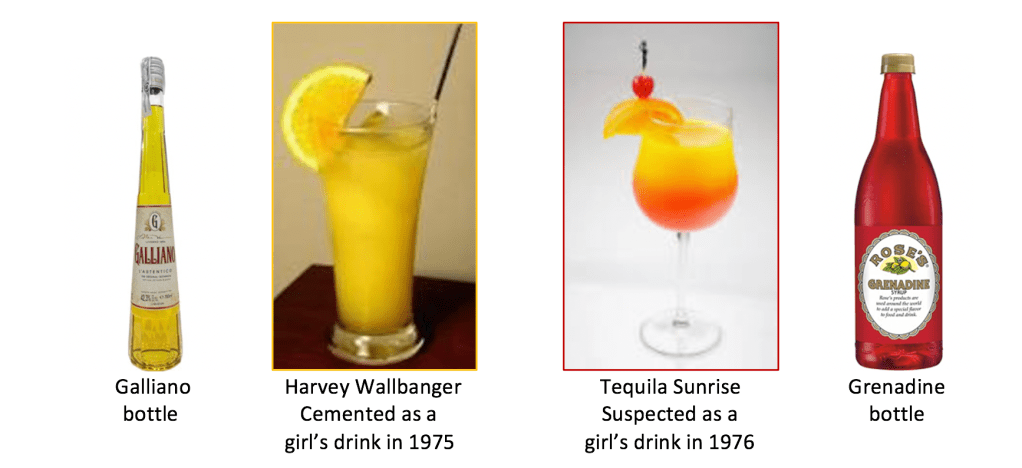
I didn’t realize at the time that Galliano was vanilla flavored; I believed it to have been banana; tricked by its yellow color. Vision dictating taste. Was it sinister synesthesia? Or potentially paranormal? ‘O Jesus. I know not where to find you. I know not upon which tree limb you scurry. Come close. Reveal yourself unto my opic eyes.’ Leaving the grand cosmic plan thing for someone else to unravel for the moment, you may know all the liquor bottles standing on Lytton Corner’s mirror mantle better than I, since I never connected that strongly to alcohol. Charlie Johnson did. We’ll meet him later. He died in his early 40’s from a painful alcoholic pickling of his distressed and damaged liver. You have heard of it as cirrhosis, which in Charlie had masqueraded as a zygote hazarde, before finally crystalizing and hardening to become forked-tongued demonic liver cancer. I received in the mail twenty some-odd years ago a fiendish portrait he had painted. It was sent to me by his older sister, Sara, as a remembrance of Charlie after his final exodus somewhere beyond the red yarmulke on top of the god’s rainbow to his box office and hard left onto what I am told is stage number two (2).
But for me, the relevant issue was that five years prior to discovering Lytton’s Corner, I had passed out face-plant-drunk in the sand, at Oswald West State Park beach on Oregon’s wild un-milled coast, after profoundly and profusely puking. It was 1970 and the escapade caused me to lose interest in drinking. At least for a time. The perpetrator was cheap screw-top red wine purchased at a 7-Eleven Convenience Store just off of Palatine Hill Road in Portland, Oregon. If you were not living then, or you were living but had grozzled your head into beach sand down to your neck, I gently alert you that at that time, 7-Eleven Convenience Store was not thought of as a wine store. It just wasn’t. It enjoyed absolutely no wine reputation. None. Nada. Zip. Zilch. I understand the impact of those sentences but they needed to be recorded. The obvious cannot be hidden any longer. Drip sodium pentothal into my veins through pinch tubes or squeegee it into the capillaries in my eyes, and you’ll hear the same. For It Is Truth. 7-Eleven Convenience Stores were not recognized as wine stores in 1970.
7-Eleven Convenience Stores were the Slurpee and cigarette stores. They did sell wine, or so their bottles were slap-labelled, meant for the duped and lazy. Their execrable wine deserved a quality rating equal to that of their scrappy sandwich selections: sloppy egg salad squirted into cracked pita discolored by a gerbil pickle piece, or the long-long-long-ago-deceased fish de tuna clumped on cold sliced multi-grain leathery heels. A generous quality rating would have pointed to the number two (2). Maybe 7-Eleven Convenience Store’s wine and sandwich selections switch-backed across the country’s highways and arrived at their delivery back doors via the same distribution network.

My larynx. ‘Excuse, me? Sir.’
His larynx. ‘Yessss (slowly), how may I halp you?’ The fez-capped Indian guy looked up from the open cash register.
My question. ‘Do you have any tuna sandwiches where both pieces of bread aren’t heels?’
Fez’s response. ‘I don’t understand you. What do you mean by ‘heels’?’.
Me. ‘Never mind. I’ll just get this sandwich, this wine and a yellow pack of Merit filters. Thanks.’
He rings me up. ‘OK. That will be $28.82.’ The black string atop his fez dangled and danced and distracted directly in front of his face.
My brows braided as I eeked. ‘$28.82 for this tuna sandwich, the cheap-ass Merlot and the cigarettes? The sandwich is $2.29 and the cigarettes are $3.50. Let’s just call that six bucks. The wine says $11.50. How can $17.50 end up at $28.82?’
Fez studied the sales receipt and looked at my purchases with puzzle pieces on his puss and then fiddled with the cash register; it seemed like a lifetime. I needed to make a rendezvous to get to the Oregon coast, so my patience had waned, through no direct fault of Fez.

So, the guy, Fez, at 7-Eleven Convenience Store, who looked more like the guy in the picture above on the left but who’s fez was more similar to that shown in the picture above to the right, sans the au naturel 25¢ Halloween beard, looked at me dead seriously, with a failed expression, pupils to pupils, left eye to right and right eye to left (right to right and left to left would have demanded each of us to look at one another cross-eyed; we were unwilling), and said, head slightly bowed, ‘OK. Sorry. My mistake. It’s $18.76. I entered $21.50 for the wine rather than $11.50 first time.’
I said to him: ‘Hey. Don’t worry about it. It’s not a big deal.’ He remained shaken by his mistake.
Then I handed him an Andrew Jackson and while he was doing change return calculations,
he says to me: ‘That is a good price on the wine.’ I didn’t know if he was trying to defuse the situation to cheer himself up.
I responsed incredulously: ‘Have you ever drank this crap before?’ I mean, I asked amicably. Not honey-soaked. I didn’t use my lullaby voice. But I was friendly.
Fez: ‘Oh, no, sir. I don’t drink. My religion forbids it.’
I asked politely: ‘What religion does that?’ with my head twisted backward as I was heading to the exit while stuffing the $1.20 change securely into the front left pocket of my jeans after discarding the four Lincoln cent used pennies into the black plastic Take One/Leave One dish.
Fez: ‘I’m a Zoroastrian, sir.’
Me: ‘OK, great. Thanks.’ And I made my escape.
I’d heard of that religion before. I’d just never met a person who practiced it. Fez seemed like a nice-enough guy. Maybe he just didn’t know that the burnt end caps of a loaf of bread are called the ‘heels’. Personally, I felt gypped whenever I purchased a sandwich that, once unwrapped, revealed a heel on one end. Actually, ‘gypped’ is misleading as an adverb. It is too tame.
It felt more like an assault whenever I would discover the heel of a loaf hiding in a sandwich that I purchased at a 7-Eleven Convenience Store. It seemed to really only happen there. And often. Did it matter if the sandwich builder back at the 7-Eleven Convenience Store’s sandwich factory was a man or a woman as long as they were an experienced sandwich builder and were wearing the black nylon hair net? And did it also matter if they put the heel side facing into the sandwich or facing out? Do they really think we can’t detect it? What fools were they hiring at the 7-Eleven Convenience Store’s sandwich factory! We, the People, always figure it out. You can’t hide a heel slice under the detecting nose of any consumer, be it Mr. Sherlock Holmes or a common guttersnipe. It’s one of the pillars of our culture.
My normal behavior upon discovering that my sandwich included a heel was always to instantly chuck the sandwich into the nearest waste dispensary. To rid my shame, I’d plunk the failed sandwich into the red-topped plastic bin with the white swinging flap on my way outside the 7-Eleven Convenience Store door, in direct view of the shiny family bulbous Buicks with their broad beluga noses and the low-rider finned Cadillacs, while glancing to see if someone caught me doing it. If anyone asked, I just wasn’t hungry. But no one asked. I’m not saying no one ever witnessed me tossing a sandwich. I’m just saying no one ever asked.
On those occasional instances where I would uncover a double-heeled sandwich, my head almost exploded off my shoulders. That really made me feel like a loser – a zip – a bufo. Like it was my fault. Like I was being paid back for something horrible that I’d done. It was MY FAULT. It caused me shame. I WAS SHAMEFUL. Professional psychotherapeutic ethologists call it ‘misplaced guilt’. The most common affliction leading to a psycho’s couch. It’s how psycho couches came to be. I tried to find solace believing there to exist a universal empathy for anyone who must contend with the exasperation of a 7-Eleven Convenience Store earmuff sandwich, be the muffs single or twin.
But, like a whole lot of other things, there are always gonna be some people that play games with themselves. Try to trick themselves. In this case calling the heel the ‘crust’. Like the whole loaf has a crust around it. Really? Does that work for them? Calling the heel the ‘crust’? Well, the heel is not the crust. The ‘crust’ on a loaf of bread isn’t awful and debilitating and doesn’t make you hate yourself. Naturally, being no childhood idiot, I wasn’t the neighborhood boob, I always ate around the crust as a kid, avoided it with great success, and never allowed either lip to get particularly close to it. I wasn’t a complete fool. I had genetic coding just like you. But I arranged my gumption and tried the crust as a youth and it wasn’t so bad. Not at all like the heel.
I recently watched a teenage girl prepare a ham and cheese sandwich at a golf course. It was my order. My tee-time was in twenty-two (22) minutes. She may have been in her twenties. Her exact age is not at issue here. She asked if I wanted lettuce and I said, ‘ok’ but not in any sort of an encouraging voice. She asked if I wanted a gerbil pickle on the side and I said, ‘No, thank you.’ She then slid her hand into the cellophane plastic bag with blue and red and yellow balloons on the wrapper to grab two pieces of bread to begin to build the sandwich … and then I witnessed her jerk her hand away like she had just grabbed a banana slug; Ariolimax morch. But it was not a morch that she pulled out of the bag. But it was similar. It was a loaf heel. Her lightning withdrawal was atavistic. Like when the doctor bangs your knees with the hard rubber end of his doctor’s mini-sledgehammer during a childhood appointment and your leg uncontrollably kicks up by itself. The sandwich maker had no choice. It was beyond her control. Such is the disdain for the loaf heel. (Note: The sandwich girl found another bag of bread and prepared a great sandwich: not with swiss cheese – which was standard at this particular golf course – but as I was feeling chipper, I asked for their new casein-rich, quite delicious cream-based Wisconsin muenster. The guy waiting in line behind me suggested I ask for their aioli but I told him that I was fine without the aioli.)

Maybe Fez had never sampled 7-Eleven Convenience Store’s tuna brickle and had never encountered the single or twin earmuff ends. If I remember correctly, and I should point out, Slurpee’d Reader, that I am stigmated as having an exceptional memory by those whose own memories falter, Zoroastrianism started around the time when the dinosaurs disappeared, choked by asteroid ash. Some argue with some evocative evidence that Zoroastrianism was the progenitor of Judaism and Christianity. If that is, in fact, swear-with-your-hand-on-an-Avesta true (Avesta being Zoro’s Holy Book), then Zoroastrians may have drank the fermented grape to excess. Both Jews and Christians are consumed by its fermentation. I knew, for example, and all my relatives knew, that Uncle Orfie, for one, drank religiously. His choice was Mogen David. He didn’t know any better. His name was Uncle Orfie. What wine did you think Uncle Orfie was going to drink? His hand always angled for the square-bottled wines, eschewing the more common round. Then there was Aunt Lottie who breathed fire and belched gas at all our family holiday get-togethers. More, the snappy Christian neighbor-wife directly across the street, who frequently welcomed daytime visitors into her home, drank all the time. At least, that was the chatter. Her name was Vivian and her daughter’s name was Valerie, and I never knew for certain her husband’s name. It may have been Wyatt but that, admittedly, is a guess. That, indeed, was shooting from my hip. Vivian was not a wine drinker. She called vodka her Vitamin V. She was tall, firm, athletic, charismatic, vivacious, had a lift in her step, and often wore aprons and curlers outdoors. She showed a freedom and more to us kids. A delicate gold Catholic cross bounced around her neck as she walked and hid in her bosom when she stopped walking. But I didn’t know much about bosoms back then. But I was eager to learn. I was becoming a sponge; a specimen not quite a plant but also not quite animal. It was awkward.
Nearby lived Margie Samuelson, three doors down Cook Street from my house, toward 10th Avenue. I won’t allow her to be ignored any longer. She’s gonna show up at some point. Ample Margie was probably fifty-two years old. I had no idea how old she may have really been. Ten-year-old’s, my age at that time, didn’t come equipped with the ability to judge another person’s age unless the person’s age being judged was, at most, twelve or thirteen. If the ten-year-old was exceptionally skilled, maybe he or she could identify a fourteen-year-old. Maybe. But probably not. None of the kids in my neighborhood, at age ten, could reliably point to a fourteen-year-old, and say, with certainty: ‘That kid is fourteen years old.’ No one could do that. And there were tons of kids in my neighborhood. I couldn’t do it. Frisell couldn’t do it. He was really crummy at it. Blum? No way. Irwin? Nah. He couldn’t do it. Wagner or Willard or Crow? Not a chance, but Willard would claim that he could do it, and then guess wildly, and if wrong (usually), throw his gum on the ground with disgust (always), and then stomp on it and walk around with gum on the bottom of his shoe for the rest of the day.
And later in the day, as Willard clod his way up the front cement steps to his house for 5:40p dinner, up and into Jack and Thelma’s house – Willard’s parents – entering through their living room’s average-thickness front door (one and three-quarter inches), his younger sister by one calendar year yelled, ‘Mom. Bob walked on the carpet with gum on the bottom of his shoes.’ Her name was Kay. Her name is Kay. She only yelled that once and stopped doing it for similar reasons as to why I only swung a sledgehammer once: she relished her health. Her older brother, Bob, was one of the biggest kids in our class and had already been able to muscle up a bicep. Like all living things, she was dominated by the instinct of self-preservation.
Bazooka was Willard’s #1 choice of gum to chew. There were a handful of gums from which to choose back in those halcyon days, but Bazooka made a real nice pink gum that came wrapped in a multi-panel Bazooka Joe comic. The comic sucked with the print and the picture often blurry and out of focus. And the inks they used were crap. Even as kids we knew there was no point in reading any of the Bazooka Joe comic gum-wrappers. But it was a real good gum. Like a little, miniature whale tongue. It was rougher and sturdier than what you found inside a Dubble Bubble gum wrapper.
Many of us leaned slightly toward Bazooka over Dubble Bubble for taste and texture. However, Bazooka was not the best gum for blowing bubbles… but it was way better for blowing bubbles than any of the Wrigley’s gums. Like Doublemint. I, myself, never actually witnessed a real Doublemint gum bubble being blown. Never. Not even once. There was rumorof a kid up on 7th and Adams Street who could occasionally squeak out a real tiny little puny pathetic Doublemint gum bubble that couldn’t even legitimately get away with being called an actual bubble. You couldn’t trick anyone. Kids would point right at you with a stiff index finger, and say, ‘That’s not a bubble.’ Or if they hadn’t had Mrs. Somma’s 3rd grade English class explaining double-negatives they might say, ‘I don’t see no bubble’. A famous saying coined in 1958 said that ‘A Doublemint gum bubble was as rare as a 1909-S VDB Lincoln cent penny’. Some bufo paid $117,000 for a 1909-S VDB in a recent auction. Whereas a Doublemint gum bubble, if you could magnify one, isn’t worth the spit it took to try to blow it.
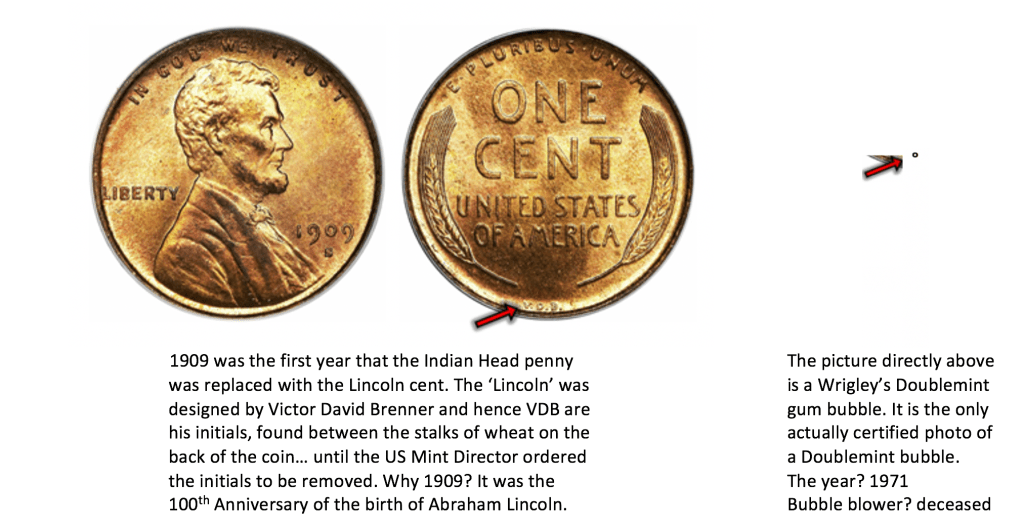
Doublemint was the gum that Wrigley’s demanded that you have a twin brother or twin sister to get everything out of it that they put into it. I never really understood how that worked but I didn’t give it much focus cuz I didn’t have a twin. I never gave Doublemint a real earnest chew. Apparently, it was said, you would double your pleasure and double your fun while you were chewing it. Which I’m all for. If it’s legit. It’s got to be legit. I wasn’t convinced that the Wrigley claim was legit. I have no proof. I relied on my ‘intuition’.
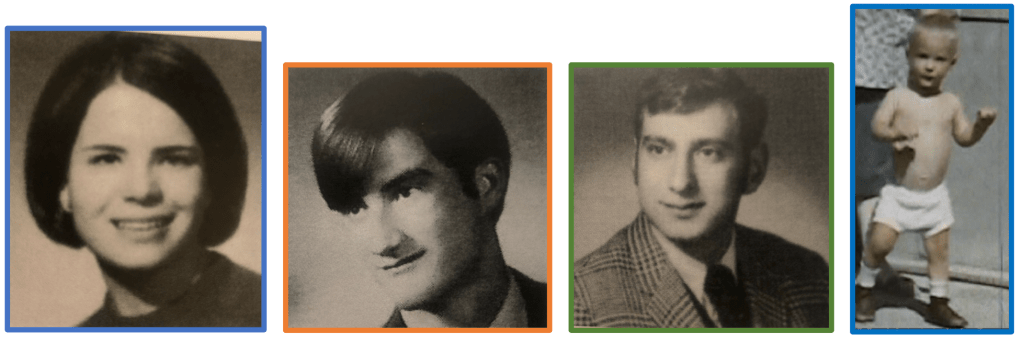
The Cantrell sister’s grew up twins and may have grown up chewing Wrigley’s and may have even chewed it at the same time together and may have even chewed it with the same cadence… two… three… four. Like the Doublemint twin girls wearing green tops in the teevee commercials just standing there on-screen chewing together. That’s the only thing the girls in the Doublemint teevee commercial were doing. Just hanging out together chewing Doublemint, smiling while they were chewing, and doing nothing else. Just looking around chewing gum and smiling. My hunch was that the Cantrell twins grew up chewing Wrigley’s Doublemint. It was one of the only things that would make sense in this crazy world.
But I don’t recall ever getting together with any of my friends just to stand around chewing gum, as though that in itself was an exciting activity to do for the day. The following phone conversation never happened and is only included, after internal digestion, to illustrate an example. It is NOT an authentic, bona fide, reenactment of any conversation I ever had with Bob Willard growing up.
Willard calls: ‘Hey Sam. You want to come over to my house and chew gum?’
Sam on the other end: ‘Cool. Sounds like loads of fun. Everyone else gonna be there?’
Willard again: ‘Oh yeah. Everyone’s coming over. Frisell said he got ahold of some new cinnamon flavor and Tim Crow bought a new pack of Black Jack. I can’t stand Black Jack gum but I stole a few balls of Dubble Bubble out of the back of my sister’s sock drawer. They’re pretty hard and old, but she won’t know. Kay doesn’t know nothin’ about gum plus she’s gonna get braces on her teeth. She’s got the overbite of a Palomino. My mom told the guy at the candy store on 12th and Madison Street not to sell her anymore candy, too.’
Sam: ‘You got any Juicy Fruit?’
Willard: ‘I think so. I’ll look in the pockets of my dirty pants in the laundry and see if I have any left.’
Sam: ‘What about Bazooka?’
Willard: ‘Of course. I always have some Bazooka.’
Sam: ‘Cool. Should I bring a football?’
Willard: ‘No, we don’t need a football. What size?’
Sam: ‘You know… the small one that fits in your hand perfectly. Can throw it a mile.’Sam
Willard: ‘That’s all right. We don’t need it.’
Sam: ‘Should I bring my basketball?’
Willard: ‘No, we don’t need your basketball. I got one anyway. We’ll just chew gum all afternoon. Do you have any matches?’
Sam: ‘I think I could sneak some from my mom’s purse.’
Willard: ‘Cool. It might be fun to try to light one of the bubbles.’
Sam: ‘That would be neat, but I don’t think it’ll work.’ This conversation that never took place occurred right at the time of the transition from ‘neat’ to ‘cool’.
Willard: ‘Well, maybe when we’re done chewing, we can light a couple of farts. That would be cool. It’s like a miniature flame thrower. Have you learned to fart, yet?’
Sam: ‘I don’t know about that but maybe we’ll find something else cool to do.’
Willard: ‘OK. Cool.’
Sam: ‘Is it cool if I don’t leave my place for about ten minutes before I come over?’
Willard: ‘Yeah. That’s cool. But no longer. Hurry up.’
Sam: ‘OK. Cool. See you in a little bit.’
Willard: ‘You gonna ride over or just walk?’
Sam: ‘I’ll take my bike. Cool?’
Willard: ‘Yeah. Cool. Don’t forget your gum.’
Sam: ‘OK, cool. I’ll bring a bag of white Chicklets. There might be a couple of orange ones.’
Willard: ‘What’s the most number of pieces you chewed at one time?’
Sam: ‘Jeez, I don’t know. Four?’
Willard: ‘Latham says he’s chewed nine at the same time.’
Sam: ‘Robert Latham?’
Willard: ‘Yeah.’
Sam: ‘The guy that ate, like twenty-seven hotdogs, and came in 2nd place at the eating contest?’
Willard: ‘Yeah. Latham. He ate eleven plates of baked beans in that contest, too.’
Sam: ‘I guess it makes sense. But it just sounds really dumb. I wouldn’t want to cram nine pieces of gum into my mouth at the same time and try to chew ‘em. Would you?’
Willard: ‘I couldn’t get in more than seven.’
Question from Excited Reader: ‘What if you replaced ‘Willard’ with ‘Frisell’ in the conversation? Would it have occurred then?’
My answer: ‘Same thing. The conversation would never have happened. ‘Blum’? Also never happened. No once. Not with anyone. You could replace Willard with the Queen of Sheba and it didn’t happen. Of course, the queen didn’t know my phone number, nor I, hers. If you investigate ‘country code for Sheba’, you get conflicting or maybe I should say multiple results: one investigation says Yemen (country code: 967) and another says Ethiopia (country code: 251) and then there is the Beer Sheba Airport in Israel (country code: 972). Who has that kind of time?’
Question number two (2) from Same Reader: ‘Didn’t the queen have more than one residence?’
My answer: ‘I believe so, yes. Let’s give someone else an opportunity. You, in the back, go ahead…’
Question in the back from Reader Number Two (2): ‘What gum was the queen’s favorite?’
My answer: ‘That concludes our question-and-answer period.’
I wanted to know the facts, as I can sense do you, Thoughtful Reader, about the twin Cantrell sister’s favorite gum and made it a point to find out for both of us… and the results came back quickly not long after my inquiry. Cathy Buchanan, nee Cantrell, promptly reported back to me that her elder twin, Carol, said that the two of them mainly scrizzled Juicy Fruit gum with Bazooka as backup. And Cathy agreed. Of course she did. All the kids chewed Juicy Fruit at some point. Sometimes to relax over-tired cheek muscles after crunching Bazooka for a couple hours. It was kinder to your jaw. Especially if you clamped down on one of those rigid Bazooka briquettes that was hard as a fossilized kidney stone and wouldn’t soften. At all. Ever.
Juicy Fruit was the Harvey Wallbanger of gum. Girls really went for it. Juicy Fruit was a Wrigley’s gum product. I was only average guessing people’s ages but I nailed it by suggesting the Cantrell’s predominantly scrozzled Wrigleys inside their mouths as youths. Although it wasn’t a bull’s-eye as it was Juicy Fruit foil wrappers on the twins bedroom floor and not the Doublemint. Guessing ages and guessing gum choices aren’t identical skills. And the Cantrell’s weren’t identical twins. They had different umbilical cords and didn’t look the same. But both had spunk.
George Kawamoto, however, could guess a fourteen-year-old’s age. That’s because when the rest of us were ten years old, George was twelve. That’s the only reason. Except he had three older sisters, which helped. My brother’s age was plus three to mine, but I didn’t pay that much attention to him all the time, so he wasn’t much help for me to guess ages. So when I say Margie Samuelson (remember her? my neighbor three-doors down the street… older lady) was fifty-two, take it with a grain of NaCl.
C H A P T E R 2 ::
Margie Samuelson – Vim – Ginger Ale – Backyard Shed – Private Lives –  – Juke Boxes – The ‘Long’ Version – Christopher Columbus – Anda O’Keefe – Teevee News Special Bulletin
Margie invited me into her living room, as a kid, a few times, after dinner, for what purpose, I never really knew, but I guess, to watch her drink. It was in the summertime and warm in the evening when the sun still lazily rolled around in the sky. She always wore the same large baggy sweater; a bright colorful afghan of vermillion, carrot and meadow pistachio with big-holes in it. Legally, it was Margie’s mother’s living room because it was legally Margie’s mother’s house. Margie lived with her mother, something that by itself didn’t make me think anything was weird. And on those occasions when Margie invited me in, it was always by calling out to me from the back of their house, through the screen door, facing the alley, where she’d catch me riding my bike. Like she was spying. It was almost like she was waiting. Like she had a condition what was called an ‘expectation’. I didn’t know what an ‘expectation’ was back then. I thought it might have been something like having a hole in your head. Or like she was lonely. She’d see me attempting wheelies on my Stingray bike with its bright speckled red banana seat and matching red speckled handlebar streamers and would call out to me. And I’d look over and see the cigarette smoke pluming out from behind the screen. One time, I watched her run out hurriedly, wearing what looked like bedtime pajama pants below her colorful rainbow afghan baggy big-holed sweater. She looked so desperate, even afraid that I might not hear her call.
When I’d accept her invitation, I’d park my Stingray in her back driveway, each time properly engaging my kickstand. I had an aluminum alloy quick-release kickstand. Just a quick knock in the right direction and I could escape robbers down an alley in a flash. Or down a street. Or down the sidewalk. Or across someone’s lawn. Unless there was snow. Or down shallow outdoor cement stairs. Or to leave Margie’s mother’s house quickly if need be, I guess. So with my quick-release aptly applied, I’d leave my bike off to the side and pull some of the stems and leaves of the lilac bush over it so it wasn’t noticeable to anyone snooping around, and then walk over a few feet, furtively look around, and open her backyard metal Elcar fence gate. Margie would grab my shoulders and direct me inside and up the short flight of stairs, encouraging and steering me from behind, now with her hands squeezing both my hips, curled around them, through the house from the back door to the living room up in the front on Cook Street. Each time, her mother was in the living room sitting on the hard chair, off to the side. So both Margie’s mom and my banana-seat ride were ‘off to the side’ so as to not be noticed.
I could see from sideline glances that Margie’s mother lacked vim. Kathy Kissell had vim; she was a tom-boyish elementary school classmate who had legendary gymnastic skills. Julie Van Attem had a vim deficiency; a classmate that endured watching Kathy perform spinning-tops yet exhibiting no interest of her own to compete. But Julie Van Attem wasn’t devoid of vim. She was just storing it. Margie’s mother had run out of vim.
Margie’s living room smelled like old people and the curtains were discolored by a faint yellowish stain. When I did look over, Margie’s mom’s head looked small and was shielded by combed over rust-red cotton candy hair, inadequately dyed with areas the size of Africa missed, rooted in cement grey, and thin enough to reveal too much scalp. An old woman’s scalp wasn’t anything great to look at from that close. Not at age ten, with or without my glasses. Margie’s mother’s lady stockings were rolled down so they ended in a puddle circling her ankles. Bulging blue veins and red roadmap arteries streaked up and down both legs. Those were days when old women wore Playtex girdles with clothesline hooks hanging down from them to keep their stockings sleek, attached and upright. Taking a full swallow prior to looking at Margie’s mom, I could see that she was close to a hundred years old. Which meant that Margie was probably closer to seventy-years-old than to fifty-two. If agreeable to you, Dear Reader, let’s split the age difference and staple Margie as being sixty-one years old during my childhood living room visits.
I purposefully just focused on Margie, while at the same time attempting to avoid looking too much at her mom. I never saw Margie’s lady stockings collapsed around her ankles. Margie dressed better than her mother, but her mother at that point was little more than a semi-functioning cadaver. Had it been one year earlier, 1960 vs 1961, her mom could have played Norman Bates’ mother. Both Norman Bates’ mother and Margie’s mother shared an absence of vim. Two peas. Almost twins. Both were Mendel’s shrunken wrinkled peas.
A couple times, after I was already seated on a chair in her living room, with her mom propped on the hard chair off to the side, which was her saddle, with a cane as her horn, Margie would slap her own gnarled hand on the sofa cushion upon which she sat advertising while straight-backed, and say, ‘Come. Sit over here closer to me.’ I did what she asked as I was a guest in their home, and I had acquired some manners, but I also sensed that something different was going on, and I didn’t know what, but I also sensed not to tell my mom. At ten years old, I already knew that keeping secrets from my mom was often the best thing to do. Truth be told, I probably realized not to tell my mom everything that was going on when I was eight or nine. Maybe six. I was precocious.
Even today, as I deliver this conveyance, even with my steel-trap memory, I can’t think of anything that Margie ever talked about other than asking me if I wanted a Ginger Ale. She said she bought the Ginger Ale specifically for me, and that seemed nice of her, but I didn’t really like Ginger Ale. The effervescence tickled the inside of my nose and it tasted like tree bark. I’d had it before. It came from Canada where they must have an over-abundance of trees and an over-abundance of tree bark.
Putting manners ahead of honesty, I told Margie, each time she offered Canada’s liquid export, ‘Yes, please.’ and ‘Thank you.’ Although my memory for conversation has waned, I do remember watching her slowly and delicately remove her long-hooped dangling earrings off of her large floppy ears and lay them on the small wooden doily-protected table to her right, next to her high ball glass, partially filled with melting ice and whatever remaining alcohol that had been topped up only moments earlier. Then she would pull at and widely stretch both ear lobes with her bent fingers a few times like she was scratching them, while her glassy furtive eyes were fixed upon me. Looking back now, Margie’s fingers didn’t look quite as screwed up as Big Red’s fingers when I saw his next to me at Lytton’s Corner fourteen years later, in 1975. Margie’s fingernails had deep red polish on them to try to make them look nice. The deep red polish almost looked dark brown. For Margie, it was only the joints and knuckles of her fingers that looked like they needed attention. Her fingernails looked ok.
It was at this time in our childhood, 1961, that Frisell and I and a bunch of our friends built a shed in my backyard. It had a lot of space inside of it and was decked out with a small couch and was real comfy inside and it was big enough to sleep in it and it had rugs on the floor and an old mattress and the slanted roof had tar paper on it so it kept the rain out. Frisell and I hung a big Mexican woolen blanket on one of the inside walls to block any cracks that would allow someone uninvited to peek inside. We constructed the shed with lumber that we nailed together using 2x4s as corner supports; sawing and hammering and using the claw of the hammers to remove nails when we missed hitting them squarely and they had bent over looking like losers. They looked like dead soldiers laying in the mud. When we couldn’t pull out the bent nails, we’d hammer and pound and smash them below the surface of the wood, until the soldiers were buried. There were more than two or three of those.
There were times when I was in Margie’s living room watching her drink her alcohol and suggestively remove her hooped earrings that I wanted to invite her over to see the new backyard construction at my house, but I chickened out and never did ask her. Chickening out was the most common form of failure for a kid growing up. Buying a tuna brickle sandwich with catcher’s mitts replacing proper bread slices was a different type of failure — less personal and beyond personal control. But there were a couple times when I imagined that I had invited Margie over to see the inside of the shed and thought about what it would be like. I couldn’t risk it though. I couldn’t risk my mom knowing. I couldn’t risk her finding out that I was getting older, already ten, and that the level of excitement found in Nancy and Sluggo comic books was officially a thing of my past and didn’t hold my interest one lick. I didn’t care about Richie Rich, either. I never cared about Richie Rich. I always thought of him as a stuck-up ass even then, but we had a couple of his comics, but I didn’t buy them. I saw a couple up in Crow’s cabin or Willard’s cabin a couple years earlier. But I wasn’t seven-years-old any longer; I was ten. The two are really different. I couldn’t let my mom know that the first girl I really thought about in that way was sixty-one-years old and that I could be moving as far away as three doors down Cook Street toward 10th Avenue. Or permanently moving into the shed in the backyard.
The painting that follows is by Denver artist William Sanderson and reminds me of Margie Samuelson and some neighbors growing up and some relatives like Uncle Orfie. It reminds me of Charlie Johnson, too. It’s called Private Lives. I’m no art interpreter, but it looks like they are all trapped.

I don’t think William Sanderson knew Charlie. Huge, huge age difference and there wouldn’t have been any natural intersections to allow them to come into contact with one another. But maybe William Sanderson knew Margie. Maybe they ran in some of the same circles. Maybe he liked Ginger Ale. I never saw his Stingray bike in the driveway. He was born in Eastern Europe in 1905 and may not have ever learned how to ride. There is an expression we’ve all heard fifteen thousand and two (15002) times. It ranks #1 for the number of times of hearing any expression when we were growing up. It goes like this: ‘Once you learn how to ride a bike, you never forget.’ For those who think that the expression is too wordy, who feel the need to move onto their next thought quickly, it had also been shortened to: ‘You never forget how to ride a bike.’ They mean the same thing. Twin expressions. Like having two halves of the same teacake.
Well, the same can be said of bowling. You don’t forget how to bowl once you’ve learned how to bowl. Same with hammering. That’s about it. If you come up with another example, keep it to yourself. I don’t want to know. We all can come up with our own. The list would be endless. Whoever handled the public relations for the ‘riding a bike’ expression did a phenomenal job. The saying isn’t, ‘Once you learn how to tie your shoes, you never forget.’ Plus some people only wear sandals, I guess. The second most common expression we’ve all heard? That one is equally easy: ‘Don’t let the door hit you in the ass on the way out.’ Not number two (2) for you? Really? Well, I guess everything isn’t the same everywhere. Or maybe you are just one of those people whose memory isn’t so reliable anymore.

Returning back to Lytton’s Corner March 18, 1975, Big Red sat at the bar with another lonely Old Milwaukee beer and a prescription of beer nuts laid out before him like a big nut map. The large room was alive with patrons shouting and shooting pool and there was the sound of glasses clinking and the juke box pounding out hits from 1973, even though it was 1975. The juke box competed with the television sets mounted on the walls. 1973 was a bad year for popular Top 40 songs. #1 was Tony Orlando and Dawn’s, Tie a Yellow Ribbon Round the Old Oak Tree. None for me, thank you. The entire hypothesis was frankly annoying and ridiculous. The ribbons that were tied around trees where I grew up identified those trees to be stripped, uprooted, permanently removed and turned into sawdust. And there were other titanic tunes like Could It Be I’m Falling in Love by the Spinners and Helen Reddy’s Delta Dawn and Vickie Lawrence’s smasheroo The Night the Lights Went Out in Georgia. I, myself, didn’t think it was a smasheroo. Gary O’Block might have thought it was a smasheroo, but not me. And I’m not saying Gary O’Block thought The Night the Lights Went Out in Georgia was a smasheroo. I said ‘might have’. I have no idea now, nor had I then, any idea what tunes made Gary tap his foot and twirl his girdle.
I had doubts that I would stay at the bar for long that night. Juke box music didn’t play what I listened to. Morning Dew by the Grateful Dead didn’t spin behind the curved glass. Nothing by the Grateful Dead spun. No Bertha. No Sugaree. No Jack Straw. No China Cat Sunflower. No I Know You Rider. No Black Peter. No Box of Rain. No good. Especially no Viola Lee Blues; that’s an eleven-minute song, so it’s automagically disallowed to touch the spindle of any American or European juke box. Get eleven minutes for one play? What world do you live in? Not a chance. They wouldn’t even have included an eleven-minute version of Tie a Yellow Ribbon if there had been one. There wasn’t. Because of Canada’s time conversion tables, the only place to hear eleven-minute songs out of a juke box was up north in the unpoliced tundra where an eleven-minute song would reduce to about 01 minutes 19 seconds US.
American juke boxes came installed with the 02 minutes and 52 seconds version of Light My Fire. Bar and restaurant owners hissed at and vexed the 07 minutes and 06 seconds version; the version called the ‘long version’. Back then, 1967, if you just said the words ‘long version’ at any point in any conversation to any person or any group of any persons, at any hour of any day, everyone knew that you were talking about the 07 minutes and 06 seconds version of Light My Fire by the Doors. That was the enormity of Light My Fire. I used their songs to live.
‘Come on baby, Light My Fire.’ Just a great, great camping song. One of the best camping songs of our generation. A new generation’s Kumbaya with a beat.
‘You know that it would be untrue’. Twang… doodie… do.. dee… do.. do.. Building and progressing into that phenomenal instrumental. Twang… twang… twang.. twang.. twang… Doo.. dee.. doo… doo.. dee.. doo… doo.. dee.. doo… doo.. Song writers and musicians and many composers later wrote actual music notes onto a paper scale to create and communicate their music. The ‘Twang… twang… do.. dee.. do’ approach to writing music made it difficult for other members of the band to learn the melodies quickly, and then there’s the syncopation aspect. Plus the ‘Do… dee. do’ approach made music copyright legal cases cumbersome and difficult to adjudicate. How long were you supposed to hold the ‘Do’ with three dots vs two dots?
The only other song that had any sort of similarity in length to Light My Fire, yet was more than twice as long, yikes!, was……. In-A-Gadda-Da-Vida by Iron Butterfly. WHAT great guitar solo-work and DRUM solo and later inclusion of ORGAN tune-age!! Then an elephant screams in front of the Taj Mahal somewhere about nine or ten minutes into it. Song length? Just over 17 minutes… 1968. There were attacks on the title of the song. What the hell does In-A-Gadda-Da-Vida mean, anyway? There were theories. There were guesses. The most believable explanation, to me, was that it was supposed to have been ‘In-a-Garden-of-Eden’. One report says that the words to the title were slurred when told to the band members and they understood them to have been In-A-Gadda-Da-Vida, so they recorded it with that.
‘three.. four… hut’
‘In-A-Gadda-Da-Vida baby’
‘Don’t you know that I love you’
‘In-A-Gadda-Da-Vida baby’
‘Don’t you know that I’ll always be true’
‘Oh won’t you come with me… and take my hand’
‘Oh won’t you come with me… and walk this land’
‘Please take my hand’
But no one knew for certain what the hell the thing was about. What it was that they were harmonizing about. I am one of the those that thought it was either:
- a gardening song set in Eden, Canada, like the stuff Joni Mitchell would write about, but with less well-crafted, meaningful words. Comparing Iron Butterfly to Joni Mitchell is unfair to her but not like comparing an old raisin hidden in the corner of the floor growing hair to a bottle of 1962 Dom Perignon
- a song about a guy trying to convince some girl that he has special kinds of feelings toward her and ends up begging her to sleep with him. Not necessarily right away. But soon.
The second explanation seemed more in step with pretty much every other song ever written since man and female man learned to slap their hands on their knees, ooh-ooh, and form human sounds inside their vertically oriented throats, ah-eeh-ahhhh eeh-ah-eeh-ahhhh. What has become commonly called by larynx historians, anthropodians, and science believers, as the Tarzan cheer. It could be heard during time of early man echoing in the primordial, soupy, dripping forests. None of the four-legged creatures form sounds inside their vertically oriented throats because their throats aren’t for the most part vertically oriented. Their throats are generally horizontal. Of course there are exceptions and the giraffe first comes to mind. But giraffes have difficulty with tongue control when attempting to roll their rrr’s. So, it’s not the same and not fair for us to make the direct comparison between ourselves and four-legged forest creatures. Unfair also to compare man to those four-leggers that populate the savannahs. For some reason, with all the weird animals that exist, that either evolved or were hand place by god, that there are no three-legged animals. There are five-armed star fish. No three-legged mammals. Go figure. Go write a paper on that oversight. I am otherwise occupied at the moment.
It isn’t that the words in Iron Butterfly’s otic were difficult to hear clearly, although understanding rock & roll lyrics was a constant problem for me. Whereas ‘chickening out’ was without question the most common problem I had in my elementary school years, beginning in junior high school and accelerating throughout senior high, one of the most common problems I had was an inability to understand song lyrics… just making out the words themselves. In-A-Gadda-Da-Vida was an exception. If I was at a party or among friends and a song we all ‘knew’ was playing and the others started singing along, I’d fake it. Most times, it was a safe bet that I didn’t know the words at all. I just acted like I forgot them and put in fake rhymey words or sang doo.. dee. doo… doo.. dee. doo. I never let on that I didn’t actually even know the words. Upon reflection, the theme to The Bridge on the River Kwai may have been popular because of the omission of words. Those that performed the tune just whistled.
I wondered if I had a hearing problem. I knew that the lyrics to all the rock & roll songs must have been human Sapiens words; they didn’t sound like barnyard noises. Not that I’d ever been in, near, or had the desire to be in, or near, a barnyard. No one had a barn anywhere in our neighborhood. Although Terri Adams’ father was secretly growing about 1000 chinchillas in his garage. He began the hidden project with two chinchillas on the first day of school, following Labor Day, in 6th grade. That was Tuesday, September 4, 1962. School started at 8:40a so Frisell and I would start walking at about 8:10a. That was our usual. But for Terri Adams, she would leave her front door at 8:35a to just cross the street. In a few years, Mr. Adams had 1000 chinchillas. They are called a herd of chinchillas. A group of porcupines is called a prickle.
The Adams’ backyard, across the street from Teller Elementary, was where Willard had planted a kick ball in disgust following the loud clang of the red outdoor school alarm bell announcing that recess was over and it was time to head back in for some final period 6th grade learning about Christopher Columbus. Here are notes from that class from a classmate. I did not say that these were Bob Willard’s notes. It is only coincidental that Bob Willard’s birthdate is October 12, which is, after all, Columbus Day:
• Cristopher Columbous was a sailer
• Cristophur Colombus sailed in 1492
• The ocean was blue that year
• Cristophor Columnbust discovered Denver
• He sailed to find a trade root to Indiana
The Columbus invasion occurred, of course, back when the buffalo roamed and Denver had no trees and the gargantuan scooping out/vacuuming of the Eisenhower Tunnel hadn’t even gotten started. Kids living today, they don’t know nothin. They think the Eisenhower Tunnel was always there, but it wasn’t. In fact, historically speaking, it was more often not there. It wasn’t even there when Columbus passed through the area. It’s called perspective and you don’t get it until you’re older. You get cavities and calves and girls get curves and guys grow Adam’s apples before any of them get perspective but some of them never get perspective.
If the lead singer of Iron Butterfly had scraped the Peter Pan® creamy peanut butter sandwich off of the roof of his mouth before telling his band members the name of the song, or if he had any interest to enunciate properly, the whole thing may have gone differently, but I believe the song would have succeeded in any case. But he didn’t scrape the Peter Pan® creamy peanut butter sandwich off the roof of his mouth, obviously. There is no argument about that by anyone. That is one of those very rare, identifiable, important, points of agreement. I believe the government should start with this type of national agreement as the mechanism to bring people together. It’s the only thing that will work. Guaranteed. Maybe the first cooperative embodiment could be all of us, together, as a nation, as a people, as one, indivisible, FINALLY signing a petition to require the last living member of Iron Butterfly to come clean, under spotlights if necessary, to tell us all, in his own words, if he can speak words, what the hell the song was about, which brand of peanut butter caked his upper palette, creamy or peanut, and the bona fide background regarding the name of the song. Perhaps there could be a lottery to place bets to raise some money to help build more post offices and Starbucks. I’ve been places where I had to walk two (2) blocks to find a Starbucks.
It was that ‘long version’ of Light My Fire that began to crack the mold on the radio of AM stations only playing short-length songs. KIMN in Denver would play the normal 02 minutes and 52 seconds short version at some point every other hour but sometimes they would play the 07 minutes and 06 seconds long version and every foot-tapper knew when the moment in the music was reached that signaled that the version they were listening to was the long version. And when that happened, if you were in your car, parked in front of your house or a friend’s house, or running a store errand, doing homework or playing competitive round robin parcheesi, in the middle of bowling three games at Monaco Lanes or chewing Bazooka or Black Jack, it didn’t matter if you had to go to the bathroom, or if you were holding up dinner, you had to listen to the full 07 minutes and 06 seconds. Or at least until the instrumental part in the middle ended and returned to the short version finale. Nothing ever got done by anyone in America when listening to the ‘long version’ of Light My Fire. But juke boxes never included it in their menu selection. Not ever. Pressing B-9 never played the ‘long version’. Neither did D-16. And the same held true for G-7. Never. You could flip the hard plastic juke box cards back and forth, left and right, and press and bang the plastic lighted buttons until fingers ached and nails cracked. Nothing. You couldn’t find it, it wouldn’t play it, and you never heard it. But Tie a Yellow Ribbon… that was button A-1.

When I first pulled open the door and sauntered into Lytton’s Corner in the afternoon of Saturday, March 15, 1975, three days before sitting at the bar with Big Red, I was new to the area, unemployed and had little to no money in my pocket and an equal amount in my wallet after paying first and last month’s rent companioned with a modest damage deposit. We had moved into our new house in the area at 11:40a on Saturday, March 8, 1975… exactly one week earlier. The time is no estimate; it is actual. That will be explained later in the tale at the height of its relevance and impact. Opening a bank account was in the dormant, planning stage.
The smiling bar matron at Lytton’s Corner was a girl named Anda O-Keefe and she liked me from the first moment. We got along right off the bat. She fed me burgers and brought me beer and didn’t charge me. From our initial matron/patron chit-chat banter, in between her answering customer’s questions, taking their orders, pouring beer, mixing high balls, serving burgers, offering ketchup, offering yellow French’s mustard, offering Dijon, offering mayo, removing plates, accepting money, providing more napkins, returning change, picking up tips and saying ‘Thank you’ to her peeps, I learned that her birthday was the same as mine, as it turned out, so we had that shiny nugget together. She was very nice and very sweet and was from St Louis and I’d driven through St Louis once before, late one night, I couldn’t remember the year, so we also had that diamond mine to share together. She told me that St Louis had more parks than any other city in America and I just believed her which demonstrated early trust, an important, yet often under-hyped, ingredient for a relationship. And it was those magical combinations of similarities and experiences and shared viewpoints that became the inner goo of our friendship. It was nearly immediate. And to even cement a stronger bond, the initials of Anda O’Keefe were AOK, which I liked and made her even more interesting. If that was possible.
Charlie and Karen and our menagerie and I had just moved to town a week prior. I say ‘moved to town’ because that’s an expression and that’s how we’ve all heard it told, but it was really more like moving to a city than a town. And the city that had been targeted upon our exodus from Denver was Palo Alto, California, nestled in the mid-San Francisco Bay peninsula, but instead, we moved to East Palo Alto, because it was cheaper, still had Palo Alto in its name, and we had no idea that it was a black ghetto. We moved into a decrepit, paper-thin walled, last house on the left at the end of dead-end Sacramento Street in East Palo Alto.
On Tuesday night, the 18th of March, three days after discovering Lytton’s Corner and meeting Anda O’Keefe, while sitting at the bar next to Big Red, both of us watching the local news channel on the teevee anchored and suspended from the ceiling in the corner right in front of our faces, it was reported in Special Bulletin format while I wiped medium-well burger drizzle off my chin (with a slice of sharp cheddar):
‘Sacramento Street in East Palo Alto is the #1 heroin dealing street
in the San Francisco Bay Area… quite dangerous…
and to be avoided by Bay Area residents’
I admit now what I wouldn’t show publicly at the time sitting next to Big Red. That news broadcast was a choker. The telecast confirmed what I felt I had sensed almost from the moment we handed over our rent and deposit checks to our new slum lord on Saturday, March 8, 1975 at 11:40a. That broadcast hit me in the chest bone like a life-or-death, fight-or-flight mortar blast – much worse than receiving a double catcher’s mitt tuna brickle sandwich at 7-Eleven Convenience Stores. Definitely more bigger and more worser.
Following the frightening ‘five-alarm-fire’ teevee news special report, with the blood in my head draining quickly, filling my neck, Big Red turned toward me and said,
Big Red: ‘Boy I’m glad I don’t live on that street. How about you?’
Me: ‘Yeah. I’m glad you don’t live on that street, too.’
Then Big Red put out his hand and said,
Big Red: ‘My name’s Buzz but everyone calls me Rusty.’
Me: ‘Oh, ok. Nice to meet you, Rusty. I’m Sam. You doing all right tonight?’ His vise grip handshake was crippling. I’d only known one other person named Buzz before, as a kid. But I couldn’t focus just then. Couldn’t think straight. Could barely hear. I didn’t bring up his swollen hands. I had other things on my mind. Well, I had one big other thing attacking my mind.
Rusty: ‘Yeah. I’m doing all right. Poured a lot of cement today. Three big jobs. How about you?’. Rusty’s larynx was really firing now, attempting to engage in conversation. Something that given the circumstances I had no interest in participating.
Me: ‘I’m good.’ I was lying through my teeth.
Lytton’s Corner was located in super safe Palo Alto, across Highway 101 from East Palo Alto. Lytton Street paralleled University Avenue which entered palm tree-lined Stanford University from that direction. Because of the devastating bombshell teevee news special news bulletin report, I immediately liked being over on the Palo Alto side of Highway 101 rather than over on the East Palo Alto side. I had to get out of there. I had to figure stuff out. But I didn’t have anywhere to go… didn’t feel right going back to Sacramento Street at night time just then.
There was a brief silence for several sloshes and swallows as Rusty’s beer nut map slowly eroded. It was becoming a smaller map, like countries disappearing during war.
Me asking Rusty once he was done devouring his latest beer nut: ‘You like riddles?’
Rusty’s retort: ‘Sometimes. But I’m usually no good at ‘em.’
Me: ‘OK. Try this. I’ll buy you a beer if you can name ten three-letter body parts.’
There was a pause, like a full minute, while another beer nut was carefully crushed by his molars, masticated and mechanically formed into a small moist pasty bolus, swallowed and chased by another swiggle of beer. Tie a Yellow Ribbon started playing, again. Anda had turned the teevee volume down real low.
Rusty responded warmly to the riddle: ‘Hmm. Let’s see, wait… let me think… first off… is… uh… let me think… um… ARM.’
My response: ‘Great. Only nine more. You can just let me know whenever you figure it out, if you want to. And they are all common words. There’s no medical terminology and no obtuse psychiatric fluveltrek. I gotta go use the john.’
With that, I escaped from my red vinyl bar seat and traveled in a direct shot to the john, walked in, saw the line, waited my turn, used it as my head rested on the back of my neck while staring up at the ceiling tiles while quickly cataloguing my life’s accomplishments and worried about where we’d just moved to in East Palo Alto, and when I came out, I didn’t want to go sit next to Whiskey again and chit-chat. I glanced over for a second and he wasn’t there anyway and so I didn’t have to talk to him and it didn’t cost me a beer.
I didn’t really have the money to buy his beer had he come up with all ten words; I wasn’t even paying for my own beer. Rusty, nee Big Red, wasn’t likely to have come up with all the answers while drinking at the bar anyway. It helps to have a pen and paper. It’s too hard for a lot of people to figure it out all ten three-letter words without writing them down, especially when schlogging beers for a stretch. I mean, some of the words are easy, like arm and leg. Eye comes real quick, too. Sometimes eye is the first three-letter body part word that people come up with. They rarely say toe first. But there are six more answers and people generally try counting them on their fingers until they decide to get a pen and paper. I wasn’t concerned about that. I had to figure out what to do about having just moved into the last house on a dead-end street in East Palo Alto which the teevee news special bulletin reported to be a drug dealer’s Ferris wheel in a black ghetto… and advised avoiding the area at all costs. To put this into flowery adult language: I was screwed. And not the preferred kind.
C H A P T E R 3 :::
Sara Johnson – Beef Stew – Thelma’s Pancakes – Dance Party – Hava Nagila – George Kawamoto – Frost Bakery –  – William Sanderson Paintings – Cupcake Pans – Charlie Johnson – Scrawny Chicken – School Test – Test Results Review –
  – To Tell The Truth – Kitty Carlisle Portrait – The ‘Tryptic’ – Arctic Caterpillar Tractor – Snot Painting – Rolling A Joint – Paper Mache
When my older brother was in high school he got his first ‘steady’ girlfriend and her name was Sara Johnson and he did a pretty good job making sure I didn’t meet her, but I did meet her more than once. The first time was for only a few minutes. He brought her into our kitchen after school. It was 1965 and I was in 8th grade, and my brother and Sara were in 11th grade and they were talking to my mom while she was making beef stew for dinner.
Beef stew was a dish that seemed like one of those dishes that only adults would eat but I liked it a lot as a kid and it made me feel like I was an adult when I ate it. I didn’t clamor to be an adult but eating my mom’s beef stew roused my consciousness and made me feel like what it would be like to be one. And it was totally fine. I liked it. Being an adult didn’t seem repulsive while eating my mom’s beef stew. It was one of the only things we ate that included angle-cut pieces of bread from a French baguette… so that may have contributed to feeling like being an adult. Baguettes were like fancy bread back then. It was special. And it was from France. Grilled cheese sandwiches, which I love to this day, didn’t make me feel like an adult when I ate one of those. Grilled cheese sandwiches still make my feel like a kid when I eat one, but my mom’s beef stew even made people other than me feel like they were grown up when they were eating it. Friends of mine like Frisell and Denny Blum and Tim Crow and Willard raved about my mom’s beef stew and they felt like grown-ups when they ate it, too. They’d talk about my mom’s beef stew even twenty years later. They’d talk about it forty years later. Any of them would sit down to eat my mom’s beef stew right now. Frisell texted me about it recently.
In his recent text to me, Frisell mentioned that the first time that he had eaten beef stroganoff was at Willard’s house. He said it made a ‘strong and positive impression’. Good for Thelma Willard, Bob’s mother. She was a solid cook, but she wasn’t ‘rave-about’ good. Not really. I think Frisell would have said something completely different about her pancakes. In fact, recently, when asked about Thelma’s pancakes, Frisell responded: ‘Eeeeks!!!’ And in an even more recent text he continued, ‘I wonder what was in Willard’s mom’s pancake?’. Ya. You and everyone else. Even Bob hid his mom’s pancakes in his napkin. He told me that more than once. But Frisell continued in his most recent text that he liked Mrs. Willard’s German chocolate cake… the one with the coconut frosting. That’s what he said and I agree, that’s a real nice German chocolate cake. My mom never made German chocolate cake. We weren’t into ‘German’ products at our house. And, as a rule, my mom didn’t bake.
Willard’s little sister, Kay, told me about a time she remembers Frisell eating her mom’s pancakes at their house on Monroe Street and then him going directly to their front porch, leaning over the side and throwing up. And I recall a time when I was up at Willard’s cabin and I partially ate a Thelma Willard pancake and I threw it up, too. I chose to exit the back door at the cabin. Frisell had bee-lined to the front door at their residence on Monroe Street. Personally, I don’t recall eating Thelma Willard’s beef stroganoff, and I’d eaten at Willard’s house 100x more than Frisell had. But I absolutely loved beef stroganoff. Always did. I can’t recall a single time that I didn’t love beef stroganoff. Yet it is almost never on the menu of any restaurants I’ve ever been to. If it were, I’d order it and return often and order it again.
Sometimes things don’t add up. To my mind, omitting beef stroganoff from the menu is a failure of the restaurant owner or a failure of the head chef reporting to the restaurant owner. Or a failure by the senior management or the CEO or the Chairman of the Board, whomever it is that decides. It’s a singular decision: Yes or Not Yes when it came to adding beef stroganoff to the menu. If the restaurant senior-most decision-maker doesn’t want to have to pay the cost to reprint all their menus, then they should just call it a Daily Special and put it in chalk outside on the sidewalk welcome board. But make it available. I’d have Thelma Willard’s beef stroganoff right now if that were possible. Which it isn’t since she made her heavenly Exodus about ten years ago. But if it were possible I’d do it. I loved Thelma Willard, Bob’s mom. She was one of the mom’s that co-raised me. Helped give me my ‘direction’. And again, according to Frisell, the impression he got of her beef stroganoff was ‘strong and positive’. Frisell was always real good with words. He plays guitar now, though, and doesn’t do much verbal talking. He got that, I think, from his father, Wilhelm Frisell. Not at all a big talker. Frisell’s father was as quiet as a church mouse.
Even to this day, finding beef stroganoff on a restaurant menu continues to be as rare as finding the 07 minutes and 06 seconds version of Light My Fire in a juke box – the long version. They don’t let you listen to any juke box ‘play’ that lasts 07 minutes and 06 seconds for only a quarter. That is a hard fast rule. And you can’t break it. They have to make money. So both finding beef stroganoff on a restaurant menu and finding the long version of Light My Fire in a juke box have similarly small fractional chances of probability. But we don’t often connect the two in this way. This equivalence is generally not considered or discussed by most people. Maybe things wouldn’t be so screwed up in the world if we made these kind of equipoise connections.
My mom really knew how to make beef stew. She learned it from her mom. And her mom was from Hungary and they all learned how to make all kinds of stew over there. My friends also loved my mom’s chopped liver, as did I, which also made each of us feel like adults when we ate that, too. I think growing up it was pretty much beef stew and chopped liver that gave me my first insights into what it was going to be like to be an adult. Maybe some exotic seasoning like Hungarian paprika could be added to the being-an-adult list. Oh. And ox-tail soup, which I never have eaten, even to this day. It was the only thing that my mom made that was only for my dad. There was never an explanation. My brother said he thought it was something dad ate growing up and that he liked it and so mom made it sometimes for him. I asked my brother if he ever had it and he said ‘No’. And I asked him if he ever thought he would try it before he dies and he said ‘No’. He feels the same way about ox-tail soup that I feel.
My brother’s first ‘steady’ girlfriend, Sara, had long blonde hair with curls and a real sweet voice. I made a mental note of her voice right away and it kinda shocked me because I’d never heard a girl talk the way she talked, except in some movies that didn’t yet really interest me. It was pinched high like jasmine and a little sappy like honeysuckle with a good air volume like a tuba. Maybe she just talked like that around my brother. He was on the high school varsity football team. He alternated playing center and guard which weren’t the glorified positions. Had he been the quarterback, maybe he would have had Cheryl Hilton’s older sister as a girlfriend, but Sara was pretty enough, it seemed to me, and I liked her. It may even have been that the quarterback of the football team wished that Sara was his girlfriend. I don’t know. I didn’t ask him. I didn’t even know who he was. We never talked.
The reader should be informed that my brother and Sara were talking to my mom about what food should be provided for a party at our house the following weekend. What? It was going to be my brother’s first party that wasn’t a kid’s birthday party with dopey friends and cousins. No cousins were invited to the upcoming party. It wasn’t my brother’s birthday. I heard the three of them talking in the kitchen that it was going to be a dance party with music and I couldn’t envision my brother dancing. It was clear to me that this was a big event. What people call a ‘milestone’. We were going to have a milestone right there at our house. It was going to be the first party of this kind at our house. I don’t think my brother ever danced before. Maybe at a Jewish wedding where everyone makes a circle and grabs hands and kicks their legs up as they move to melodic staple Hava Nagila, or as Willard would call it, Have a Tortilla. You know it, the dance that’s circle hopscotch. I didn’t think they were going to be dancing circle hopscotch at my brother’s dance party. At least I hoped they weren’t. I was pretty sure Sara would seriously question her choice of boyfriend if that were to happen. She might even leave my brother. I didn’t know about this stuff too good, then. Plus I imagined that if Sara left my brother, he’d still never get Cheryl Hilton’s older sister to be his girlfriend if she heard they were doing the circle hopscotch dance at his party. I didn’t even want him to be my brother anymore if they did the circle hopscotch dance at his party. I didn’t say nothing tho. I valued my safety and didn’t want my diaphragm wrapped around my Adam’s apple; not that I thought anything good about my Adam’s apple. Girls are lucky. Adam’s apple’s blow. The medical community should be honest and call them unlikable neck walnuts.
The afternoon of the dance party, Saturday, I was told to stay downstairs in the basement and my parents agreed to stay in rooms ‘off-limits’ to the party. Being downstairs wasn’t a big deal. That’s where my brother and I shared a large bedroom. It had a ping pong table in it and it’s where my brother and I lived with all of our stuff. Sometimes the ping-pong table was covered by plywood boards painted dark green with a train set up on it. Lots of tracks and areas with mountains and tunnels made out of plaster-of-Paris. My dad made the mountains and tunnels with the same soup he’d use to put casts on kids with broken arms or fractured legs. The locomotive had a cow catcher and a headlamp that shined bright illuminating the tracks for about nine inches in front of the train while smoke escaped from the smokestack, also called a train’s chimney. At night time, with the bedroom lights off, the train with its headlamp and the passenger cars which lit up showing people in their seats is a favorite childhood memory as it climbed the hills and disappeared into the tunnel system to only emerge on the other side and travel the rails next to the town and its trees which were to scale. There was a car that transported cattle and when you stopped the train there, sheep and cows would automatically move up a buzzing ramp and into the cattle car. In later years, when they became a fad that we chased, we replaced the train tracks with slot car race tracks and ran our slot cars as fast as we could to see how far they would fly off the track. My favorite slot car was my brown Jaguar XK-E but I had a red Corvette, too, which wasn’t as aerodynamic as the Jaguar, so it sat in the corner being punished, growing hair or gathering dust next to some old pretzel remnants from my brother’s bad habits. When I got older, I knew I’d never buy a brown car and wouldn’t buy a Jaguar. I had enough of the Jaguar in miniature… plus, I knew they were really expensive and that English cars had a bad reputation in general. But Jaguar had a real good slot car.
My brother’s bed was located far from the bedroom door while mine was right next to it. His stuff was on his end of the bedroom and my stuff was on my end. The bedroom was in the very back of the basement and directly above it was the living room where the dance party was going to be. No one ever really used our living room anyway, so there was pretty much no inconvenience to me because of this upcoming party. Back then, the living room was the space you passed through to get to the mailbox but neither my brother nor I ever got mail anyway. What? Was Willard going to mail me a letter? I saw him every day. Frisell? Of course not. I walked to school with him our entire childhood. Birthday party invitations from cousins? We had phones. To be precise, we had four phones positioned in strategic locations throughout the house, so we never missed any birthday party phone calls from anyone, including cousins.
When we were even younger, the living room was that open field of no man’s land we had to race across to get to the front door and down the outside steps two at a time to Cook Street below to stop the ice cream truck man before he got too far away by frantically waving our hands and screaming ‘STOP!, STOP!!’ at the top of our lungs hoping that the volume we could manage would be heard by the driver over the fairytale tune repeating over and over from the white speaker horn on his ice cream truck’s roof. I usually got the fudge sickles or the ice cream sandwiches. Both of which were solid purchases without any surprises. A couple times I got Drumsticks but those things have problems. Poor design. Part of the hard chocolate covering and a few of the nuts would always fall off, onto the filthy black street asphalt or onto the front of my shirt. It just felt a little messed up. Drumsticks were like having a broken toy.
Frisell came over on that Saturday an hour before my brother’s dance party began. I called him and we planned it. He didn’t have an older brother. Frisell was the older of two brothers, so my brother’s dance party was Frisell’s first opportunity to witness such an event, just like it was for me. Frisell’s younger brother, Bobby, was eleven-years-old and hadn’t had a dance party to the best of my knowledge. Frisell came in the back door, where everyone always entered our house, unless it was the police who wouldn’t know we never used the front door except when the ice cream truck man drove by. The police came once. To the front door. It was the wrong address. Not real comforting. Their guns weren’t drawn or anything. Their sirens were silent. But still. It was one of my first WTF moments… adults… police… in uniform… dispatched to the wrong address? My impression about police and adults shifted a bit when that happened. Denver felt like Mayberry that day when the front doorbell announced visitors that seemed like clown police.
After he walked in the back door, Frisell took an immediate right turn down the nine stairs to the basement, curled around to the left twice making a U-turn, avoided going through my dad’s scary as hell dark tool room where spiders and monsters lived, meandered by the washer and dryer and laundry chute that descended from the ceiling where the upstairs bathroom was located, and continued on to the back, to my brother’s and my bedroom, just beyond the closet on the right. He’d been there five thousand, three hundred and eighteen (5318) times. He knew the way. He didn’t need my help or anyone else’s help. We could hear the upstairs doorbell ring at the beginning when the first party guests arrived through the front door, like the police had, and then the music thumped and it sounded pretty much like I thought a party might sound. The ceiling in the bedroom rumbled a bit from the bass sounds coming from the stereo speakers upstairs. I’d never heard that before. My mom brought Frisell and me some party sandwiches a little later and he and I played ping pong and looked at Mad Magazines and talked about girls and Margie Samuelson, the lady three houses down the block, and listened to my brother’s party from below. One of the girls Frisell liked at the time was named Sandy Anderson and she lived down on 14th Avenue. Sometimes we would go out of our way when walking to school so Frisell could walk by Sandy’s house and we’d have to leave our houses earlier than normal to make that work.
We were both getting into music then, junior high school, and we talked about George Kawamoto and about the bands he started: The Road Runners and Dux. George, who lived two doors away, pretty much exactly between Frisell’s house and my house, was the lead guitar player. Kawamoto was at my brother’s party, of course. George was a regular in our house and my mom adored George. Kenny Passarelli played in Dux with Kawamoto. Passarelli became a legendary status rock and roll bass guitar player who performed with Joe Walsh, Elton John, Steven Stills and others for decades. He was friends with my brother, but he wasn’t from our immediate neighborhood. My mom didn’t know Kenny Passarelli. Even so, he was at the party. So were George Tague (pronounced ‘Taig’ with a hard ‘a’), and Phil Van Buskirk and Rick Achatz and all my brother’s friends. A lot of them were on the high school football team.

Passarelli played first chair trumpet in our high school concert band. He was already a virtuoso performer when he was in 12th grade and he was also first chair in the citywide band. When Passarelli was in 12th grade, Frisell and I were in 10th. Frisell ranked as first chair clarinetist in high school and he was first chair in the citywide band, too. In high school, Phillip Bailey was in the back of our concert band banging on snare drums and kettle. The next year, Larry Dunn played baritone horn and Andrew Wolfolk tenor sax. Bailey, Dunn and Wolfolk became founding members of Earth, Wind and Fire.
Kawamoto was our neighborhood hero growing up. He was two years older, treated us like we were his friends, like equals. He was really smart, athletic, all the parent’s liked him, everyone in school knew who he was. He was a super A+ kid. There never was anything bad anyone could say about George Kawamoto. Or of his three older sisters. Lilian, Judy and Mary. Or of his parents, George and Rose. Except the stairs in the back of their house going down to their basement were really steep and really really narrow and at the time I was an agile scrawny kid with short feet and even I was afraid of going down Kawamoto’s back stairs.
About an hour and a half into my brother’s dance party, Frisell had to go home. Which required walking five houses away. So I said, ‘See ya later.’ and he said ‘See ya later.’ I’m pretty sure he didn’t walk through my father’s dark tool room with all the spiders and monsters on his way out. Frisell knew what could be in there.
I remained downstairs alone, listening to the pounding and excitement above me. Being curious and daring and jealous and having waited a full three or four minutes after Frisell had gone home, I creeped up the nine basement stairs to the back door and then slowly crawled up the five remaining stairs up and to the right to scan the first floor where the kitchen, followed by the dining room, and finally, the living room, were all in view. I didn’t have to worry about the second stair that always creaked because of the noise from the hi-fi speakers. As I peeked just over the top at the melee beyond the kitchen, keeping my head low, like in teevee combat I’d seen a few thousand times, a couple girls entered the kitchen and adjusted their dresses. They weren’t the enemy but I had them in my sights. One of the girls had a red ribbon in her long brown hair. It was the first time I could watch girl-behavior at a dance party but I was too far away to be able to hear their conversation. They were smiling and laughing. They didn’t stay in the kitchen very long before returning to the party.
The gala was through the kitchen doorway toward the large dining room/living room. The music was playing louder than I’d heard my father’s Wharfdale speakers play before, and there were more girls in our house than ever. There were a lot of guys, too, some of which I knew, some I could recognize and many that I couldn’t. The guys had sports jackets on and noosed skinny ties around their throats which made it harder to figure out who was who and the lights were low and some light bulbs had been replaced with black lights which made everyone’s teeth really bright. It wasn’t the first time I’d seen black lights. But I knew that if I ever had a party, it would have to have lots of black lights. There was a time when black lights were just about the coolest thing there was. It was that same period that having a small vial of mercury was really cool, too. Before they knew it was poisonous and could kill you. They didn’t know. They were just selling it.
Authorities later put heavy restrictions on having a vial of mercury. Mercury was also called quicksilver. Now they tell you not to handle it but as a kid I let it roll around the palm of my hand. My hands seem fine even today, no worse for wear, anyway. And I ain’t croaked yet cuz of handling it. It isn’t like it was radioactive. Willard died from complications of cancer from handling radioactive isotopes. He was told that the radioactivity levels were too low to make any difference. He was assured the levels were safe. The bosses that told him that were in error. I wish he’d have been working, instead, with quicksilver. He might still be here. He might still be here helping remember some of these stories. He had an incredible memory… best of all of us. My memory is pretty good, but Willard, his was better. Especially names. Now those memories are part of the dust and bone in the urn on his sister’s mantle. And although I haven’t seen, nor do I anticipate ever seeing, the urn, I can envision it being extra-large cuz he was a big boy (350+ pounds) with a big oversized memory.
When I spied across the floor toward the dance party in progress, I made sure there were no lights shining behind me, an intelligent strategy to stay hidden that worked to perfection. I watched for a long time, and eventually boldly snuck into the kitchen and grabbed some desserts on my mom’s kitchen countertop without anyone knowing I was there.
The party desserts had been brought over in person earlier in the afternoon by Inge Gulkin who owned Frost Bakery along with her husband, Herman. Frost Bakery was on 14th and Krameria Street and was kosher. Which I think meant that the wheat wasn’t used to feed pigs. Both Herman and Inge were close friends of my parents and Herman gave blood to help my father when he had an emergency operation on his stomach ulcer in 1958. Frost Bakery supplied the cakes and desserts for all my parent’s parties. Every time. Every holiday, every birthday. My brother had a cowboy birthday cake when we were little and it had cowboys with rifles on the top along with horses and fences. And those plastic embellishments cost extra, but they didn’t charge my mom. I don’t think the Gulkin’s ever let my parents pay for any of the cakes. My dad saved the older Gulkin’s boy’s leg from an accident. His name was Danny Gulkin and my dad was an orthopedic surgeon. My dad saved me, too. Twice. The cakes and cookies and frosting and plastic decorations were just the Gulkin’s way of paying my father back, but it seemed weird to me because I know my dad didn’t ask the Gulkin’s to pay him for saving their kid’s leg. My father fixed Danny Gulkin’s leg as friendship so they really didn’t owe him anything. My dad didn’t charge a lot of his patients, and my mom never made desserts; she made beef stew and chopped liver. She didn’t bake. My father’s ulcer scar was about eight inches long but he never complained about it.
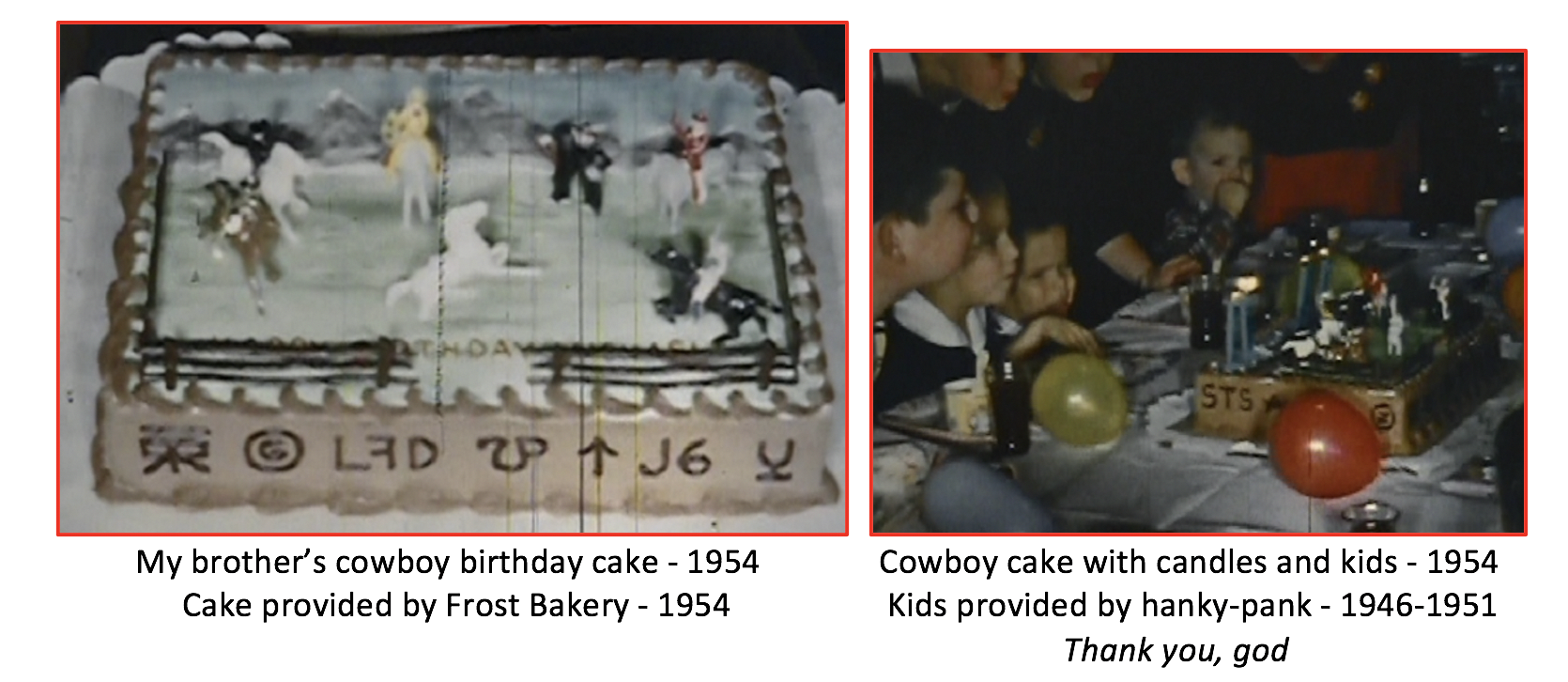
Another patient that my dad didn’t charge for fixing them up was a close friend or relative of the William Sanderson family. William Sanderson was the fine artist that painted Private Lives shown earlier in this opus. He had a wonderful, almost fanciful, style. He painted realistic paintings, as well. Seems like all the real good artists go through periods of one style or focus, and then change to another, and back again. And then sometimes onto something completely different altogether. He painted in oils and watercolors and there were a lot of pencil drawings. Sanderson was already really well-known nationally when he showed up at our house and painted a large mural in oil on our dining room wall in the late 1950s. I remember him coming in the back door to our house for a couple of weeks as I watched the mural grow and reveal itself daily.
A couple examples of Sanderson’s paintings are shown below. The one on the left, named Fort Garland, Colorado, completed in 1950, hangs in the Smithsonian in Washington DC. The one below on the right is called The Woman Of The Plains. Sanderson painted it in 1947. Plainswomen were tough birds with eyes that had encouragement sucked right out of the sparkle. If Rusty, sitting on the barstool next to me in 1975, had been a woman instead of being a large man, this painting captures the raw enthusiastic demeanor that he carried with him into Lytton’s Corner bar, after a tough day on the job; the plains woman in the painting is said to dream about hand cream and soda biscuits.

At age seven, the difference between a house painter and a fine artist was unknown to me. So while the whole mural painting was being created on our dining room wall, I couldn’t figure out why any painter would choose to paint a wall with Sear’s flat off-white with a 114-B base, applied by roller and pan, over painting a cool scene like Mr. Sanderson was painting on our dining room wall. My mom made him black coffee and offered him cookies from Miller’s Supermarket and small cakes from Frost Bakery. My mom didn’t bake. Well, she would bake a meat loaf, but she didn’t bake cakes. We did, however, have one of those metal cupcake pans. The ones that could bake twelve (12) cupcakes at a time. But it was really rarely used. I think it mainly had cobwebs growing in it. There was a little rust. Much later on, as her life progressed, she used the cupcake pan with its twelve (12) cupcake caverns to mix artist paints. Different greens and yellow. That’s what happened in the end to the cupcake pan. That was a lot of years ago. The metal cupcake pan was really old by then and no longer close to being what anybody could rightly call a new or young cupcake pan. You don’t need to feel in any way that the cupcake pan was at all mistreated.
OK. Full disclosure. Now that I thought about it a little longer (basically, at all), my mom owned three (3) metal cupcake pans. I guess it would be proper to say our family owned the three (3) metal cupcake pans. My mom didn’t use any of them. And they were just enough different from one another that they wouldn’t stack properly. I hated it when I had to move the cupcake pans out of the way to get my mom something buried in the back of the cupboard. They just never felt right when putting them back. There was no satisfaction in it and there was no sense of completion. Kinda screwed up the day for the next five or ten minutes when I had to deal with cupcake pans that didn’t nest within each other. There should have been government manufacture guidelines. One of the main sources of annoyance growing up was having to deal with three cupcake pans that didn’t nest. It was like fingernails on a chalkboard without the sound but delivering the same chill.
The dining room mural Sanderson painted was a massive fantasy outdoor scene with big green fronds of slightly different hues and storybook sidewalks leading from one colorful house to another with a fantastic blue Colorado sky marbled with distant storm clouds. On the far left was a precarious cliff with yellow frond-flowers that dipped down to a dark blue bay. I never tired of staring at Mr. Sanderson’s mural. We had other ‘Sanderson’s’, as my dad would call them. Below are a few paintings of his that were part of our family collection.
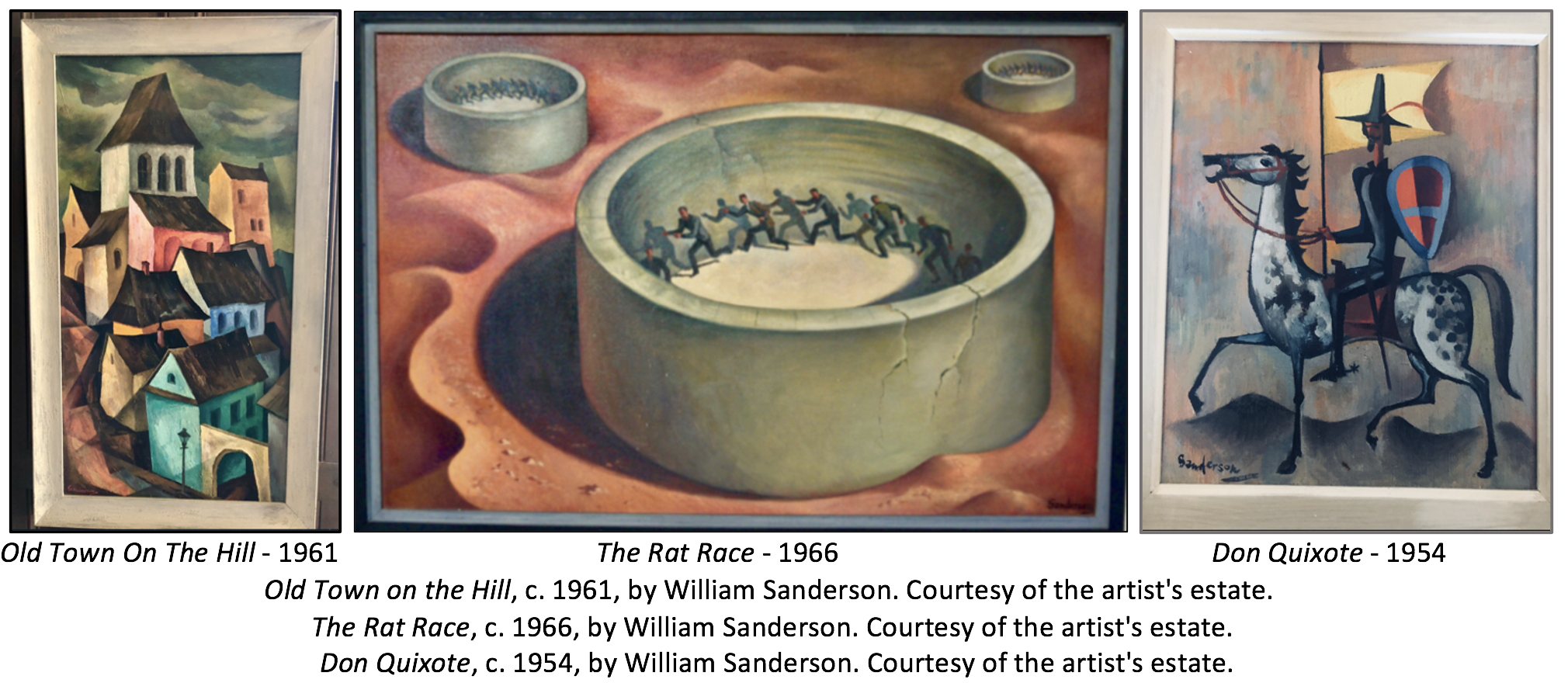
As for the giant dining room mural painted by William Sanderson, there are no snapshots. Zip. Nada. I’ve loaded home movies. I called my brother. And I called him again a second time because he didn’t answer the first call. He probably wasn’t at home, ok? The lack of a single shot of the dining room mural is an astonishing failure. Basically, we grew up with an original William Sanderson dining room wall and no one even has a single Kodachrome of any part of it. It was most similar to Old Town On The Hill. Except eight times wider and six feet tall and lots of foliage standing on hillsides.
Back then, we only took pictures of things we might not ever see again, like volcanoes on vacations in Mexico or Hawaii, rather than take pictures of things we know we won’t see again, once we are gone, like the inside of our own home. I guess we were supposed to remember how many steps there were going here and there and what pictures were hanging at what locations and how the furniture was arranged and it was for us to remember what the warning labels said hanging from the radiators.
I don’t remember exactly how I got to know Charlie Johnson, but he was a fine artist in his own right; just not well-known, as he was only two years older than I. He was in George Kawamoto’s class, one year younger than my brother. He hadn’t become broadly known and admired like William Sanderson, quite yet. I’m not even sure where I first met Charlie, but my brother’s girlfriend, Sara, was Charlie’s older sister so that was the likely root of the connection. Charlie looked like Leon Russell from the 70’s with long, long hair and had an infectious almost-devilish smile that girls loved, and an overall look that seemed to control them. I have never known another guy that had so much impact on women. And it wasn’t just looks. Charlie had a charisma and charm and a laugh and creativity and uniqueness that hypnotized women, and all mixed together, that was Charlie’s ammo. I don’t believe that the girls could even help themselves.
He was a fine artist that did art a little differently than most normal artists, if there are, in fact, any normal artists. They certainly seem to all relish in their belief that none of them are normal. It’s one of their main things. Fine artists think they are all a little twisted and they wear that belief as a badge of honor. Their secret club. I wasn’t a fine artist at all, so I didn’t really hang out and get to know other fine artists and wasn’t in any club like that. I never took a painting course and had I tried I would have been laughed out of the class following whatever the first assignment may have been. It wouldn’t matter in the least what the assignment was.
As I have mentioned in an earlier volume, one time growing up, and only one time, I was given an art task. To be clear, it was an art assignment for our entire 4th Grade class, not just me. Every kid was asked to paint a dinosaur on a gigantic paper-roll Jurassic panorama. My assignment was to paint a brontosaurus on the 30-yard-wide paper scroll that would be hung along the entirety of a long school hallway. I knew while I was painting it that it was pretty bad; unacceptable, really. My scale was all wrong compared to the other dinosaurs and the giant Jurassic plant life and the flying Pterosaurs. When I had completed my brontosaur, the other kids said, ‘What is that?’, and I said, ‘It’s a brontosaurus,’ and they replied, ‘It looks like a scrawny chicken.’ And they were dead right. I never overcame that failure. I have lived the entirety of my life knowing I am one of the worst artists in the world with no ability to draw anything. Accept maybe a scrawny chicken. There was very limited succor drawn by me when it was announced years later that dinosaurs and birds were closely related.
The most watched Ted Talk was given by Sir Ken Robinson. You can find it on YouTube. He was a wonderful, gifted, English educator extraordinaire that believed creativity is being undervalued in education and his work was so important that he was knighted. In his first talk (he gave three (3)), he tells us about a little six-year-old girl that was painting a picture. When asked by the little girl’s drawing instructor what she was painting, she replied, ‘It’s a picture of God’. When the little girl was told ‘But no one knows what God looks like’, she replied, ‘They will in a minute.’ If only I had the confidence of that six-year-old girl when I painted my brontosaurus, perhaps I would not have shied away from art. The reaction to a child’s creative endeavors can have a lifelong bearing.
There were tests that were given to us and measured by school administrators while we were growing up that were used to evaluate us in many different ways. In 6th Grade, final year at Teller Elementary School, all the kids in our grade were given what they called an aptitude test. They explained that an aptitude test was the type of test that we couldn’t study for at home in advance. It sounded like the best kind of a test to me ever and I was all for it and excited to participate knowing that I was probably going to perform quite well. The test included different sections and one of the sections had a series of multiple-choice answers from which to choose from questions that referenced three-dimensional boxes or shapes drawn on the page flattened to two-dimensions, with dotted lines indicating where to make a fold. The four graphic choices from which to choose the correct answer included the correct graphic as to what the flattened shape would look like once it was folded.
I now jump ahead. I couldn’t do it. I guessed on every one of the folding box answers. My aptitude for the test was low and I did a remarkably poor job of guessing. I think even worse than guessing ages or guessing gum preferences. After completing the test, the results were reviewed individually with each student. They told us what types of things we could be good at, later in life. I overhead comments made to other students, like ‘You’d be a great doctor.’ Or ‘You could be a pilot.’ Things like that.
When my review came, I sat down, and two facilitators sat on the other side of the table from me. One was a man and the other wasn’t a man. The one that wasn’t a man was a woman. They looked at one another for a few seconds before sitting down. I watched them look at one another and then, as if choreographed, sit down in unison. The reviews took place in the school lunchroom. Immediately prior to beginning my review, a couple kids were arm wrestling at a nearby table and it got out of hand and the woman that was about to give me my review got up and went over and straightened it out and returned to the table opposite from where I sat. I hadn’t seen any of the other kids being reviewed getting two counselors performing their review. I thought that seemed encouraging. Once the female reviewer woman sat back down, my two reviewers were looking down at some paper or evaluation guide or their notes or my test or were reading aloud from whatever it was they were looking at, but I was told by the female reviewer woman, in a curious nasal mono-tone, ‘The results from the test indicate that you could rake dirt.’
I’m not going to provide to you, Dear Reader, a deep dive into the results nor am I going to perform a self-analysis here relative to the tests accuracy or probability. I’m not going to do that. But was the test scientifically proven? Was it given in a fair environment? Were the administrators professionally trained? Could they provide proof by presenting their diplomas? What specifically do we look for to determine if the documents are forged? What kind of childhood did they have? Were they repeatedly beaten up as kids by their siblings? Were they in Scouts – either Boy or Girl? At what age did they begin to walk? Anything unusual about them we should know about? Do they have an ‘inny’ or an ‘outy’? And finally, does the cowlick on their heads swirl clockwise or counter-clockwise? Or anything along those lines. I’m just reporting. That’s what she told me. ‘You could rake dirt.’
I could only assume that I’d gotten the lowest possible score. The score that wallows in the basement. Didn’t the reviewers realize that raking dirt didn’t ring with much positivity? Well, they must have known. How could they not know. They didn’t look thrilled for themselves, much less me. And I’d never seen a teevee show or a movie or an ad on any teevee show, of any guy smiling, out in a field, in the heat, under the sun, wearing a straw hat, with his head cocked toward the camera lens, as we watch him rake dirt. That film footage had never been shot. Additionally… there were no ‘celebrity’ dirt rakers when we grew up. No John Wayne-types raking dirt in Westerns. It’s not a job that any of Jimmy Stewart’s characters had in dramatic or suspense films. No Munchkins off to the side raking dirt while singing Over The Rainbow songs. Basically, there were no dirt raking models to emulate, to mimic. To study. To learn from. From whom to gain an edge. We’ll return to this later. To the conclusion that the reviewers had told me that I could rake dirt. Neither reviewer looked me in the eye. We shall see whether I could rake dirt or not.
Charlie was an exceptionally talented fine artist without much of an internal filtering system. He lacked morals which was coupled with a subtle eye toward the bizarre or macabre.
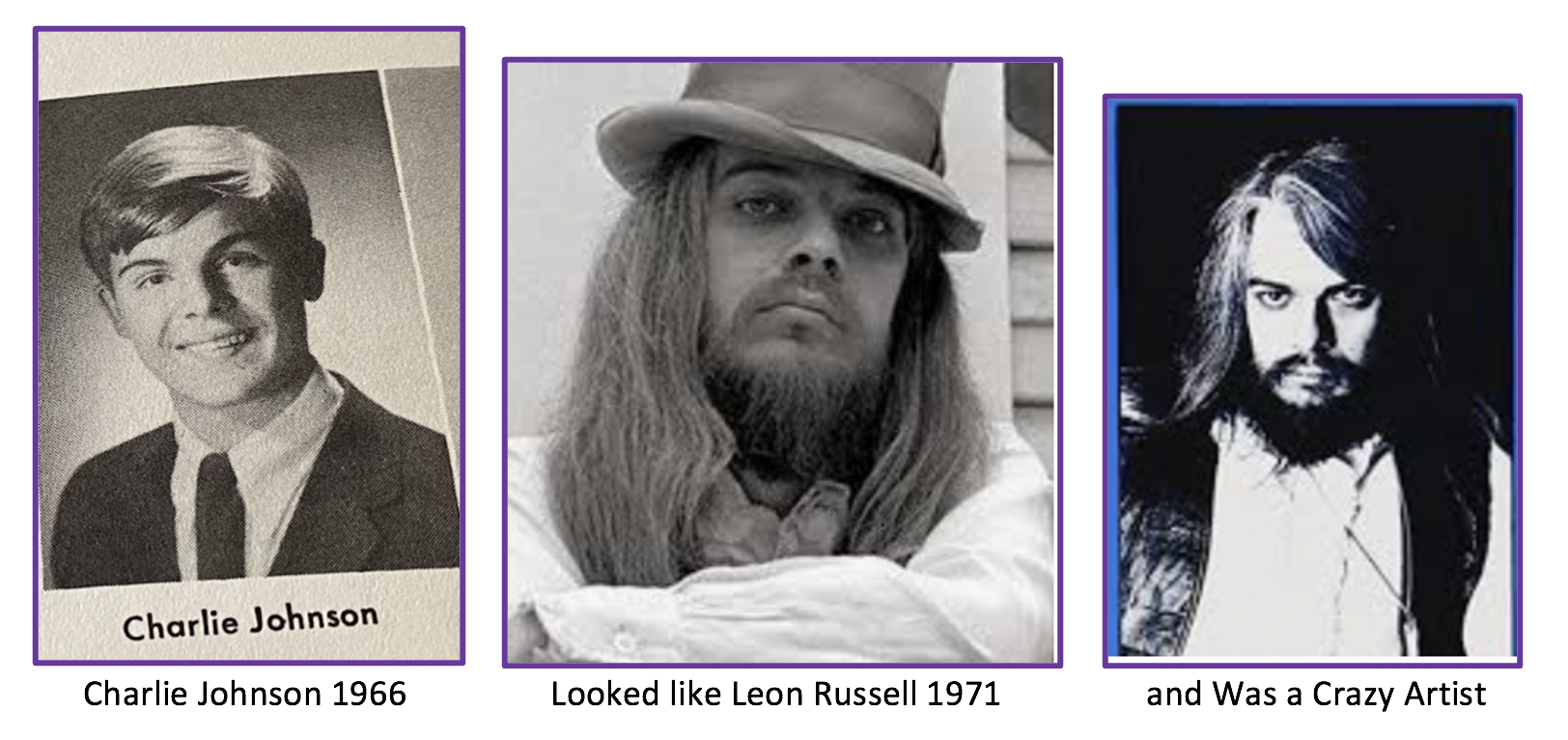
Like many other fine artists, Charlie developed a wide swath of skills which he applied to a variety of art mediums. One of which was that he painted 18” x 18” portraits on stock canvas and gave them away to the subjects. Exclusively girls. By all accounts, they loved their portraits. Charlie never did a portrait of a guy that I ever saw. And then he got the inspiration to paint a portrait of Kitty Carlisle, one of the women of the cast of the 1950’s popular teevee game show, To Tell the Truth. The show introduced three contestants claiming to be the same person. For example, the first contestant would say, ‘My name is Paula Newcastle.’ And the second contestant would say, ‘My name is Paula Newcastle.’ And the same was declared by the third contestant. Of course only one of the contestants was the real Paula Newcastle and the purpose of the show was for the celebrity panel to figure out who was, in this case, the real Paula Newcastle. The mechanics used to make the determination was through a series of searing questions that the celebrity panel would ask the contestants. The celebrities would evaluate the answers and when time was up, each would vote for contestant #1, contestant #2 or contestant #3.
At the time Charlie painted Kitty Carlisle’s portrait, Charlie, his girlfriend Karen and I were renting a red brick house at 1560 Grape Street in Denver. It was two doors down the street from Randy Guber’s Aunt Fay’s apartment. The portrait he painted of Kitty was carefully crafted and you couldn’t help but look at it without frizzling your brow as though trying to figure something out. There was something odd about the painting… at least it seemed that there was something odd… and you would examine it trying to discover what was wrong.
Kitty was the female lead panelist and pseudo-star of the show. She was the Grand Dame. Each week, host Bud Collyer pursed his lips into the shape of a pitted maraschino cherry and spit out her name with love and flowers into the airwaves and the canned audience would cheer wildly. Once announced, Kitty would enter the stage from the side and throw her head back as her dress ballooned as if to say ‘Here I am, World. Yes, it’s ME.’ and proceed to go and walk to her seat, always one stool in from the left of the four celebrity stools. Although calling them four celebrity stools sounds judgmental. Kitty’s photo below isn’t that dissimilar to Charlie’s painting, although she was wearing a similar, but red, gown in the painting. Lipstick: same. Hairdo: same. Earrings: exact. Expression: mirror image.
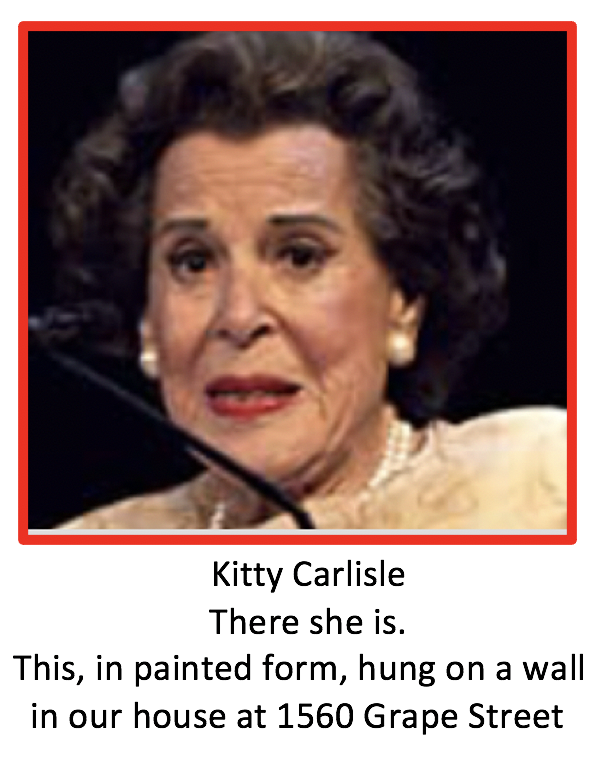
Charlie was exceptional at capturing expressions and in his portrait of her, she wore the same startled look as the photo above. That’s where it started. For five months, Kitty lived alone, by herself, on our wall. Eyes always open. Blank stared. The star of To Tell The Truth.
The picture you see above is what we looked at on the wall in portrait form where the teevee was located. Which was in the basement of the house on Grape Street, where we always hung out, where everything happened. There was a full kitchen down there. My bedroom. Bathroom with shower. A knotty pine paneled living area with the teevee and stereo with speakers and a couple worn couches and a couple tie-died blankets and a bean bag chair and on the wall, Kitty Carlisle’s portrait as created by Charlie. Looking at us. She didn’t look like she could think.
After complaints as to the singularity of showing only one painting and suggestions and pleas to add something more to the wall art, Charlie painted the two remaining female celebrity panelists from To Tell The Truth. Polly Bergen, seen in the middle below, followed very quickly, a few days later, by a knock-out look-alike Arlene Francis face-on, also seen below. Charlie faithfully captured Arlene’s orange wave of hair and lips that took the shape of an orifice that had lost its sphincter. Polly and Arlene were second and third bananae to Kitty on To Tell the Truth.
I carry a belief even to this day that we were probably the only ones to have a set of portraits, our tryptic, of these three magnificently-talented women hanging on the wall in our house. This, of course, was before our Exodus to California. Upon careful inspection of Charlie’s paintings, not easily recognized even with a simple stare, observers could notice that each portrait had one eyebrow missing with a small, punctuated bullet hole between their eyes, but you could look at them 1000 times and never notice. Below are photos, both eyebrows attached.
 My job at the time of the tryptic creation while living on Grape Street was being a COM Operator making a modest wage at US Datacorp. It was the same type of job that I had at Zytron, as earlier described.
Karen didn’t have a job at that time. But her father, down in the Big Easy, New Orleans, worked for Exxon. He bolused a tobacco plug in his cheek only during waking hours and Karen asked him in southern girl daughter speak to get Charlie a job at Exxon. What Jake, Karen’s dad, found for Charlie was a job north of the Arctic Circle driving big Caterpillar tractors for the Alaskan Pipeline. Charlie didn’t recognize the possible insult being offered a job five thousand (5000) miles away. He took the job and would be gone for a few weeks at a time. But he made a lot of money, so Karen just sat at home with her cat, Bonny, waiting for Charlie to come home on his breaks. Exxon flew their Alaskan Pipeline workers anywhere they lived.
Charlie wasn’t the most employable guy in the world. I can’t imagine him working for even one day without getting completely distracted and interested in something else. Karen told me something that was told to her by her dad. Apparently the second time Charlie was up in the Arctic doing fancy Exxon work, he drove one of their largest Caterpillar tractors near to the edge of the thick ice and just left the tractor there and the ice cracked and fractured, and the Caterpillar tractor disappeared beneath the icy water. Those tractors weren’t timid and they had a considerable cost to them. But Charlie avoided any financial liability and they didn’t deduct nothin from his pay. According to Karen.
Charlie said the food they served was flown in daily and real expensive but he didn’t have to pay for that, either. It was paid for by Exxon, and he’d traverse the meal line and say, with repeated resignation, ‘O.K. I’ll have the prime rib, again. And a few pieces of the lobster. And the fresh pineapple.’ For breakfast they’d make any choice of eggs and there was bacon and back bacon and turkey bacon and linked sausages and patties and about fifty different juices. And he said he could go back and get more. And each time he said he would get a new clean plate and another napkin of silver ware. Charlie said they had something called hominy and corn meal pancakes and chitlins and weird Southern cuisine. And so Charlie thought he was eating pretty good up in the Arctic Circle.
When Charlie was on his break from the Arctic and back in town, in Denver, he’d paint and smoke a lot of cigarettes and drink a lot of alcohol. I don’t remember Karen smoking, except on some odd occasions. She would drink, but not like Charlie. Few people could drink like Charlie. He set up a card table on our outside front lawn, which wasn’t much of a lawn – more gravel and weeds – and he’d always have some high alcoholic content in a glass, and he and Karen would play backgammon or cards if it wasn’t windy. Sometimes the people inside the cars driving down Grape Street would wave or the driver would honk and Charlie and Karen didn’t care. They didn’t have anything else to do. Charlie was on Arctic Circle sabbatical for a couple weeks each time.
After completing our To Tell The Truth tryptic, Charlie painted a mattress in the basement, where the teevee room was located, and I don’t remember what it was that he painted on it but everyone liked it. He painted it with acrylics. Everyone pretty much liked anything Charlie painted… or sculpted. It didn’t seem to matter which medium he used. He got thrown behind bars one night in Denver for something probably not too important, but he had dropped some windowpane (LSD) before being nabbed by the PO-LICE. He was behind bars when he started tripping. The next day, following his release, he said he had made a snot painting on the jail wall overnight and that the other jail birds/cell mates liked it. He told me he could have been friends with some of them. He said that pens and pencils were not allowed in the jail cells so it wasn’t possible to write down the phone numbers or other information about anyone unlucky to be there. So none of Charlie’s jail mates ever showed up at our Grape Street house.
One day in Boulder, while we were all endeavoring to achieve advanced educations at the University of Colorado, Guber and I walked over to Charlie’s house on the Hill. The ‘Hill’ continues to be a well-known area next to the university with coffee shops, beer halls, restaurants, Jones Drug and amenities that support the local residential area. I was living on the Hill, as well, while Guber was living down on 17th Street across the street from Boulder High School. There was a girl named Rici Peterson who was a senior at Boulder High who became my girlfriend for a short time. She invited me to her parent’s house for Thanksgiving and I accepted the invitation. In those days the Dallas Cowboys were the rage and Rici and I ate turkey watching the game together while her parents and her siblings and a bunch of her parent’s friends stayed in another part of the house. I remember when I drove to her parent’s house at approximately 1:00p, there were no other cars on the road. There wasn’t much traffic on the roads on major holidays in Boulder. On those occasions, Boulder was a ghost town.
So, as I was explaining, Guber and I went over to Charlie’s house to see if Charlie had any pot we could smoke and I knocked on his door and he called out, ‘Come in.’ Guber and I opened the door and Charlie was on his bed on top of some girl as though it was nothing, and mid-stroke, just pointed with his left hand to the pot on the desk and told us to just roll a jay. The bedsprings eeked and the girl oohed and Charlie ahhed all at the same time. It was like a chorus. And when I finished rolling the jay, Guber and I left and said ‘Thanks’ and the girl said ‘Anytime’. Charlie could get away with stuff like that. And the girls fell deeper in love with him. It may have been influenced by something called confidence, which I didn’t know much about and neither did Guber, but I think it was really more what Charlie looked like and how carefree and unexpected he was about everything. Girls liked guys that were unpredictable.
Charlie took art classes at Boulder and for one of his assignments, he told me, he would stand on a corner on the Hill, wearing roller skates and a black cape and a black stovepipe hat and glitter (he may have arranged his outfit after going to a Dr. John concert), and ask girls he’d never even met before that walked by if he could papier-måçhe a mold of their breasts for an art project. And they’d just look at him and size him up and say, ‘Ok. Where and when? What’s your name?’.
And Charlie would tell them his name and where he needed them to go to do the mold sculpture, to participate in an art project, and they would show up. He’d just give them the address to his house on the Hill where he had let Guber and I roll the joint. Guber and I watched two (2) girls go inside Charlie’s house together from across the street. Artists have it good. They can say anything is an art project. It’s a good gig if you have talent… and look like Leon Russell.
Charlie had confidence in high school that I would normally have believed to only exist with the star athletes or star academians. Charlie was neither. His father had retired and moved the family to Ankara, Turkey for Charlie’s junior and senior year of high school. One high school classmate that attracted his artist’s eye was an exceptionally well-known, well-respected girl. Her name was Beth Fisher. It still is to those of us who knew her back then or knew of her, except now she has an added marriage last name now. Charlie signed her yearbook and she told me she remembered that Charlie asked her for some of her skin. I thought that Charlie could easily have done that and really don’t know anyone else that may have the courage to write something like that. Even though he was leaving for Turkey, it seemed a bold move for someone in 10th grade. Here’s his transcript including salutation:
Hello Beth, The lone Turk greets you. Did you know that the world’s best sppitter is Yohon Shamulte of Denmark? I find you irresistable to Turkish people. If you ever lose any skin or anything, send it to Turkey so I can remember you better. I Love You Chas.
He barely even knew her.

C H A P T E R 4 ::::
Forged Inspection Sticker – After Hours Hashish – Patrol Car – Precinct Visit – Urine Test – One Call – Clanging Gate –  – Single Mattress – Dental Advise – Tuck – ‘Hooper’, ‘Hooper’ – Paddy Wagon – Cousin Joanne
Having concluded the general survey of background scenes and primary actors, it is now necessary to provide a more detailed account of the events that unfolded rather than by condensed narrative.
Back in Denver, 1560 Grape St, end of 1974, early 1975, prior to our exodus to Northern California, a number of consequential factors converged that were of a quite disruptive and damning nature. Below is a recent picture of the Grape Street house, although not captured by my own Brownie nor by my own eye. In any event, the house appears identical to when we lived there other than some cursory corrective notes found as captions.
 To begin humbly, my car, a 1968 GTO, was reliable. Which is to say that it started. Often with the first twist of the key. It traveled forward when the gas pedal was applied and functioned in reverse without issue. It did all the things a car is supposed to do properly: steer, stop, signal, heat, defrost, air condition and buckle. The windshield wipers worked flawlessly and when turned off, closed up and hid below the outer windshield casing awaiting further instruction. The headlights were straight and bright and had covers that lifted when turned on, and the front bumper was solid rubber that didn’t dent when run into. The inside passenger-side vanity mirror light never failed. Vents and temperature controls would earn standing ovations.
But the car couldn’t pass the annual tailpipe emission inspection required by the Denver Police or the county police or the state or whomever it was that imposed the car exhaust limitation requirement. I knew that. Or at least I believed that and behaved as though it were true. I’d been through the drill before. The car had a big throaty engine that Willard audibly diagnosed as running on 6 of its 8 cylinders. So, although it provided all the functions demanded of it, it had some muscle car problems. For starters, it ate gas like it was Jane Frisell’s chicken fricassee. Jane was Bill’s mom and fricassee was just one of her delicious dishes.
Smog levels in the air above Denver had been examined, measured and legendarily documented as the highest in the country – with much of it originating from automobile exhaust. And that needed correction. Hell, the air above Denver looked brown so no one was surprised. The winner of the unhealthy air quality award was going to be Denver or Los Angeles and that year, Denver had more brown particles hovering in the sky than did Los Angeles.
So there were legitimate reasons to monitor car emissions annually to keep them within guidelines so that we Denverites could hope to someday return to air that wasn’t tinted. And I knew it, but I wasn’t willing to spend whatever it might take to bring the car up to snuff. I didn’t have the dough. Not then. And this was Denver – the city about which Frank Zappa wrote a ballad detailing how screwed up the cops were after one visit. It’s not a well-known tune, not super famous, but that doesn’t mean it wasn’t an accurate depiction of Frank’s experience. The Denver Police did have a reputation that extended beyond the back alleys of Aurora and the dirt roads that climbed the base of the foothills. Their aggressive reputation carried all the way east to Kansas City, up I-25 to Cheyenne, Wyoming, south to Albuquerque, New Mexico and west into the city halls and shanty houses in small towns like Meeker, Mesa and Montrose.
The car exhaust inspection stickers were 2.5” squares with a big number 1 thru 12 printed on them. They were color coded by year and attached to the bottom left corner of the inside of the windshield in front of the driver – a location very prominent that could easily be spotted from distance. And it was at these stickers that found the police peering intently at the beginning of each month. Either your car showed a valid inspection sticker… or it had expired… or it was missing. It was really quite an easy catch by the police – a gimmee. The cops simply hunted for cars being driven with a prior month’s expired sticker or for those that had none to display. Other lawbreaking violations by Denver’s miscreants were basically ignored at the beginning of each month while cops hunted for cars being driven with the prior month’s expired sticker. It is viewed as an exaggeration, but to make the point, it was often said that if a bank had been robbed at the beginning of a month… or a pedestrian had been shot in the street… or Floyd Little’s #44 jersey had been stolen from inside his locker at Mile High Stadium… that during the investigations into these heinous crimes, while yellow police tape continued to mark off the crime scene and detectives wore six-corner hats and badges and batons… that if any car with an out-of-date inspection sticker was spotted, the cops would quick-footedly race to their patrol cars with their hands on their holstered guns, jump behind the wheel, ignite the cop car vrrroooom engines, turn on their glaring lights and deafening siren, and accelerate after the inspection sticker offender, postponing whatever investigation that had been underway.
So, my friend David Witman and I knew that we had to create a pretty convincing inspection sticker forgery to put on the inside left of my windshield just above the dashboard. And so we did. Witman hatched the plan and he kinda directed its operation greenlighting it to go-ahead. Of course, it wasn’t his car and it wasn’t his neck if it didn’t work, but I knew he was properly disposed and working honorably on my behalf. The colored construction paper we used as the backing for the big number wasn’t perfect in color but it was close. We thought. We believed it would not draw attention without serious up-close eyeball stuck to windshield inspection. Still, it was nerve-wracking for me driving to work with the forged inspection sticker, but I reasoned that when I had the money, I’d find out how much it would cost to extinguish the white smoke poofs emitting from my tailpipe, get the work done, and earn the proper date-stamped and signed documentation to get a real Colorado-grade inspection sticker. I was driving to work with the dashboard window forgery for a couple weeks before that night when things started going haywire.
I finished my swing shift at US Datacorp, even stayed a little longer, and punched out at 12:30a rather than 12:01a like usual. The graveyard shift COM operator had called and said he’d be late due to the treacherous roads from the winter snow that dumped earlier that day. It was night time on Thursday so I only had one more shift for the week. After leaving work, I drove to the house of a guy who was a friend of a co-worker. He lived in south Denver, just a couple blocks east of Broadway. The co-worker had called him so he knew I was coming over to try some hashish with the perchance of purchase. It was a blonde hash and I took a few hits and got more stoned than I had thought I had because the ‘high’ continued accelerating long after the last inhale was chased by the exhale. I bought two grams, finishing the transaction with cash, and was pretty wasted when I left, only twenty minutes or so after arriving. I was in a hurry and jittery from having illegal drugs in my car, on my person, in my pants pocket, and anxious to get home as I lived across town at 1560 Grape Street. It was already, by that time, close to 1:30a. The unplowed side-streets demanded strict attention while driving.
I came to a complete stop before turning right onto snowy Broadway which only dimly reflected the few commercial lights that were on at the indecent hour. There weren’t any other cars on the streets anywhere. I looked for the blue light cast by snow plows but they must have been working in some other neighborhood at this hour or just weren’t working. I was heading north to get to 6th Avenue, which was a main artery with timed lights that was the quickest and most direct route home. Snow flurries swirled lightly, like a filigree mist, making it hard to see the individual lanes on Broadway, which had been unevenly plowed earlier in the evening. Certainly before the midnight hour. I hadn’t gone more than a block on Broadway when I saw, reflected in my rearview mirror, a police car speeding for and turning onto Broadway, and heading my direction. Within moments, his red lights were flashing. No siren. Just red lights reflecting off the condensation circles of my back windshield and off the defrosting snow and ice. I pulled over the best that I could, given the circumstances. The snow that had been plowed earlier was piled up on the sides of Broadway and barricaded the curb. It was quite high and prevented proper parking.
I was nervous, of course, as I was stoned, and I had blonde hash in my pants pocket, and he was a cop, and it was winter, and freezing outside, and I don’t know why he was pulling me over. The erect, hefty policeman gets out of his car and walks up to mine and I’d already rolled down the window the second I saw his flashing lights to ‘air out’ the car in case there was any smell of hashish… and to wake myself up. To be alert. To be ‘on my game’. To survive. To win.
Cop: ‘Can I see your driver’s license and registration?’ I didn’t ask to see his driver’s license and registration. That would be the wrong thing to do. He had a southern accent.
Me: ‘Here you go.’ I give him what he asked for. ‘Did I do something wrong, officer?’
Cop: ‘You were swerving between lanes,’ he said curtly. And with that, he took my documentation and returned to his cop-mobile.
I watched him through my rearview mirror as the inside light of his car was on and he was using his coppy walkie talkie to speak to his precinct headquarters and it took fifteen minutes before he opened the door of his car, got out, and walked forward, returning to my driver-side window.
Cop: ‘There’s an awarran fer yer arrest, so I’m gonna bring ya into headquarters.’
Me: ‘What? How is there a warrant out for my arrest?’ This was totally unexpected.
Cop: ‘Unpaid movin vilations, sir’ he answered curtly.
Me: ‘Really? I didn’t know there were any of those.’ Being stoned didn’t make this encounter with the fuzz less troubling. My mind was racing… I think.
He didn’t directly respond to me. But he told me to stay in my car. He told me he was going back to his cop-wagon to call the tow truck company to come impound my car.
Me: ‘Can’t I just park it on the street over there?’ I pointed to a wonderful spot just around the corner, off Broadway. It looked promising. And I was if anything, hopeful. I didn’t want them to impound my forged inspection sticker automobile.
Cop: ‘Nope. We’re going to have to do an impound. Stay in your car.’
With that, the southern accented cop returned to his patrol car to make his call to the towing company. While he was sitting in his car, I thought that I needed to get rid of the hashish in my pocket in case they search me wherever he was going to take me. I had never been taken into custody before, but I’d watched teevee and seen movies and felt I had some idea what was in store for me. But I also realized that the police might search my car and I couldn’t leave the hashish in the car, and I couldn’t make any rash movements with my arms like throwing it out the window. I could see him in his cop car through my rearview mirror, but not well enough to know when and if he was looking at me or my direction. So, with as little arm and shoulder movement as possible, I took the hashish out of my pants pocket and put it down my pants into the crotch region of my anatomy.
A few minutes later, he turned the flashing red light off and gets out of his vehicle, turns his head utilizing neck muscles both directions as if stretching, and returns again to my GTO’s driver’s side window.
Cop: ‘I’m gonna have to put youz into the backseat of my vehicle while we waits here for the tow. I can’t leave you in yer car. Hand me the car keys, please?’ This was getting to suck more and more. I hand him my keys. He hands the keys back to me.
Cop: ‘Please remove the other keys from this here key chain? I only want the car keys.’
So, I noticeably fumble trying to separate my house keys from the car keys and was having trouble since my fingers were almost numb from the cold, and I was stoned, which in this case, was not helpful. After handing him the removed car keys, he led me back to his patrol car through the snow flurries and icy Broadway street. He opened his backseat passenger door and before directing me in, told me to turn around and face the other direction. He then securely fixed handcuffs on my wrists. Behind my back. And then helped me into his car and closed the door. There was no door handle on the inside of the backseat of his car. I hadn’t known that before. Some cop in the cop hierarchy had been doing some smart thinking.
He didn’t get into the cop car at this point, but instead returned to my car. His frozen breath was noticeable as he walked away. I was worried that he’d notice that the inspection sticker was a fake. I also worried that having the hashish stuffed into the crotch region of my body could become a real issue if they strip searched me wherever I was going. Would I be able to throw the hash away while walking from the cop car to the cop precinct headquarters building? There wasn’t a clear ‘Yes’ answering that question in my mind. So I see him walking around my car, looking at it, no, more, much more… he was examining it. He had a flashlight in his hand that he had taken from his cop-issue pants belt and he was shining it here and there at my car. While he was engaged in his detective search, I somehow managed to get my hands reached into the crotch area of my anatomy, even though my hands were cuffed. I grabbed the hashish with my fingertips, then forced it into the crevice behind me between the car seat I was sitting on and the back of the seat. I didn’t know what else to do. There didn’t seem to be a lot of options. It wasn’t multiple choice, really. Only two choices. Keep the hash or ditch the hash. I felt better when it wasn’t on my person, when it was no longer warm and hidden in the crotch crevice area of my anatomy. It took a Houdinian effort to manipulate this maneuver wearing handcuffs. Indeed, they felt like they were cutting into my wrists with all the strain and stretching required.
The cop was shining his flashlight inside my car at this point and had encircled his way to the windshield in front of the driver. Properly positioned, he was shining it directly at the inspection sticker. I could just tell. He looked to be reading it. He certainly stared at it intently and held his position for more than a full minute. He moved his head closer to my windshield which reduced the distance from the forgery to his eyeballs to approximately three-inches. I knew I was in trouble. This was one of the most heinous violations that any of Denver’s citizenry could become engaged. And he had my car keys which would allow him instant access to a reach around to peel the forgery from its position.
And then… he moved on, circling the car some more, shining the flashlight. Doing his job. The way cops do their job. Like pros. He didn’t seem to notice anything weird about my inspection sticker. And so we waited.
Once the tow truck driver arrived, the cop drove off to the headquarters with me hand-shackled in the back seat. We didn’t wait for the tow truck driver to connect my car or anything. It must have been 2:30a by this point. We get to the destination station and I’m brought inside and there was some activity indoors, in the warmth. A cop with a badge that had the #15 on it walked by. His name was Joe. I know that because some other smart cop called out from a room somewhere down the hallway:
Hall cop: ‘Hey Joe.’
And Joe yells back: ‘Yes?’
Hall cop: ‘How do you spell Boulder, anyway?’
And Joe yells back: ‘B-O-L, uh, D-E-R. Just like it sounds.’
Hall cop reacts stupefied: ‘Ya. That’s what I thought. This moron we hauled in an hour ago put a ‘U’ in it.’
Apparently, they had nabbed some kid from Boulder and from this verbal hallway exchange, I knew I wasn’t dealing with good intelligence in this office. I figured the cop with the #15 badge, the one called Joe, must have been on the force a long time to have that low of a badge number. It was my belief that he should have known how to spell Boulder, a major university town just thirty miles away.
The indoor cops direct their attention to me and tell me to stand where there are height lines painted across the wall and they snap my picture head-on and side-view. Next, a cop comes up to me with a finger-printing kit and rolls the thumb on my right hand and then the index finger and then the middle finger and then the index finger and then my thumb again and repeats the exact sequence with my left hand. In both instances, the finger-printing genius printed my index fingers and my thumbs twice on each hand – rather than the ring fingers and pinkies labeled on the form. Maybe it was his first time. Maybe he was an idiot. Maybe the hashish was influencing my interpretation of him. Maybe I would have felt the same way about him if I’d been ‘sober’. Maybe I should pay attention to whatever was going to come next.
And then, the finger-print genius policeman gave me one tissue to clean the ink off of all my fingers along with a disposable Dixie paper urine cup and some jail prisoner clothes and points to the bathroom just ahead. He tells me that the sample is used to detect drugs in my system, and he named about ten different ones that the current test could identify. I entered the bathroom while he was still rattling off names off his list and in the process, he corrected himself a couple times, trying to get the name right. I hadn’t even heard of some of the drugs or he couldn’t read them properly or he had a peanut butter sandwich stuck to the roof of his mouth so his enunciation was poor. Was the guy a member of Iron Butterfly? Like many things, it was probably a combination.
There was no one in the bathroom but me. The cop didn’t follow me in! While in there I only hesitated momentarily as I remembered that in the movie Alice’s Restaurant, Arlo Guthrie had a similar jail house experience, and he just watered his urine sample down to dilute it, and it worked for him. So that’s what I did after changing into the ill-fitting prison garb. The pants were too long. It happens all the time to me. A constant dilemma. Often, after buying pants, even jeans, or cords, the legs would have to be shortened to 28” or I’d have to roll the cuffs up real high – enough so to carry my sack lunch. This time it was the inseam. Rather than complain about the ill-fit, I rolled the pant legs up a bit and gave the cops the sample after also wiping off the purplish finger ink. Note to Reader: Arlo’s hit song about his encounter is titled: Alice’s Restaurant Massacree. The album and the movie were titled Alice’s Restaurant.
So, back out in the precinct hallway, having completed mug shots, finger-printing, a change of clothes and filled-to-the-very-tip-top urine-sample disposable paper Dixie cup return (it could spill if not transported by a steady hand), I was handed a bare mattress. Well, they didn’t hand it to me, it was resting against the wall just ahead. Since it seemed I was going to be led somewhere else, I asked the admissions cop a question.
Me: ‘Aren’t I allowed to make a phone call?’
He thought for a second: ‘I guess so. Do you have someone to call at this hour? It’s nearly 3am.’
Me: ‘Ya. I can call someone at my work.’
I couldn’t believe how smart I was. I knew from teevee that I had a legal phone call to make and by thinking fast on my now bare feet, I figured I would tell one of the guys at US Datacorp (the microfilm company where I worked the swing shift) a series of names and phone numbers to call on my behalf throughout the night and into the morning, if necessary. One of the persons on the list that I told my co-worker to call was the father of my friend, David Witman. His name was T-Bone Witman and he was a big shot lawyer whose office was down by city hall. I knew T-Bone was a high-fallooting lawyer and that he was my best shot of getting out. He’d taken me to a lot of Broncos games along with David and others, and he’d typically instruct a bunch of us to go ahead of him, through the turnstiles at Mile High Stadium, before he would hand the guy at the entry gate the tickets, and I think there were times where there were more of us that went in than he had tickets, but he knew the ins and outs of all the legal stuff. I knew I could count on him. He was T-Bone Witman. He was my ringer.
It’s awkward carrying a mattress by yourself. Normally, you’d drag it part of the way – or all the way, if possible. But it’s especially not easy to carry a mattress when you enter a blackened room and can’t see. The metal door to the jail cell loudly clanged shut behind me as I blindly entered the dark black hole, struggling to keep the mattress off the recently mopped, slightly wet floor. Even though the mattress was an exceptionally thin single, the quality of which would not have cut mustard for even Willard’s cabin – did you think they’d give me a Sealy® Posturepedic® king? – I struggled to drag that mattress. After entering the cell, my eyes couldn’t adjust to the pitch black quick enough. Some inmate or jail buddy or whatever you’re supposed to call them somewhere in the cell must have been awakened by the metal cell-door BANG and in a gruff, low, voice called out ‘What you in for?’. The guy’s voice was deep and he sounded like he wasn’t happy to have been awakened by the jail cell door clang – he sounded like longtime Denver resident and professional heavyweight boxer and convicted murderer Ron Lyle. I ignored the question as though I hadn’t heard it. I knew that if I said, ‘My car crossed the lines in the street,‘ that it would sound really lame and I’d be marked as a real sucker, a real loser, a person that deserves no respect… and maybe, a jail-cell target… translation: a butt to be challenged.
I set the mattress down somewhere, I still could see absolutely nothing, and lay on top of it and curled into the smallest ball I’d ever crawled into. I became a human roly-poly bug. And I listened and waited and worried and wondered. And didn’t fall asleep. But I guess I must have fallen asleep at some point because when I woke up, I saw that I was in a huge cell with about twenty other guys, all of whom were awake.
My mattress was the only one on the floor. All the others were on springs on beds and it looked like a teevee show army camp barracks with rows of beds and some of the inmates had pictures of their wives and kids on the wall next to their beds and some had playboy centerfolds above their beds between the spring and mattress above them if they were bunk beds.
I just tried to remain invisible and one of the inmates began advising me:
Brilliant inmate: ‘You git free dental care while yer in here, if ya ask ‘em.’
I remained silent.
Brilliant inmate: ‘You can even git teeth emoved… but don’t av too many emoved, or some of these guys will be on you that night.’
Seemed like good, sage advice. This guy was like a genius. But I didn’t want to tell him that I wasn’t planning to be here that long. I’d made that phone call hours earlier, that should, in my estimation, be bearing fruit any time. And so I waited.
By 8:00a, I was getting more concerned and had hoped that I’d be called out of the cell by a bail bondsman. At 8:15a, my concern crescendoed when a different cell-mate was called out of the cell by the guard and he looked back at all of us and smiled and said goodbye. That guy had a gold tooth and a couple missing in the front. Could have been a couple bicuspids, I’m not sure. I wasn’t then, and continue not to be, a teeth expert. At 8:30a, breakfast was brought in for everyone, and there was more and more activity going on in the huge cell. The residents were all active now. The breakfast was applesauce and peaches and a square bread-like concoction that they identified as a waffle. The utensil was a plastic spoon. I wasn’t really a big waffle-guy so I didn’t eat it and when it was clear I wasn’t going to eat it, one of the other inmates told me to give it to him in a mean tone, but I wasn’t judging anyone, I wasn’t looking to demand proper respect and manners, so I gave it to him.
QUICK SIDE-STORY: My friend, Bob Willard, had a few pets in his life. Started with the family dog when we were kids; an inactive, overweight, really dumb, slobbering black lab, named Tuck. Tuck was too large to walk through the Willard’s living room and when he wagged his tail, it would knock things over. Tuck didn’t seem well-trained. He didn’t know simple commands like ‘SIT’, which didn’t seem like it was asking too much for him to have known. All the other families’ pet dogs knew ‘SIT’. When I would go to Tim Crow’s house, if I told their dog, Susie, a small Border Collie, to ‘SIT’, Susie would sit. And Susie wasn’t even my dog. Even our dog, Sporty, knew how to ‘SIT’. And Sporty was a dirty matted-hair mutt that chased cars. But Tuck didn’t know how to ‘SIT’ and couldn’t chase cars because he was so overweight. Maybe he had a listening problem, too. One time when I was over at Willard’s house, Tuck just plunked his fat rear end down on Mrs. Willard’s fluffy tan living room cut pile carpet and laid a patch about four feet long right in front of us. I think I saw steam. I did. There was steam. It embarrassed me tremendously and I wanted to climb into Mrs. Willard’s cup and saucer fake-mahogany collection cabinet and hide, but it didn’t seem to embarrass Bob. He just called out to his mother, who was in the kitchen reading pancake recipes, ‘Mom, Tuck just laid a brown patch across the carpet, again.’
That was the Willard’s family pet dog, ‘Tuck’. But the pet I intended to ‘QUICK SIDE-STORY’ to was Willard’s own cat years later named Hooper. I wasn’t a cat-person and we had never had a cat in our family just like we never owned bright colorful Samsonite luggage, but when Willard was living in his grandmother’s house, out on South Gilpin Street, he had a cat named Hooper. The previous winter from the one that I had now found myself sequestered in prison, also included a lot of snowy cold nights and on one of them, Willard couldn’t find Hooper. It had snowed a couple days earlier but the ground was still covered with white, and the streets were still icy and discolored black and grey from car exhaust. South Gilpin Street was an off-the-beaten-path side-street that probably had never been plowed, ever.
So, Willard was calling out sweetly from his South Gilpin Street front door, kinda like a little angel’s singing voice, ‘Hooper’, ‘Hooper’, into the night freeze and was getting no response. Nothing. Bob Willard said he heard no mew; just silence interrupted with snow collapsing in clumps from the white, leaf-less, tree limbs. Bob struggled pulling on his winter boots and waddled out to the frozen sidewalk (he weighed over 350 lbs) and was calling out, ‘Hooper’, ‘Hooper’. Real sweet like. Syrupy. Not real loud because it was around midnight and he was just being neighbor-respectful. But he wasn’t getting any response. Still, no mew. So, he shuffle-footed up the sidewalk, toward the corner, calling out Hooper’s name real mellifluous with a cream topping, ‘Hooper’, ‘Hooper’, and finally, at the corner, out in the middle of the street, under the corner streetlight, but definitely still on South Gilpin Street, Willard saw what has become known as ‘a Hooper-waffle’. When the gruff guy in prison cell number two (2) basically ordered me to hand over my prison waffle, I thought of Willard’s cat, Hooper. I’d never really thought much about Hooper before that.
Back in the jail cell, time slowly crept forward in the morning but I was beginning to feel more comfortable. It was now 10:00a, and the other inmates were talking about this federal prison compared to that federal prison or Canon City federal penitentiary vs the penitentiary in Lawrence, Kansas or Alcatraz Island out in San Francisco Bay. These guys knew a lot about the federal prisons. Turns out a lot of them had personal experience. Had prior residency. Even so, I felt safer with them than with the cops. The cops had guns and all the power and they didn’t seem that bright. THEN… finally, my name was called at just about 10:30a, and I walked toward to the metal jail cell door and the guard at the metal door told me to go back and grab my mattress; so I did that. And I had less trouble carrying the mattress with the light on and was just glad that Witman’s father had finally come through to rescue me. This took far longer than what I had expected. But my step was noticeably lighter.
When I got to the front entryway of the police headquarters building, after dumping my mattress where I was told to dump it, there was a big policewoman waiting for me. She was wearing a police uniform that was real tight and she was real out-of-shape and her hair was bobbed on the back of her head what looked to be tighter than a cat’s ass. But I could still tell that she was a she. I was told that she was there to pick me up to take me to the county where the warrants had been issued for my arrest. I couldn’t believe it. Where was T-Bone or one of his henchmen? Or bondsmen? Or whatever they’re called? Didn’t my US Datacorp co-worker call anyone on the list that I gave him the night before?
The policewoman with the Pamplemousse figure and tight policewoman outfit handcuffed me, again, and pushed me into the back of her police paddy-wagon. There were two benches in the back of the paddy-wagon, one on each side, and she chained me to the one on the left and I had to sit leaning forward because my hands were handcuffed behind my back. She was a vengeful driver as I was being thrown back and forth and couldn’t use my hands to steady myself. My thighs alone did all the steadying they could do.
I didn’t know where we were going but I knew where we were because there was a small window on each side of the paddy-wagon and I could see outside. We went down a lot of streets, cutting across Denver. We drove by my cousin Joanne’s house, and I could see her husband, Howie, outside, shoveling their sidewalk. But I didn’t yell out to him. What was he gonna do? Run alongside the paddy wagon barking like our childhood dog Sporty?
We got to the police headquarters building in the other county, maybe it was Adams County, I didn’t know the names of the counties too well, and the Pamplemousse policewoman brought me into the station. I wasn’t there too long, ten minutes or so, and I asked if I could make another phone call since I’d only made one last night. The policeman I asked seemed like a fellow homo sapiens with some compassion, and although the impression I got from him was that I wasn’t really due to be able to make another phone call, he granted me that privilege. Having just passed my cousin’s house a half hour earlier and having seen Howie outside doing a super job shoveling their walkway, for which there was not yet a civic requirement but Howie and Joanne were solid citizens and shoveled their sidewalk promptly as needed, I decided to try calling Joanne. So, with Joanne on the other end of the phone, I explained that I was imprisoned and told her the address of the police station, and Joanne came within the hour and posted bail and I got out of serving more time.
Joanne drove me home, to the Grape Street house, and it was 2:00p by then and I had to be at work in two hours but I didn’t have my car. And I didn’t know where my car had been towed. And I didn’t have time to figure it out. I’d have to call the cops and ask them about it and I didn’t want to call the cops an hour after just leaving them. Karen, Charlie’s girlfriend and my housemate, drove me to work so that I could make my shift and Karen picked me up at midnight after my shift to drive me back home. I would have done the same for Karen had the circumstances been reversed, but I still thanked her A LOT for helping me out. I even had her stop at 7-Eleven on the way home and bought her a bottle of their wine. It was Merlot.
The next day, Friday, I made two important phone calls. I called exceptional ringer lawyer T-Bone Witman’s office and I called the much less exceptional police precinct headquarters. I made an appointment to go in and talk to T-Bone early that afternoon, and I asked the nice police receptionist lady about my car and she told me it had been brought to a lot that held a lot of police impoundments.
Karen, again, drove me to T-Bone’s office down near Broadway. T-Bone told me he had received a call from my co-worker at 6:00a, and that he had directed a bail bondsman to go get me at 7:00a. But the bail bondsman was told at the police jail that I was in, the exact building in which I was imprisoned, by a deputy named Joe with badge #15, that they didn’t have anyone in the jail with my name. So, T-Bone had come through after all, but Joe the policeman that I had seen when I was brought in five (5) hours earlier didn’t even know who they had in custody behind bars in their own jail. I also told T-Bone that I had bought some hashish and stuffed it the best that I could between the seat in the cop car. I told him that I was worried about it, and envisioned that some cop would find it, and the police station would point fingers at me, and there would be another warrant out for my arrest, but that this time the charges would assuredly be more serious than having not paid a moving violation, or two. And to this, T-Bone told me that that is what the cop car is for. He said you’re supposed to ditch your drugs in it and that I did the right thing. He said I didn’t need to worry about it. It was one of the ways that the cops get their drugs. I didn’t know if he was telling me the truth, or knew of a way to get me off regardless, and was just making me feel more at ease… but it worked. I never worried about it. When you have T-Bone working your case, you don’t worry. And since his son, David, was my friend, he never charged me a penny for anything. I didn’t even have to pay the moving violations. I wish I could reveal what T-Bone did, how T-Bone ‘fixed’ the tickets, how it happened that I didn’t even have to pay for the tickets, but I can’t. I never found out.
I didn’t tell T-Bone about the forged inspection sticker on the inside of my car’s windshield for two thoughtful reasons:
- I didn’t want to rat David out to his father by letting him know that his son David had criminal tendencies since it was his idea to forge the sticker
- That David helped create the forgery
I was understandably concerned about safely gaining possession of my car; I was worried that someone might notice the forged inspection sticker. David Witman drove me to the holding lot once I was given its location, and he and I could see the car through the chain link fence. It was over there, facing us, a little to left of straight ahead. The forgery in the front windshield was visible from where we stood. The owner of the lot, who didn’t appear to be that much older than either David or me, saw us peering through the fence and came over, slowly dragging his right leg through the mud (the snow had already disappeared). We exchanged hellos and I pointed at my car, and he unlocked a heavy chain wrapped around several times to keep the gates securely closed. He opened both wide chain link gates and after I completed the legal paperwork in his small office, I got my GTO back, forged inspection sticker intact, but still, fake, and illegal.
The arrest fiasco was just the first event that made moving to California six weeks later seem like a make-sense decision. But for the sake of clarity.
- I did have two moving violations. I had been awarded them ten minutes apart.
- The first violation was due to not coming to a full stop at a side street stop sign. I didn’t ‘run’ the stop sign; I came to a ‘rolling stop’ or a ‘near stop’ and continued… and got nailed by a policeman one-half block later. Willard was with me, snickering in the front seat, enjoying my blunder immensely. I was so happy to be able to entertain him. Not.
- The second moving violation was given to me by the same policeman after accelerating away from the curb following the conclusion of having been awarded the first violation. I screeched the tires of the GTO pulling away from the cop that had just handed me the first ticket. It is my opinion that he took personal umbrage as though I were shoving the first violation in his face, but that wasn’t my intent, at all. I was upset from the first ticket because it was the first ticket I’d ever received and was too heavy on the gas pedal. Willard could not believe that I got two moving violations within minutes of one another and was laughing uncontrollably with tears staining both ruddy cheeks. He said his side hurt. Poor guy.
It was my ignorance and inexperience which allowed me to think that I would receive a bill in the mail from the city for each violation. I didn’t know how the payment responsibility worked. They were my first tickets. At the time, I would have testified in court, if given the opportunity to do so, that neither bill was ever slid into the mail slot by the front steps of our house. The slot is visible to the right of the front door in the picture of the red brick house at 1560 Grape Street. But I was given no such opportunity. Couldn’t the police follow through and mail a proper bill like the electric company does and the water company does and the phone company and the trash collector and the bicycle repair business and the paper boy and the corner butcher and the firewood delivery man and the credit card companies and the supermarkets and the department stores and the seating reservations for the High Holiday services?
C H A P T E R 5 :::::
McDonald’s – Looney Tunes Glasses – DU – Where’s Sunny? – Mr. Cass – Toll House® Cookies –  – Insurance Man – Eviction – Bye Bye Birdie – Decision to Leave – U-Haul® – Packing Up – Backing Up –
  – Trapping Bonnie – Buster’s Pencil – Rock Springs – Truckee – Alcatraz Island – VW Bus – Lease Signed –
  – Soul Train – Mr. Mateo – Karen Returns – Final Decision
The beginning of the next week remained very cold outdoors and there was not a lot of activity from me other than the dreadful drive to work and back with a still-forged inspection sticker on my windshield. The weather turned for the better mid-week and continued a climb to warmth for the next ten days. I wasn’t happy that I’d spent $40 on hashish and had no hashish to show for it and had spent $65 to the tow truck lot man for my car’s release from impound. But I accepted what had occurred, was all-in-all thankful for surviving the experience, and learned a couple things that I would not have known had the arrest not occurred.
- It is possible to be thrown in jail, even for only moving car violations, even if just for the night, and end up in a cell with hardened criminals. Teevee had not made that clear. The cell to which I was thrown held about twenty (20) or so inmates and other than me, they all appeared to be more than simple overnighters. They weren’t on vacation either. They were living there. Some had tooth paste. None were allowed toothbrushes. I didn’t ask about toenail clippers.
- I felt more at ease inside the jail cell with my cellmate hardened criminals than on the outside of the bars with cops with guns and holsters and gold badges and blue hats and shined shoes.
There was a McDonald’s right up the block from our house on Grape Street. It was on Colfax Avenue alongside other businesses serving our neighborhood. Colfax was what people called the main drag. It was popular. Witman and I walked up to it on Friday, two (2) weeks after my arrest. It was around noon, lunchtime. It wasn’t our usual eatery but it was that day. It turned out to be during those weeks when they served chocolate milk shakes in Looney Tunes® glasses, of which there was already a variety. It was a promotion with Pepsi that had originated two years earlier, in 1973. They were fantastic glasses. Colorful; a grey Bugs Bunny glass, a pink Porky Pig glass, a black Daffy Duck and a yellow Tweety, my favorite. An advertisement on the wall said that Road Runner was coming out the following week with a reminder to Collect All Six. The sixth was yet to be announced and everyone was dying to know whether it would be the Tasmanian Devil or Elmer. Few were hoping for Yosemite Sam. It was Elmer, of course. Mr. Bunny’s nemesis, Mr. Fudd — the hunter with the aim of Magoo out to get wabbits.
I ordered a cheeseburger and fries and a chocolate shake in the Tweety glass. The whole thing went down something like this:
Me: ‘I’ll have a cheeseburger and fries and a chocolate shake in the Tweety glass.’
Order taker: ‘Is that all?’
Me: ‘Ya. No. Sorry. Make that two (2) cheeseburgers.’
Order taker: ‘Is that all?’
Me: ‘Ya. Two (2) cheeseburgers.’
Order taker: ‘Do you still want the chocolate shake?’
Me: ‘Ya. Two (2) cheeseburgers and the chocolate shake in the Tweety glass. And French fries.’
Order taker: ‘Is that all?’
Me: ‘Yep. Thanks. And extra ketchup if you have it, please. In your little cups. Thanks.’
Order taker: ‘Are you together?’
I looked at Witman and then back to the order taker and then I said:
Me: ‘Yes ma’am. Go ahead and give the lady your order, David. I’ll pay.’
And so Witman ordered the exact same thing that I ordered except rather than Tweety, he opted to begin his Looney Tunes® promotional glassware collection with Bugs Bunny.
We got our cheeseburgers and fries and I was really shocked how high-quality my Tweety glass was. I hadn’t given it any advanced thought, but upon receiving it and holding it in my hand, I was overwhelmed. It was a tall thick glass. Better than any of the glasses we had back at the house. And the baked-on painted Tweety on the side was solid, bright yellow, big white eyes, full of expression, seemed like he was just hovering, suspended in air. This was a great day, warm, with an unexpected great purchase. Witman felt the same way about his Bugs Bunny glass. We both scriggled with our happy legs into either side of the wooden picnic table with our McDonald’s bags and new Looney Tunes® drinking glasses in our hands. The picnic table was next to the parking lot at McDonald’s on Colfax and we ate our burgers and fries with smiles and sighs and sucked the chocolate milk shakes through the plastic straws that had a little scooper on the end that helped grab globs. It was certainly an improved straw with that tiny shovel but I didn’t keep it. I liked it, but I didn’t keep it. I debated, but I didn’t keep it. I threw it away along with my burger wrappers and the paper sleeve that the fries came in along with the McDonald’s bag and a handful of napkins, some of which I’d used and some of which I’d not used. I also threw away the small paper cup holders that I’d filled with ketchup. But I didn’t throw away my Tweety glass. I kept that thing for years. She went with me to California or he went with me to California or it went with me to California. It had never been confirmed to me as to whether Tweety was a boy or a girl.
But I packed the glass away carefully so as not to break it Witman kept his Bugs Bunny for a long time, too. The Looney Tunes® glassware provided by McDonald’s was the best thing I ever received from them. And these serious, efficient glasses kept the milk shakes colder for a longer time, too. Long enough to make the fancy scoop at the end of the straw come in handy.
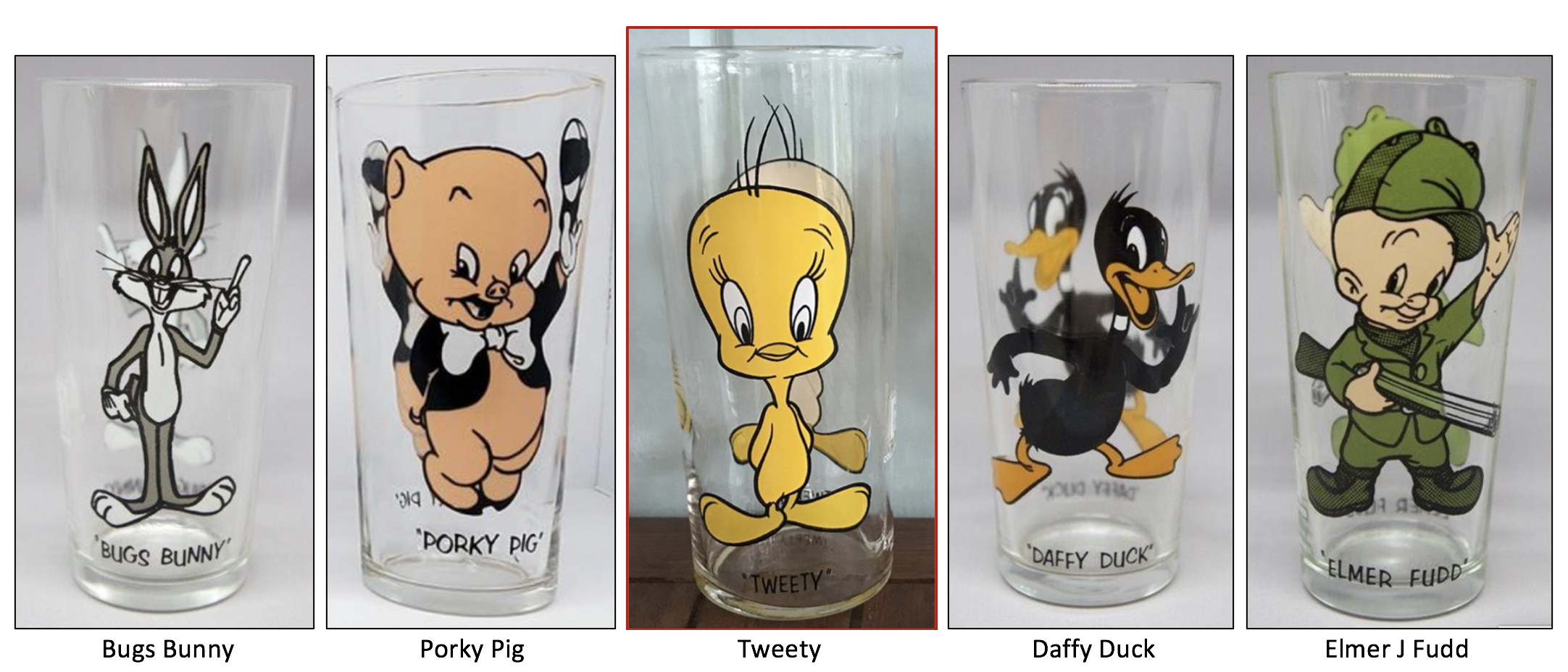 After we ate and ditched our trash we carried our new glassware back to my house and showed them to Charlie and Karen and they were real impressed and rushed back up to McDonald’s to get theirs. Charlie got Porky, which didn’t surprise me, and Karen copied Witman and went with Bugs. Charlie was real good at saying ‘ee.. biddee… ee.. biddee… ee.. biddee… ee.. biddee…’ in Porky’s voice so we heard Charlie practicing that for the rest of the afternoon. Then Witman and I got tired of hearing it and tired of doing nothing at my place so we both drove over to his place to do nothing over there. I left my Tweety glass in my kitchen in the basement and Witman took Bugs home with him. He had cleaned it up before we left so that it didn’t have chocolate milk shake scum inside it during the transport. My dog, Sunny, had jumped into my car and that was fine. Sunny was a dog that used to belong to a roommate in college named Julie Siegel from Davenport, Iowa. He was a real mellow dog even though I was told that he was a mix of husky, collie and wolf. That’s what Julie said. She said he was a Mackenzie River wolf. I think the Mackenzie River was a tributary up somewhere in the Yukon in Canada. When Julie said she could no longer keep him, my girlfriend at the time and I agreed to take him for her. He was a super-friendly dog and everyone liked him.
Later that evening, Friday, after eating more crap somewhere, Witman and I drove in his car to DU, that’s University of Denver, to see what kind of mischief we could get into. Sunny stayed in my car back at Witman’s house. He stayed in my car a lot, something he was used to doing and seemed to like. He’d just stretch out on the backseat and sleep. Witman and I had been to DU a few times before with no successes at finding anything interesting. That night carried the same result. After wandering around doing nothing there, we went back to his house and I got my car and with Sunny now sitting in the passenger seat drove back home to Grape Street.
The man and woman from whom Charlie and Karen and I were renting the house lived four short blocks east of our house, on 15th and Elm Street. Their last name was Cass and they had a son younger than me by a couple years. His name was Gary. We didn’t know each other. Except the one time I met him he said he knew my name. And what I knew of him was that at age seven (7) he was an exceptional ice-skater with realistic aspirations to make the U.S.A. national team. He was a very serious ice skater but later ditched that to become an anesthesiologist in Tampa, Florida. When Mrs. Cass (first name Yolan) agreed to rent to me, she had mentioned she knew who my father was, that he was an orthopedic surgeon and that she knew who my mother was, as well. Both my mom and Mrs. Cass were of Hungarian descent. It unquestionably helped secure the rental knowing I came from a respectful family with an orthopedic surgeon for a father, a Hungarian mother, and that I could obviously be trusted.
Mrs. Cass was a nice lady and Mr. Cass (first name Stanley) was a nice man with some serious health issues. She told me that but it wasn’t hard to notice that his breathing had a slight wheezing sound and he walked with a bent back. As she reported, he had already had part of one lung removed and had just recently undergone open heart surgery and she seemed worried about him, about his frailty. She wasn’t frantic, but you could tell she cared. Some of his problems had lingered for many years.
When I turned down Grape Street off of Colfax Avenue, I didn’t know anything had happened. But there was a lot of water in the street. I just kept going. I didn’t pay it no mind. It was dark outside and I couldn’t see much from inside the car. When I pulled up and parked and got out and let Sunny out, both Charlie and Karen came rushing out the front door sort of hysterical.
Charlie and Karen: ‘Oh thank Joseph you have Sunny with you we thought he died in the fire.’
Charlie had smoked a roll-your-own cigarette on the mattress in the basement that he’d painted, and after watching teevee had retreated upstairs. The mattress smoldered and eventually caught fire and the paneled room in the basement with the teevee went up with it. There were flames shooting out of the basement windows and the fire department had sirened their way to the house and attached hoses to the fire hydrants at both ends of the block. The fire didn’t reach the upstairs and had only begun to creep around the corner to the downstairs kitchen. It was actually remarkably contained to the one big room but the one big room was still smoking when I got there and there were several inches of water in that room and it smelled like a burning forest. From the pine paneling. It wasn’t a good thing. Charlie and Karen knew I wasn’t there because my car was gone, but they didn’t know Sunny had gone with me. They said the fire was so intense that they couldn’t get downstairs and kept calling Sunny but he didn’t bark or run up the stairs so they didn’t know if he had gotten caught in the fire. They thought he could have been burned up and were freaking out about it.
They knew he wouldn’t have run away if he had escaped. He wasn’t a forest animal after all. He was a dog. A Mackenzie River wolf, whatever the hell that is. At this point, I don’t even believe it. Never looked the breed up. Not about to do so now. I heard Sunny bay at a full moon on two (2) separate occasions and veterinarians had pointed out that his front legs were closer together like a lupus vs a canine which allowed him to pivot quicker during a chase and pointed out something about how his tail was attached to his body was not canine-like. But Sunny didn’t go to the vet enough for me to get a full bloodline diagnosis. 23andMe didn’t exist at that time and not for dogs anyway. Their number wouldn’t be 23. It would be 39. Dogs have 39 pairs of chromosomes. Fruit flies have four (4). Gold fish have forty-seven (47). Zebra fish? 25. It’s basically a crap shoot.
There was no room for surprise nor anger for what had happened. It all seemed totally to be within Charlie’s wheelhouse. I knew that living with Charlie could bring unpredictable, outlandish moments. It was expected. Every day in some minor way. I just didn’t think that he’d set the house on fire. The houses in our neighborhood were all brick, so they don’t burn down. The insides just burn up. I decided almost immediately that night that I wasn’t going to rush over to the Cass’s house that minute and tell Mr. and Mrs. Cass, the owners, the bad news. To tell them that the person who signed the rental agreement, the person they put their trust in, had a two-alarm fire at their rental property. I didn’t know about insurance and all that stuff. What I did know is that I didn’t want Mr. Cass to have another heart attack in front of me as I inform him of the partial destruction of his investment. I needed to plan this out. I needed a strategy.
My bedroom, although also in the same basement as was the fire, was untouched and the kitchen was mostly untouched and the bathroom in the basement was totally untouched but the windows in the entertainment room down there had been kicked out and left that way so the smoke could still find its way to the outside. It was cold enough at night time to need an extra layer but that’s all I needed that night. The firemen had permitted re-entry into the house, including the basement, after final structural examination just an hour before I had arrived home. Sleeping there that night reminded me of camping but without all the hassle of the sleeping bags and whether or not it was going to rain and morning dew making everything soppy and all that crap. And the tent. Pitching tents is a pain-in-the-ass no matter how many times you lie to yourself, continually droning, ‘I like camping. I like camping. I like camping.’ And of course there’s the issue of the campfire. Can’t leave that out of the discussion with circumstances as they were.
The next morning, Saturday, I figured I’d wait until Monday morning to go over to the Cass’s house, hoping to catch Mrs. Cass at home alone, to drop the big heartbreaking news just between the two of us. I was hoping that Mr. Cass would be at his work place. He was some sort of a paper pusher focused on accounting. I figured he was likely to be at home over the weekend and I didn’t want to risk running into him. I realized Mrs. Cass could think I was skirting responsibility by not going over immediately, but in truth, I was just trying to protect Mr. Cass from keeling over. I didn’t want him to become dead as a door nail. I figured that I would tell Mrs. Cass what happened and then she would know how to tell him without the tubes in his nose popping out.
Charlie and Karen and I spent the weekend picking up burned-up this and burned-up that and putting the burned-up this and that in big plastic bags. Some of the stuff was burned beyond identification. Some stuff was still a little bit warm. And we cleaned up soot over the items that survived… like the To Tell The Truth tryptic. Each painting was hung on a piece of basement wall that escaped destruction. When Guber and Witman heard about the fire, they came over pretty quickly to see the damage for themselves and other than the one main basement room, the house seemed to handle the ordeal quite well. Since they both knew Charlie, they weren’t at all surprised this had happened.
When Monday arrived, I did as I planned and walked over to the Cass’s house. I took a little detour giving myself an escape if I chickened out, but I didn’t. I had to own up to this. Like a grown up. I think it was easier for me to tell Mrs. Cass about the incident than perhaps otherwise since I wasn’t the one that actually caused the fire. I was covering up for Charlie. But I felt like I was the one responsible since no one in their right mind would ever assign responsibility for anything to Charlie. Of course, Mrs. Cass couldn’t have known that.
To my relief, Mrs. Cass answered the doorbell, not Mr. Cass, and left the door open for me to enter. I hadn’t even said anything yet. I went inside and their house looked nice and it smelled like freshly baked chocolate chip cookies. They smelled more like a Toll House® cookie than Keebler®. Toll House® is a more pungent, stronger smelling cookie. It’s due to the cocoa mixture. It’s chemistry, not for here, at this time.
I explained to Mrs. Cass what had happened and she told me she knew about it already. She wasn’t panicked. She was very matter of fact. She told me that a neighbor had asked her about the fire while at the grocery store on Krameria Street on Saturday morning.
And that’s how Mrs. Cass found out about the fire. And that’s how I found out what it felt like to be a doofus. I should have told her right away, on Friday night, and never considered she’d find out from anyone other than me. I apologized once and then twice and after many rounds of apologies, I could tell she didn’t need me to apologize any more. She asked me before leaving if I’d like a cookie. This lady whose house we had burned up to some crippling degree asked me if I wanted a cookie before leaving her house. I said, ‘Yes, please. Thank you, Mrs. Cass.’ And with that, Mrs. Cass gave me three (3) Toll House® chocolate chip cookies wrapped in a yellow napkin. The cookies were a little bit burned up, which seemed fitting. Had a burnt chocolate odor. They were still decent cookies, just blackened around the edges, like our basement entertainment room.
When I walked back into the Grape Street house after visiting Mrs. Cass, I told Charlie and Karen that we need to meet so I could tell them what happened. But I let them know I had to do a couple things downstairs first. So I continued through the upstairs living room without stopping, past the upstairs kitchen, leaving Charlie and Karen upstairs, and took the stairs down to the pine forest smell of the basement. Once alone, in the basement kitchen, I poured myself a ½ full glass of whole milk into my new Tweety glass and sat down at the green Formica table, let out a big exhale, and unwrapped the third cookie hidden in the protective yellow napkin. I ate that third cookie slowly, morsel after morsel. I believe my eyes were closed. It was a nice sized cookie and I thought that Mrs. Cass’s son, Gary, the progeny ice-skater at age seven (7), and her husband, Stanley Cass, were lucky to have a mother and wife that knew how to make Toll House® cookies of such dimension and flavor and crispness. Other than the burnt edge and the fact that it really could have used more chocolate chips, it was quite a good cookie. Some cookies are soft and gooey. That’s not my preference. I made a mental note to remind myself to let Mrs. Cass know how delicious her Toll House® cookies were. I ran my fingers up and down the Tweety glass marveling at how solid the paint had been baked on the sides. All in all, the milk in the Tweety glass in combination with Mrs. Cass’s Toll House® allowed the rush of events to return to calm.
Mrs. Cass had told me that she had contacted her insurance carrier almost immediately after being informed of the problem by the snoopy, snitching neighbor on Saturday morning at the grocery store. She scheduled to have someone from the insurance firm come out to the Grape Street house and inspect the damage that day, Monday. Not wanting to be interrupted eating my cookie, I took my time none the less, and finished it just as the insurance man pressed the doorbell upstairs. It was good to know that the doorbell still worked.
The insurance man seemed very organized and the company was sure quick to react. The man had driven up in a four-door sedan that he parked directly in front of our house. It looked like it had just been washed. After answering the door and exchanging hello’s, he showed Charlie, Karen and me his business card. It didn’t take him long to look around as the damage was mostly confined to the one basement room. He took a series of pictures with a camera that spit out one photo after another and they developed while resting in his hand. He made chicken-scratch notes on the back of each photo. He also took some measurements and I was happy to hold one end of the tape measure for him. I kept fussing with where to hold my end but he said that it was just rough measurements and to just hold my end still; which I did. I noticed that I had gotten a little chocolate chip cookie remnant smudge on his tape measure but I was able to clean it off quickly without him noticing. He told me he was going to return to Mrs. Cass’s house to discuss his findings with her. He said he’d already been to her house prior to driving the four blocks to our house to perform the inspection.
The insurance man wouldn’t tell me anything about Mrs. Cass’s fire insurance coverage. It was private and confidential. While leaving, I walked with him to his car. I asked if he had any idea how soon it would be that the house could begin to be repaired.
Insurance man: ‘I don’t know. There are a number of steps. My guess is pretty soon.’
Me: ‘How soon is pretty soon?’
Insurance man: ‘That’s up to Mrs. Cass and her contractor.’ He opened the door to his car. I peeked in. Very nice. Clean. Like a real estate salesman that drives potential buyers around looking at houses. Not like a rug salesman with his car filled with filthy scattered samples.
Me: ‘She needs a contractor?’
Insurance man: ‘She definitely needs a contractor. And maybe an architect. She asked me some questions about doing additional work earlier when I was at her house.’
Me: ‘Ok. Thanks for coming so quickly.’ I could see in his front seat that he had the same yellow napkin that Mrs. Cass had wrapped my cookies in.
Me: ‘Oh, hey. Is that a cookie from Mrs. Cass in the napkin?’
Insurance man: ‘How did you know? She gave me about ten of them. She told my company on Saturday that she’d bake cookies for us if we could get out here today. I’d already eaten about four of them at her house earlier but she insisted I take more with me. We would have come today anyway, but she wouldn’t listen. I have to say, the woman knows how to bake cookies.’
Me: ‘Ya. She’s famous for making real good cookies. Can I ask? Were your cookies slightly burnt?’
Insurance man: ‘No, not at all. They were perfect. Just perfect.’
With that, the insurance man drove off. As we lived just three houses from the corner, I watched him slow down and turn left. He didn’t come to a full stop at the stop sign. And he didn’t signal his intention to turn left. Similar to the kind of infractions that landed me in jail cell #2. I briefly wondered how the whole Citizen’s Arrest thing works. They do a poor job communicating what you’re supposed to do to make one. I had not missed a meeting or a class… no one I knew had any idea how Citizen Arrests work. Do you just go up to the violator and say, ‘Stick ‘em up and turn around,’ and they know to put their hands in the air and face the other direction? Then what? Ask the criminal law-breaker to lie down and ‘stay’ until you go knock on someone’s door to call the police? Assuming the person that answers the door would even let you in. Maybe they aren’t fully dressed. All I know is that if Citizen’s Arrests were occurring or had occurred while growing up, I think I would have heard about it. Just didn’t seem that Citizen’s Arrest were promoted, prominent or even probable. There were law-breakers driving down the streets every day. They have no fear. No shame.
I walked back inside to the scene of the conflagration. Mrs. Cass dropped by later in the afternoon and recommended that we move out. She wasn’t mean about it. Again, just calmly spoken matter of fact. She was a real nice lady. And an exceptional cookie maker, which I congratulated her on when we were out of earshot of Charlie and Karen. Neither had received a cookie and I was keeping Mrs. Cass’s cookies a secret from them. The damage that the fire caused in the basement wasn’t ‘extensive’ but the damage was serious enough to require more than just a little bit of work to return it to what it had been. Mrs. Cass felt that things would go easier and better for her and for her husband, Mr. Cass, if the house were vacant while the work was being done. Plus, in addition to Charlie and Karen and me… we had a menagerie of pets that would be in the way of the partial demolition and construction:
- Charlie had Buster, a seven-year-old male black lab that acted goofy half most of the time
- I had Sunny, a large male wolf-breed, albeit very mellow and friendly. Sunny was seven.
- Karen had:
- Bonnie, a five-year-old mother cat
- Becky, one of Bonnie’s kids; aged two (2)
- Boomer, Becky’s sister from the same litter; also aged two (2)
- Bob the bird (age unknown)
Not being a bird enthusiast at all, to this day I have no ability to gauge the age of a bird. I never knew how old Bob the bird was. I never asked Karen. Never crossed my mind. I rarely consider their ages. I could have written that I never consider their ages and you would not have been led down a blind alley. Birds have no bleep on my radar. Maybe bald eagles would bleep. But does anyone really think of them as birds? They aren’t called Birds; they are called Birds of Prey. And they should be called Birds That Prey. ‘Birds’ are things with wings like parakeets and toucans and parrots and sparrows and robins and blue jays and doves. If you want to open the kimono farther for a wider exposure, add flamingoes and storks. But not eagles and hawks and falcons and vultures. Technically, they are all birds. I know. I took biology: four chamber hearts, tiny nostrils, feathers, the whole enchilada, I get it. I know all about them. Most of them can fly. But if the thing flying around has six legs, it’s not a bird. That’s an insect. Ok? I know all about birds. But eagles are not the same as sparrows. Sparrows are closer to butterflies than they are to eagles. Let’s say that a robin is equivalent to a butterfly. Then a sparrow is a moth, and an eagle is a pterodactyl. At one end, you have a worm with colorful wings, and at the other is a US Air Force F-15E Strike Eagle or F-22 Raptor. Our most deadly military aircraft are named after eagles, falcons and dinosaurs… not robins or parakeets or the lesser-known chestnut-tailed minla
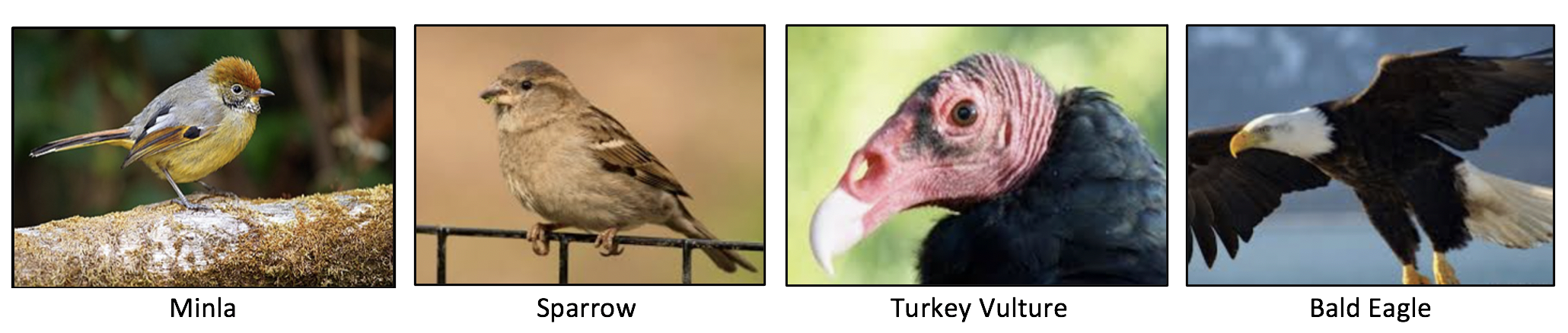 We did own a bird. I regret to say (more accurately, I rue the memory) that there was a time when my family owned a bird. My wife had bought a wooden bird cage in 1989, in Beijing, China two weeks before the Tiananmen Square squeaker, and shipped it home. It was professionally packaged and withstood its travels intact. The construction was quite intricate with many vertical wood ribs. And horizontal rib supports. Each rib was cut to fit its location precisely. As it turned out, my wife wasn’t any more of a bird lady than I was a bird man. We both had bird brains when it came to bird care. The only meaningful way to convey bird husbandry capabilities is how long the bird under your care lives. It is a chicken dumping eggs every day. It’s a pet bird. Length of ownership is the de facto measurement to determine success owning a pet bird. For us, or more so for the bird, it didn’t go well. I have no idea what kind of bird it was although it was nothing exotic… or exceptional… or worthwhile… or worth cleaning up after. Frankly speaking. It didn’t sing. It didn’t chirp. I guess I never really knew why we had it. Nor did it bring joy or happiness. It was all rather glum. It was small, parakeet-size. Yellowish. Maybe. I really don’t remember what color.
The cage with our bird in it was in the breakfast nook window of our house in Half Moon Bay so the bird could look outside. We didn’t have the bird long enough to have decided whether or not having the bird in the window so it could see outside was a good thing that the bird would enjoy or if being able to see outside was a cruel thing because the bird was caged. Was our bird an excitable outgoing bird with dreams of flying into tree limbs or a more serious bird with internal circumspective tendencies and somewhat forlorn? We didn’t get into the ‘mind’ of the bird. Would not have known where to start. We hadn’t had the bird long… less than one (1) month. Shoot. I think we had it a week. I don’t think we’d even named it. It isn’t like we were going to let it out of its cage and it needed a name so that when we called it, the right bird would fly back.
One morning at breakfast, while eating lightly buttered whole wheat toast, marionberry jam and strong black coffee with a few polka dots of milk, we heard a sound like an unenergetic, lazy slap of a hand on a table top. Not hard. Not aggressive. Just average. Just a sound that didn’t convey any real meaning. Just a drop of the hand. It was not alarming. It was just a single slap. My wife and I looked up at one another briefly. I was finishing the last blob of marionberry jam. Yes, from Oregon. Upon looking over, I saw that our nameless bird lay beak up on the bottom of its cage, deceased. No longer with us. The uncomplaining bird, through our ignorance, not negligence, but rather ignorance, had heated up too high for its own well-being sitting in the window and I guess his heart got going pretty fast. Too fast. The sand had run out of his hourglass. There was no warning. We didn’t know. We didn’t rush the bird to the bird vet to get a concrete diagnosis as to what happened. We put it in a Safeway bag and put the Safeway bag into the trash under our sink and said our goodbyes over more toast and I switched to a jarred strawberry jam. What? No, the strawberry jam was made locally. In Half Moon Bay. Only the marionberry jam was from Oregon. Thank you for the question. I’m not sure everyone in the back could hear the question. The Reader asked if the strawberry jam I opened after our bird died was from Oregon.
We are now able to return to the events that ushered in our exodus. Once Mrs. Cass had left our Grape Street house after delivering her directive that we should find new lodging, Charlie and Karen and I talked about what we were going to do. We certainly didn’t feel it made any sense to fight her proposed eviction. I recommended moving to Palo Alto, California. I’d been there a couple times. It’s where Stanford University was located. Both my brother and David Witman had attended and graduated from Stanford. During the Spring break of 1971, our sophomore year at University of Colorado, Guber and I drove out to Palo Alto from Boulder to visit his friend, Witman. I had not met Witman before. He was living in a trailer on campus which they said was part of Stanford housing. The weather was always great and everything was green and everyone was doing anything they wanted to be doing for twelve months of the year; not hamstrung with bad weather or lingering ice and snow. It wasn’t hard to convince Charlie and Karen that moving to Palo Alto would be a step in the right direction. Plus it was closer to the Arctic Circle and Charlie’s Exxon job than staying in Denver. Not a lot closer. We never measured. Plus it would allow me to escape the cost and ordeal of getting a valid inspection sticker for my car, something that had been sowing my mind with seeds of aggravation… into my mind in the brain section inside my cranium covered with and protected by sandy brown hair follicles. Below the hair were two ears on the sides and a still-partially bent nose from a skiing accident that stuck out from my face like a dodo bird.
We did a quick assessment as to how much of our stuff we would take and how much we would get rid of whether by discarding it in the trash or making donations (which never occurred) or selling at a garage sale (which also never occurred). Charlie and Karen had an old beat-up car that they sold for $200 and were happy with the transaction and the extra money would help pay for the gasoline to drive to California. With the plan that all the animals would be stuffed in the back seat with one of us alternating as back seat passenger, we elected to rent a 5’ x 8’ U-Haul trailer that we’d fill with beds and my elaborate comic book collection in my fireproof trunk and art supplies of Charlie’s and whatever else we could manage to fit inside. I still had the basic saddle tan Samsonite suitcase. Karen had a huge flower-print fabric suitcase that looked like it could hold a swimming pool. And of course we’d hitch the U-Haul to the back of my white 1968 GTO which already had one of those steel hitch balls fused to the chassis.
I gave my employer, US Datacorp, a two-weeks-notice that I was quitting. They weren’t happy but I was. This new venture promised to be a chance to start over, no issues, a new lease on life. The following weights and anxieties that confounded daily existence were soon to be lifted. I anticipated that these would include:
- No more swing shift getting off at midnight
- No more Denver prison system
- No more Denver policemen that can’t spell
- No more worrying about what to do about the fire
- No more constant worrying about the forged inspection sticker
- No more icy streets and shoveling walkways
Karen wasn’t working so she had no one to tell she was quitting and Charlie still had a high-paying job at Exxon eating gourmet meals from all over the world while working on the Alaskan Pipeline north of the Arctic Circle. Charlie was hired to help make everything better for everyone down here in the lower forty-eight through his efforts as an Exxon employee. That is something that for anyone that knew Charlie could make them break out in hives or shingles.
Fortunately, when the fire began its rage from Charlie’s cigarette in the basement a few days prior, both our White Pages and Yellow Pages were sitting on the floor upstairs as a combination door stop. Having removed the lint and filth that had collected, I looked up where the closest U-Haul location was in the Yellow Pages and scheduled to rent one the Friday after the upcoming Friday. For the remaining two weeks we had left on Grape Street, we did a lot of cleanup and throw out and order in. When the three of us drove over to pick up the U-Haul, it didn’t have Colorado license plates. They were from Wisconsin. I didn’t know they could do that but it made sense once I gave it some thinking time since we were going to be dropping it off in California if everything went ok. Charlie said: ‘Karen. Go comb your hair there and everythang.’ which was something he told her 35 times a day in a Louisiana southern dialect and had become our secret signal that we were all in agreement. Charlie was mimicking Karen’s father and accent – something he’d tell her as father-to-daughter almost daily. According to Karen, that is. She said that her father, Roy, would tell her every day, ‘Karen. Go comb your hair there and everythang.’
The afternoon of Friday, February 28, 1975, we picked up the U-Haul as scheduled. The sky was mostly clear with only an occasional wisp of clouds. The weather was warm. Lots of sun. Lots to do. I had never driven a car with a trailer tethered to its ass by a metal bar before and it was certainly noticeable to me that something was in-tow. There was loud banging as the trailer responded to the uneven streets. It was like a big metal Mexican jumping bean back there. I had to make sure of having extra room when changing lanes and seriously reduced my lane changes after the honking and yelling and raised fingers I received after the first attempt. I turned onto Grape Street off of 17th Avenue Parkway and drove up the block and turned into our long driveway, all the way to the back of the house. That’s where the back door was located and was where we were going to be loading the U-Haul the next day, Saturday, March 1, 1975.
All three of us woke up excited. We breakfasted quickly. Each of us did our job carrying our things up or down the stairs to the car rear’s hookup out the back door. The actual loading of the U-Haul went without a hitch. Exactly as we had estimated using our careful eyes and tape measure, everything we intended to take with us fit snugly in place with blankets used as buffers between breakables. A primary consideration during the loading process was doing our best to insure that the weight distributed evenly so that one side or another wasn’t overburdened. Additionally, it was recommended by the U-Haul rental lady that the heaviest items should go into the cabin of the U-Haul first, closest to the car. That was easily accomplished by sliding in my oversized comic book collection trunk. It slid all the way to the back. It took both Charlie and I to lift it up the stairs and into the trailer.
At 2:00p, we were loaded up. The door to the trailer was pulled down shut and padlocked. Key put safely in my right front pants pocket. As prearranged with Mrs. ‘Toll House®’ Cass, I placed all sets of house keys on the upstairs kitchen counter except for the one I used to lock the front and back doors at our departure. I scratched out one final thank you note to Madame Toll House® for renting to us and included another apology for the tinder mishap in the basement. I ended the note by congratulating her on her skilled Toll House® cookie baking abilities and applauded myself from refraining from including a helpful suggestion to her to add a few more chocolate chips prior to sliding the tray onto the center shelf in the pre-heated 325˚oven. I also did not mention in the thank you note that the cookies that her home insurance man had been given were free of any burnt edges, whereas I had received slightly burnt Toll House®. Not overly burnt. Not uneatable. Quite the contrary. But for Toll House® cookies they were embarrassingly light on chocolate chips and more than lightly blackened along the entire circumference of the edges and cookie bottoms. Still, Mrs. Cass earned my praise. With certainty, she had developed into a skilled cookie baker. Had we departed under different circumstances I may have hinted to her to keep a closer eye on her timer. You have to be exact with Toll House®. You have more leeway with the cookie doughs that the elves in hats at Keebler® were selling. That’s not commonly known. The packaged Keebler® cookies were satisfactory, but home baked Toll House® shined brightest. Toll House® does lay claim to having invented the chocolate chip cookie. My, my. Mrs. Cass sure could bake. It was one of the sad things about leaving Denver, but not important enough to stay.
At 2:30p, we all climbed into the GTO. Charlie road up front with me, the driver. Bob the bird was in his small cage at Charlie’s feet with a blanket covering to basically trick him into thinking it was the middle of the night. It was explained by Karen that the blanket is for making the cage dark, not for warmth. I choose to believe it does both – like an ambidextrous application. Karen, Sunny, Buster, Bonnie, Becky and Boomer found spots in the back seat. I turned the ignition key, the car roared, I smiled, it was acknowledged by all passengers that seat belts were snapped in place, Charlie said ‘Karen. Go comb your hair there and everythang’, I put the car in reverse, looked at my door’s rearview mirror… and at 2:40p we were off. We resembled Jeb Clampett and family moving to Beverly Hills. I was Jeb. Charlie was Jethro Bodine. And Karen was Elly May. Hallelujah, our pilgrimage was about to begin, at last, to California! Hee-haw!! Finally. I felt like a present day Puah… ensuring we’d all live… and hoped we’d prosper.
I gently caressed the sole of my right shoe to the automobile’s gas pedal and I am able to estimate now, all these years later, that we had traveled about three (3) feet and the U-Haul trailer was already sideways, up against the house. My inexpensive Timex wristwatch had not yet fully pointed to 2:41p. We had left less than a minute ago. The wristwatch date window showed ‘29’. Those were rough days when you had to manually advance the date in the wristwatch date window with careful fingers if the month that was the just expired month did not have thirty-one days. When I turned the steering wheel to the right to back up to the left, the trailer went to the right. Had I gone two (2) more feet, the U-Haul would have collided into the red brick siding of Mrs. Cass’s Grape Street investment. This was unexpected. Having never before ‘hauled’ a trailer, I had no idea that its directional response was opposite to that of the car when driving in reverse. Apparently what happens is that when you turn the steering wheel to the right, and back up, that the car goes to the left as expected, but the trailer goes to the right. Or something like that. It’s like crossing streets in London, England. The British finally required printing right on the curb which way for pedestrians to look for autos prior to crossing. This was for safety. It just makes it more confusing. When I cross the streets in London, whether it be Piccadilly, Covent Garden, Trafalgar Square or Chelsea, I swivel my head back and forth at the edge of my neck fifteen times to try to figure out what is going on with the traffic and then I usually race across with my eyes wide open, like I’m terrified. Which I am.
Charlie and I looked at one another with the trailer angled at ninety degrees and then I set the automatic gear shifter to ‘D’ and inched forward, back to where we’d started only moments ago. It was now 2:44p. At 2:45p, I tried backing up again. I may have successfully gone five (5) feet this time before turning the steering wheel back the other direction to attempt to maintain a straight line, and the trailer almost hit the side of Toll House® Cass’s Grape Street house again. What added to the confusion and difficulty was that with my head turned to look backward at what was happening, I was now looking straight at the circumstances rather than through the door’s rearview mirror which of course reversed all visuals because it was a mirrored reflection. After another fifteen minutes of this, we all got out of the car to stretch our legs and try to figure out a solution. I was sure I could do it and just needed a couple more stabs.
It was at this inopportune moment that Bonnie, Becky and Boomer’s doting mother cat, and Karen’s favorite feline, decided she had other more important things to do than go to California. She jumped out of the backseat window and ran behind a bush. Then she ran along the side of the house toward the front. Karen was calling her. And then Bonnie ran back between Karen’s legs and Karen missed grabbing her and Bonnie went to the backyard. So Karen hurried after her and Bonnie went under the fence into the neighbor’s yard and stood there, out of reach, licking her paw. And then cleaning herself. Apparently she had picked up a lot of schmutz sitting in the back of my car for ten minutes. Then Karen went around our house and into the neighbor’s backyard and Bonnie went under the fence again back to our side and ran over toward the garage.
While this spectacle was going on I managed to successfully back the car and trailer stopping at the Grape Street gutter. As Karen, aided with Charlie’s help, was still trying to capture Bonnie, I set the correct date on my watch by pulling ‘out’ the impossibly small dial on the side. I turned it carefully and changed the window date from ‘29’ to ‘30’, then to ‘31’, then ‘2’ because the thing is almost impossible to control and then I succeeded to back it down from ‘2’ to ‘1’. Then I pressed the watch’s side button back ‘in’ to lock it. My watch now correctly communicated the date. It was March 1. 1975. As Karen and Charlie continued to try to outsmart and outflank Bonnie, I went back inside the house with the key I’d used to lock the doors. I reread the final thank you note to Mrs. Cass and considered some additions but in the end I left well enough alone.
Bonnie kept eluding capture and Becky and Boomer began meowing like two oboes inside the car. Together they sounded like they were being strangled, but no one was wringing their little pussy necks at all. My fingernails needed clipping so I clipped them using the small scissors on my Swiss Army knife. It was the traditional red Classic knife with one small blade, the scissors, the small tweezers, and the ineffective plastic tooth pick. The knife was also equipped with that short screwdriver blade with one side that tried to emulate an emery board. But it was a real poor emery board. And a fairly unusable screwdriver blade unless it was used to loosen and tighten light switch cover plates, for which is performed dandily.
I wasn’t any help trying to catch Bonnie. Bonnie never listened to me when we were inside. She wasn’t going to all-of-sudden listen to me outside. We ultimately unlocked the heavy padlock on the trailer and allowed the door of the U-Haul to slide up into the ceiling and Karen grabbed a can of foul-smelling cat food from inside and started to bang it with a fork, calling ‘Bonnie, Bonnie’ in a similar voice and timbre that Willard had used to call out ‘Hooper, Hooper’ on the winter’s night a year previous.
Sunny and Buster had long gotten out of the car and Buster was bouncing around with his pencil out. Which was usual for him. That was a bad habit of his. He did that a lot and we called that red thing sticking out of his genitus, ‘Buster’s pencil’. We applied the name ‘Buster’s pencil’ to all male dogs when they had their pencil’s out. But no dog I’ve even known constantly ran around like a goofball with his pencil out more than Buster. Bonnie had been cornered and captured by the back door trying to go back inside the house. By 4:10p, everything finally returned to what it had already been just an hour and a half earlier. Everyone took their places in their chosen seats for a second time, I completed the car/trailer backup snappily and happily onto Grape Street, and we headed up to Colfax Avenue, where we turned right. West. To California.
With a full tank of gas we were on our way in earnest. We could have proceeded west on I-70 all the way across Colorado to Utah but I chose to head north on I-25 toward Wyoming and then take the US 267 diagonal from Fort Collins up to Laramie. From Laramie, it’s I-80 all the way to San Francisco. I reasoned that going the I-80 route would take us out of Colorado about four hours sooner than the I-70 route would allow so it reduced the time of driving in Colorado with a forged inspection sticker. Since it was 1975, and being obeying, abiding 20-somethings, we observed the national highway maximum speed limit that was fixed at 55 mph. We all participated in President Nixon’s national maximum speed limit as part of our nation’s response to the OPEC oil embargo. Saved gas. Saved lives. Made traveling take much longer. Caused road rage, which wasn’t even a term yet. Impatient driver’s leaning on their horns wildly gesticulating at law abiding drivers. Driving 55 mph on the highways was the worst. Thanks a lot, Mr. Nixon.
But the maximum speed restriction presented no dilemma for us since it was 10 mph faster than the maximum speed limit printed on the side of the 5’ x 8’ U-Haul trailer. In 182-pt type was printed: 45 mph maximum speed limit! Who are they kidding? That was the maximum U-Haul limit in 1975 presumably so that the U-Haul company and their lawyers could lessen their liability. No one in their right mind was going to drive on highways at only 45 mph, not even if they were hauling a big tent circus with cheetahs and elephants. Any mishaps or accidents and U-Haul might claim driving at excessive speed to throw all liability out the window. I drove at 55 mph and could extrapolate that to be flying across the uneven asphalt at 70 mph pulling 800 wobbling pounds of U-Haul and its contents would be dangerous. Akin to trying to control a 5000 lb sledgehammer when you consider 3500 pounds for the car plus 700 pounds for Charlie, Karen, me, Buster, Bonnie, Becky, Boomer, Bob the bird and Sunny plus 800 pounds for the trailer and its contents. I did not want the thing to flip over and scatter my comic books all over the highway. Each comic was wrapped in plastic as protection, but not enough protection if scattered about like gunshot across all lanes of traffic. And I didn’t want anyone to get hurt, too. That’s part of it. I was going full Puah. A name born in molasses. I’ve never met anyone named Puah. Beautiful name. Puah. Types smoothly on a QWERTY keyboard.
There are men named Shithead, pronounced ‘shih-THEED’. This is a real name. It’s both comic and tragic. Often they are the same person. If you search genealogical siblings names, no family EVER IN HISTORY named their only daughter Puah and their only son Shithead. Not even Monty Python. Not even Frank Zappa, although Zappa came closer. And understandably there is not a single Shithead Jr (pronounced ‘shih-THEED Junior’) to be found anywhere. No Shithead named their offspring Shithead. This is one of the important things that I’ve learned through my ongoing deep friendship with David Witman. He told me. And I believe him.
I drove the entire trip from Denver to the Bay Area myself, which was my preference. And it was Charlie and Karen’s preference, too. The first night, having gotten a late start in the day due to my inability to navigate the driveway backup at the outset along with Bonnie’s selfish desire to play ‘fuck off’, we stopped late at night in Rock Springs, Wyoming at the Motel 6, which flashed a 1-Star rating. Whoever applied the rate never visited. Leave it at that. Rock Springs is 440 miles from Denver and we rolled in after midnight. At check-in, the awakened and groggy desk clerk asked if we had any pets and after saying a black lab, the desk clerk interrupted and said ‘OK’ and then asked ‘How long are you staying with us?’. I said ‘one (1) night.’ Had the clerk allowed me to progress through our pet list, I’m not sure what my response would have been as I felt conflicted to let them know we had two (2) dogs, three (3) cats and Bob the bird. But it worked out, we got a room, slept, showered and continued west in the morning.
The hill descending from the southwest west corner of Wyoming into Utah and on to Salt Lake City is a steep decline that is made more precarious dragging a U-Haul. A reduction of speed was required to ‘hold the line’. Although it was early March when the weather could be anything from warmth and sunshine to dark clouds with snow storms and ice, we felt lucky to have been traveling in the former. In fact it was warm enough to have the windows somewhat lowered. We were reluctant to have any of them all the way down due to the possibility of a spontaneous animal argument ensuing and one of the cats hopping out onto the highway and getting ‘Hooper waffled’. Having not ever owned a cat, the responsibility was left up to Karen to be backseat referee. I am pleased to report that we had no issues in that regard the entire journey.
We stopped the next night in the beautiful Nevada dust town of Winnemucca. Both Elko and Battle Mountain were in our rearview mirror many hours earlier, but due to wind gusts, a safe driving speed had decreased to the 45 mph that I swore I’d never succumb to abiding. Our troubles were behind us at this point, a distant memory, even though we’d only left Denver a day and a half ago. It was like leaving a troublesome job and as soon as you quit working for that company there is a noticeable weight instantly removed from your shoulders. I felt like a kid again. No worries. No heavy plans and deadlines making havoc to ruin our lives.
The last day of driving to the Bay Area found our start high in the Sierras and around noon we neared the location where the Donner Party picnicked on whatever food they were carrying. We stopped near Truckee and had our own picnic albeit a quick one. We weren’t going to be staying long. Karen had one cat leash and alternated giving Bonnie, Boomer and Becky their chance to breathe the crisp mountain air without being in the backseat of the Pontiac, breathing fumes. The Truckee River was a marvelous light blue ice color, unlike the dark opaque greens of the South Platte. There was some snow on the banks of the Truckee but already the brown Nevada landscape switched to California pine green. Neither Karen nor Charlie had ever been to California and they were already in love.
The farther we drove down from the Sierra Nevada mountains to lower and lower elevations, toward Sacramento, the greener and more lush were the surroundings and the more brilliant the sky blued. Clouds that had been resting on the tops of the mountains at Truckee were nowhere to be seen as we drove by a small town named Colfax at a considerably lower elevation. Named after Schuyler Colfax, the same man for whom Colfax Avenue in Denver was named, the 17th Vice President of the United States serving under President Ulysses S Grant. The diversity of the natural beauty that is California was undeniable. Buster’s nose was busy twitching excitedly at the volume of new smells. We all seemed more alert. We continued across a short stretch of the central valley on the way to the San Francisco Bay. In Denver, we’d cross downtown viaducts at twenty feet above Cherry Creek. Here, we paid a toll to cross the four-and-a-half mile-long Bay Bridge with Treasure Island marking its mid-point and San Francisco directly in view once we exited the island tunnel. Our height above the Bay looked like a mile although the records say it is actually 190 feet above San Francisco’s blue Bay. Off to the right was Alcatraz Island, the infamous prison from which few inmates successfully escaped. Farther off to the right we could see the Golden Gate Bridge glistening in the sunshine. It was red, not gold. It’s called the Golden Gate Bridge because California is nicknamed the Golden State. Charlie said he wanted Rice-A-Roni. Karen agreed. We wondered if we’d run into Karl Malden. Or other celebrities. We had arrived. We were giddy. I noticed that the highway was lined on both sides with amber reflectors in the pavement and white/clear reflectors divided every lane. That seemed so ‘rich’. The state had wealth. They had money to spend in this state for reflectors to line lanes and sides of their highways. Back home, reflectors were sparingly used on six-foot barricades to bring attention to large pot holes from the harsh winter, not yet scheduled to be filled. We began to understand the positive differences California offered. It was already our state, too.
To get to Palo Alto we continued to drive onto US 101 and headed south for about thirty miles. Along the traverse, to the left was Candlestick Park where the San Francisco Giants played in professional baseball. No more empty stadium AAA Denver Bears. Next came San Francisco International Airport with the home headquarters for It’s It ice cream sandwiches two exits farther south. I wanted Rice-A-Roni capped off with a chocolate It’s It. It was still late winter/early spring, but it seemed like summer. People in their cars wore tee shirts. There were lots of motorcycle riders. Most without helmets. We passed an exit for Marine World in a city called Redwood City and minutes later we passed Menlo Park, the city just north of Palo Alto. And then, an exit I remembered from earlier travels. University Avenue in Palo Alto. Stanford University was a mile or two to the right, west, the direction we exited US 101.
Palo Alto was built on neighborhoods like Theodore Cleaver’s town, Mayfield, in the teevee show Leave It To Beaver. Gently winding tree-lined streets; not a square rigid grid. The trees’ canopies were laden with thick green foliage rather than stripped bare by winter’s attack. People had manicured lawns. There were bushes and flowers blooming everywhere. And lemon trees pregnant with lemons that you could just reach up and pick ‘em if you wanted to. And there were orange and grapefruit trees on every block. And fig. Downtown Palo Alto looked like a Hollywood set. No paper blowing around on the ground. The corners of the sidewalks at both ends of the blocks sloped with ease to the street asphalt to make it easy for bicycle riders. Doors to businesses were wide open. People were shopping. The storefront windows were shiny and reflected cars that travelled past. As well as roller-bladers out taking a turn. Tasteful graffiti that seemed to have been commissioned showed women with strollers and kids flying kites. There were a lot of ice cream cones. And clothes stores with new spring lines already available. There were sidewalks made of inlaid red brick placed in creative combinations, 45˚ herringbone and basketweave.
 Honeysuckle hugged arbor gates and perfumed the air with sugar cookies. Purple violets bordered flower beds with an occasional river of purple filling an open field. And there were roses next to blackberry bushes and raspberry bushes. There was the smell of lilac followed by lily of the valley. It smelled like success. The air smelled like happiness. Maybe a bit of what people would call heaven. It all cheered my heart.
We got a couple of rooms for four nights (Monday – Thursday nights) at a motor lodge on a busy street named El Camino Real in Palo Alto. El Camino Real is a mixed commercial and residential street that ran the length of the entire San Francisco Bay peninsula… and according to some, continued all the way to South America in one form or another. It translates to English as the Royal Highway. It reminded me of Colorado Blvd in Denver, with a center divide of similar width. We filled our motor lodge rooms with the menagerie and the contents of the U-Haul and I returned the trailer on Tuesday to a receiving depot that I’d looked up in Palo Alto’s Yellow Pages. The drop-off depot for U-Haul was also on El Camino Real. Once the trailer and the attaching metal rod that was stuck into the ass of my car were removed, my car instantly felt zippier, quicker, more nimble. It was nice to be rid of the big metal goiter hanging off my tail.
I returned to the motor lodge following the trailer drop-off and ate breakfast with Charlie and Karen at the lodge’s restaurant by the outdoor swimming pool that was part of our accommodations. I ordered macadamia nut pancakes and two eggs and bacon and coffee and a medium orange juice. Also, water with ice. You had to ask for the ice special or the water came straight out of the tap, uncooled. Two priorities took ownership of the top shelf of our list of to-do’s and both were discussed during breakfast.
- Charlie and Karen needed to buy a used car
- We needed to find a place to live
Charlie looked in the Want Ads section of the Palo Alto daily newspaper and found a few candidate used cars that he earmarked. I agreed to go look at the cars with Charlie and Karen but made it clear that I was not experienced with buying cars and new absolutely nothing about them. They understood but asked for my assistance anyway. This car-search/purchase endeavor took less time for Charlie and Karen than I would have taken as they bought the first thing they saw. $400 cash bought a yellow and white used VW bus. I don’t know the year. They all looked the same anyway. The tires had tread and it started and that was good enough for me and apparently good enough for Charlie and Karen. They didn’t know anything about cars either. But at this point Charlie and Karen had their new transportation. Charlie and Karen had their VW bus and I had my GTO.
Also in the local newspaper were columns of rental listings. Together, we scoured. Rental prices varied considerably depending on size, number of bedrooms and bathrooms, etc. Standard process. Standard considerations. There were a few houses we set up appointments to see. There exists in Palo Alto a style of house called an Eichler, which has large wall-size windows, post and beam construction and open floor plans and both the ones we saw looked fantastic to us. Real California. You’d never find this style of home in a cold environment like Colorado. Our issue wasn’t finding a place to rent that we liked… but rather finding a place to rent that would accommodate three (3) adults and six (6) pets, including Bob the bird. We repeatedly struck out and learned to bring up our pet manacles at the outset so we could be denied over the phone rather than waste time looking at the houses in person, wasting everyone’s time, only to be told then that we weren’t qualified.
We didn’t go house hunting all day every day. We spent a lot of time hanging out on University Avenue and the streets that were in the immediate vicinity; Lytton Avenue and Hamilton Avenue, and on the Stanford University campus. Enormous Eucalyptus trees dotted the campus and there were a lot of wide-open spaces, enough room to play wide open frisbee. The students were not that much younger than us and they participated playing frisbee when it landed at their feet or hit them in the legs or the back of their heads. We’d strike up a conversation and one of the girls told us about a bulletin board in their student center where people list places to live. The board wasn’t helpful as it was almost entirely students looking for roommates, not full empty houses.
It didn’t take long to learn our way around Palo Alto, but we didn’t really venture into adjacent cities on the map like Menlo Park and Los Altos and Mountain View. And we didn’t venture into East Palo Alto, but we liked the prices of the rentals more in East Palo Alto than Palo Alto since they were less expensive to rent. Considerably less.
We contacted a polite talking landlord who had a house available at once on Sacramento Street in East Palo Alto and arranged to see the house at 11:00a on Saturday, March 8. I handled the negotiation over the phone and wanted to make sure the kind landlord knew the extent of our pet situation. He didn’t seem to be put off by it at all. Very accommodating. The first hurdle had been cleared. We extended our stay at our motor lodge for one more night and on Saturday, I drove to the Sacramento Street address and Charlie and Karen did the same in their newly purchased, mid-sixties VW bus. The house, as it turned out, was located at the end of the street, which turned out to be a cul-de-sac, which seemed ideal for all our animals since it meant that there wouldn’t be much traffic, if there were to be any at all. The place was made of wood horizontal siding and was on the small side; a two bedroom with one bath and a kitchen and a postage stamp called the living room and a dining room that seemed to be the sample-size. A single bite dining room. Hanging on one nail pound into the sheet rock in the living room wall was a crappy clock with chimes. It came as part of the ‘package’. In the backyard was a small garden which included a hose. The hose was also part of the ‘package’, as did the duct tape wrapped around the part of the hose that had a small leak and the landlord wanted to make sure that we knew that he intended to replace the hose with a new one but he had been busy.
There was a garage toward the back that was filled with the landlord’s junk, including a rusting old car, so it was made clear that the rent did not include garage access even though the door was jammed open for all to see its contents. But the place had a cement driveway leading to the garage that was long enough to be able to park at least one of our cars. After the landlord finished presenting this Shangri-La to us, Charlie said, ‘Karen. Go comb your hair there and everythang.’ Which meant, of course, that they were good to rent the place and I didn’t have any objections and I think all three of us just wanted the house hunting to end because we didn’t want to keep paying for a motor lodge and we knew we wouldn’t find many alternatives with six (6) pets. Plus, Charlie was scheduled to return to the Arctic Circle to help save America’s oil concerns in the middle of the following week. He could probably have extended his leave from duty by a few days since Karen’s father, Roy, was a big fancy-ass at Exxon in Louisiana, but Charlie wanted a few days to relax and not have house hunting weighing down upon his average width male shoulders.
The landlord presented us with the lease to sign and he and I chit-chatted and it turned out he had a number of houses that he rented out. He called himself a slumlord and I’d never heard that term before but it didn’t sound great to me but he meant that he was building his ‘kingdom’ of properties and was proud of it. The entire signing process only took ten minutes, and at 11:40a, March 8, 1975, with our new landlord departed, Charlie, Karen and I had completed another important phase of moving to California. We had a new residence at the end of the block on dead-end Sacramento Street in East Palo Alto and our landlord had two checks from us: one for a deposit and one for the first month’s rent: a combined total of $337.50 US dollars currency.
We excitedly unpacked both vehicles, my Pontiac and their bus, and brought our boxes and suitcases into our new rental domicile, which is a word similar in characters to Damocles, which I think had something to do with a bad omen. I could look it up but so can you. This unwieldy tale was meant to be a dozen pages or so at the outset and was quite different on the drawing board but it got away from me. Oh, why lie to you now, Exhausted Reader, now that we near its end. You don’t deserve that. Truth is that there was no drawing board. Not even a leg of a drawing board to support itself. Had there been, perhaps we would have been done with this tale pages and pages ago and I’d be doing something else right now and you could be reading Of Mice and Men or throwing a frisbee.
But to continue in narrative: Charlie helped me lift and carry my large trunk of comic books into our new rental castle. We placed the overburdened trunk on the dining room closet-size floor. Sunny and Buster ran around outside and Karen put the cats and Bob the bird in one of the bedrooms for the time-being. It was at the stroke of noon that the chimes began to fill the living room from the ‘package’ clock with a wispy tin sound like laryngitis counting out twelve coughs. It brought back memories of a school bell announcing time to change classrooms but instead of school hallways filling with activity, Sacramento Street neighbors began appearing outside in droves. Up until noon, there had been no sign of anyone. Only a quiet neighborhood populated with small houses. At noon, Sacramento Street filled and came alive. Drawing only upon the facts here without presenting any judgement to it at all, but to state simply and with necessary clarity, every person that flooded the outdoors was black. Afro-Americans. Charlie and Karen and I and our troop had just moved into the last house on a dead-end street in a black neighborhood.
It felt unlucky and rather disquieting. It also made sense why the rent so much more affordable. What we loosely called a ‘neighborhood’ others later referred to as a ‘ghetto’. But I had to wait to hear that description. Stuffing cotton in my ears would have had no lasting effect. Following on the heels of accurate analysis and circumstantial reflection, putting the pieces of the puzzle together from all the evidence, what had occurred at noon on that Saturday became understandable. Readers may recall that in 1975 from 11:00a to noon on Saturday mornings throughout America, including the San Francisco Bay area as it turned out, broadcast on teevee everywhere, was an exceptionally popular and successful show called Soul Train: a music/dance show for the black community, divined in part as a cultural equivalent to Dick Clark’s American Bandstand. The dwellers in our new neighborhood had been indoors watching Soul Train on teevee from 11:00a to noon. Once the teevee show shindig concluded, those folks in our new neighborhood had no reason to remain indoors and outside they all went to continue to boogie. Neither Charlie, Karen nor I knew how to boogie. At least not out in view of the public on the sidewalk or lawn or in the middle of the street in front of our house. I’m not saying 100% certain that had we known we wouldn’t have rented the house, but I’m saying 99.9% certain that had we known it was a serious drug dealing black ghetto, we would have looked anywhere else. Timing IS everything. Information CAN BE important. Being UNINFORMED can be costly.
 Recognizing that we had probably booboo’d, but not wanting to react negatively or without forethought and consideration, we decided to stay. We had all lived with and amongst black people before… Charlie and I had attended East High School in Denver and for me, had attended during Martin Luther King’s assassination when tempers were substantially raised and on high alert. But Charlie, Karen and I were cautious and each night slid the comic book collection trunk in front of the front door to bar any casual forced entry.
During the daytime, upon awaking in the morning, we’d vigilantly drive down Sacramento Street, come to a complete stop at the stop sign, and turn right onto University Avenue and continue the six or seven blocks up and over US Highway 101 that divided East Palo Alto from Palo Alto to spend all day avoiding a quick return to our broken Sacramento Street castle. During the drive, we kept our eyes sternly focused on the road directly in front of us and refused peripheral vision. We did not look and especially did not stare at anyone in the streets, on the sidewalks, in the trees, on the rooftops or in the other cars. We always brought both dogs with us. The cats and Bob the bird stayed home overseeing the cheery living room.
But there was that one morning when we got motivated to take a closer look at the backyard garden. It was Wednesday, March 12, the day before Charlie flew north to the Arctic to eat pineapple and lobster and save America. The garden wasn’t large by any stretch but could be tilled to raise one or two or three vegetables. An herb or two. The patch was anything but verdant and fertile… it would require soil replacement surgery and hoeing and scratching in advance of planting and fertilization and water and sowing seeds. Just beyond our backyard garden dirt patch lived an old man, in his 80’s, named Mr. Mateo. He saw his new neighbors in the backyard looking over the unplowed dirt and took his time coming over to introduce himself. We watched him walk toward us for ten minutes, stepping with his right foot and sliding up his left. He was bent at the back and waist and shrunken and frail with a leathery skin and a big sun hat that had seen its share of seasons. He looked like he had spent his life in the fields. He had access to our garden for his own pleasure but said he hadn’t done much with it in recent years. Only occasionally. His voice was soft and quiet and his speech was slow and slightly accented toward Mexico.
I told him of our plans to see if we could raise a vegetable or two and asked for his suggestions as to what to sow. His eyes were still bright and without answering (I don’t know if he could hear any longer) he motioned to me and I followed behind him over to the side of the garage. Leaning against it was a rake that upon closer inspection must have been as old as Mr. Mateo. Its long wooden handle looked like it had been eroded by wind and water and use over millennia. The long handle was wrinkled from the natural acid from Mr. Mateo’s fingers. It looked like a rake skeleton. He handed the rake to me and pointed at the ground and nodded his head suggesting that I use it to till. It was an incredible gesture from an old man allowing me time to spend with his oldest friend; his rake. I asked if he meant for me to try it now. He nodded. I hadn’t really applied any pressure on it and it snapped in two in seconds, like a seed cracker. Mr. Mateo’s eyes dimmed with an obvious sadness from the loss. I had just broken his oldest companion. So as it turned out, the elementary school facilitators that had reviewed my test and concluded from its results with sullenness, ‘You could rake dirt,’ were wrong. I couldn’t rake dirt. Although I felt absolutely devastated breaking Mr. Mateo’s oldest buddy, a part of me was satisfied knowing that I can’t rake dirt and that the facilitators were wrong all along, just as I had suspected.
Charlie flew from San Francisco International Airport to somewhere in Alaska the next day and would be gone for three weeks. Karen was accustomed to being sans Charlie, but she and I were living in our paper citadel afraid to even go out front and walk down the block. There were no curtains on the windows. No blinds. Everyone could see in. We hung a tie-dyed bedsheet but then we couldn’t open it without a hassle. It was a relief to have a place, but this one came with too many ‘yeah, but’s…’. At this point, we had lived there five days and Charlie was gone. Karen and I talked.
Karen: ‘I don’t know if I can stay here. It doesn’t feel safe. It doesn’t feel fun.’
Me: ‘I know. I’m sorry its turning out like this. Maybe we can find a new, safer place.’
Karen: ‘We tried earlier but no one wanted six (6) pets. I don’t know if I can do it.’
Me: ‘You don’t want to try?’
Karen: ‘I think I need to just pack up and go back to Denver. I’ve got a lot of friends there. The VW bus is big enough to hold everything. Charlie and I talked about it before he flew back to Alaska. We just didn’t know how you’d feel about it.’
Me: ‘Karen, don’t worry about me. I’ll figure something out. Are you sure about this?’
Karen: ‘I don’t know what else to do.’
Karen packed up her things and Charlie’s things and there was room to spare in their new used VW bus. Buster jumped in the front seat and Bob the bird was put on the floor in front of it with the same nightshade blanket over his cage that took him from Denver to East Palo Alto. All three felines took up residence somewhere in the back half of the bus. The next day, Friday the 14th of March, Karen gassed up, gave me a long emotional hug and I her, and I watched her take off, back to Colorado, back to Denver. Back to safety. Back to certainty. She hadn’t been in jail there. She hadn’t had any arrests. She was clean. She’d be fine.
I never saw Charlie or Karen again. We had been more than friends for years, lived in the same house for a couple of those years, did many of the same things together, helped each other, supported each other, looked out for each other, moved across the country together… and then separation was followed by silence. Charlie’s sister contacted me years later informing me of Charlie’s passing. Alcohol. I don’t dwell on it but Charlie almost always had a drink in his hand. It may have steadied his hand, but it poisoned his liver and ultimately stopped his heart. Age forty-two (42). I don’t even know if he and Karen were still together. I never got to say goodbye to Charlie. I guess that’s what I’m doing now.
The decisive moment sparked suddenly, Tuesday night, March 18, 1975. It felt like I was at the point of a pistol. I was seated at the bar at Lytton’s Corner with Big Red next to me and we’d just watched the News Special Report Bulletin warning of the dangers of Sacramento Street in East Palo Alto. The street that Charlie and Karen and I had moved to ten days earlier. And already, Charlie was back in northern Alaska, Karen returned to Colorado and I had my dog, Sunny. He and I weren’t tied down by the menagerie any longer. We had flexibility. We had not stayed overnight in the clapboard shanty we’d rented in East Palo Alto since Karen and Buster and Bonnie and Boomer and Becky and Bob the bird burned across the black asphalt in the VW bus.
I had one decision to make, there and then.
- Do I stay and look for a new place to live? Still new to the scene.
- Do I also go back to Colorado like Karen? Where I have family, friends and familiarity.
It was time to pull the trigger. The magnitude of the decision wasn’t hidden from me. If I was laid bare, I was by nature an analytical person. Brain driven. I could create lists of the important elements forming around a big decision, consider them, rate them, modify them, analyze some more, make notes and add it up. That’s one approach to decision-making. Common. That’s the thought process of decision-making. That’s the process driven by higher thinking – by your brain. That process said to return to Colorado. But this occasion demanded something else; a different viewpoint. The center for this decision was not going to reside in my head. This decision was made in my stomach. My gut. That thing they refer to when they say ‘gut feeling’. It’s not hocus-pocus. It’s not superstition. It’s actually where many smart decisions are made. Many big decisions. Major decisions. The brain can be too analytical. It’s how its wired. The heart runs its own show and is as capable of making poor decisions as the brain… and some decisions aren’t the type to be made by the heart. Thankfully, there was no love interest at this time to gum up the works. Same with the loins. That’s a bad decision location most of the time. Loins can muck up lots of decisions if there isn’t a muzzle applied. Financial considerations can clam up career decisions, but that didn’t apply here. I wasn’t forgoing a lucrative career at one place over another.
My intention was to turn the obvious defeat of our frivolous rental fiasco into something very much like triumph. After writing down the lists sitting at the bar, including the Plusses and the Minuses, I decided that night. Riding on the heels of the disturbing news broadcast, despite the fact that I had but one new local friend, Anda O’Keefe, the bar maid at Lytton’s Corner, I elected to stay in the Bay Area and give it all more of a try. To give it a go. To stay in California with blind enthusiasm and high expectation.
I sold my comic book collection at a comic book store on El Camino Real and included the heavy trunk that protected it to raise some cash and lighten my responsibility. I returned to the Sacramento Street catastrophe and threw my remaining things into the trunk of the car and part of the backseat, wrote a note of explanation to the landlord, locked the door and slid the key back under it… and didn’t return to Sacramento Street ever again.
Deciding to stay in California ended up being a good decision for me. It worked out. It didn’t cause me any big problems. Even though for the next four months I didn’t have an actual address. At one point only days after Karen and Buster and Bonnie and Becky and Boomer and Bob the bird took off for their return to Denver, a friend named Tom Rehrer from my Boulder days, from my University of Colorado days, just showed up out of the blue and he and I took a short ‘vacation’ by driving north to Oregon. Before leaving for Oregon, I put in an application as a COM Operator at a company named Zytron in San Francisco.
Tom and I and Sunny, my dog, and Lunchbox, his medium size black lab, piled into my car and headed north. Tom’s dog was the same breed as Willard’s childhood pet, Tuck, but Lunchbox knew how to ‘SIT’. And he knew how to ‘STAY’. Maybe it’s all in the owner. Maybe some dogs are just not as capable as others of their same breed. Tom and I stayed in Oregon for five days. Until my money was getting harder to find, hiding deeper in my pockets. Upon returning to the Bay Area, I slept in parks and in a tree house I’d located in a park in Menlo Park, only ½ mile from Lytton’s Corner. I slept on the flat roof of a huge 300-student Stanford University frat house for a few weeks. No one knew everyone who lived in the gigantic frat house or who were visitors so I was never approached by anyone questioning my being there. I’d climb through a large bathroom window on the third floor; the top floor. On the nights I didn’t sleep there, Sunny and I would just stop at night wherever it was that we found ourselves. During those months, I carried a foldable mattress in the trunk of my car and spread it out at bed time anywhere hidden from wanderers. It was wonderful sleeping under the stars. California was warm. And friendly. And I had no cares in the world.
The exodus from Denver allowed me to reset, to restart. Ten days after returning to the Bay Area from the Oregon sand dunes with Tom, I started working at Zytron. I began working there only one week after Bobby Maddox had begun his employment. But I didn’t know that at the time and his behavior made it seem like he ran the place and had been there for years. Bobby became a close friend immediately. We worked the same shift at the start. And we tore it up. It became clear from comments from our boss, Mike Varella, that we would be broken up as a team because we were both too skilled with two dominant personalities that made the COM shop hum like never before but also made the rest of the shifts throughout the week look anemic, like the company was getting screwed by having employees that needed a kick in the ass (‘ass’ is not allowed as one of the ten three-letter body part words… sorry).
Bobby and I were like two aces on a professional baseball team’s pitching staff. The analogy is understandable to the reader, but the truth is that Bobby didn’t and had never owned a baseball glove. He wasn’t a sports nut… he was a ‘reader’ growing up. I, on the other hand, was a sports kid every day of the year. All sports. Not hockey. I grew up in Colorado, not Canada. I always had at least 20 baseballs, several bats and my blonde Wilson glove with a cherry pocket that I had carefully and meticulously sculpted myself so that I could snap the glove closed making a catch in a fraction of a second. Instantaneous really. You couldn’t capture it on film – 24 frames per second was too slow. You couldn’t see it. Like the punch Muhammed Ali threw that knocked out Sonny Liston in their second fight on May 25, 1965. It was better for Zytron to have the two of us cover more of the hours of the week. Bobby was assigned day shift operations manager and I became night shift operations manager. It was a forward-looking dynamic company that had non-traditional rules: each shift was twelve (12) hours and we worked three days per week. We worked 36 hours per week and they paid us for 40. Night shift received 10% additional pay. My first shift each week started Sunday night at 8p and ended Monday morning at 8a. Then I would return at 8p Monday night, ending 8a Tuesday morning. The last shift of my work week was 8p Tuesday night ending 8a Wednesday morning. With that schedule, ‘weekends’ for me were all day and night on Wednesday, Thursday, Friday and Saturday and continued to 8p on Sunday night. Which allowed an incredible amount of time to explore the Bay Area. It was not long before it was home. Even without living in a house. The area was my home. Eventually I moved in with two strangers into an Eichler in Palo Alto… the original destination for Charlie, Karen and me… and our menagerie.
RIP Charlie.
Anxious Hand-Waving Reader: Have you spoken to Charlie in the last few years at all?
Me: No. Maybe I wasn’t clear. Charlie died over 25 years ago. We haven’t spoken since that event.
Unidentified Reader: Didn’t you just love the words to John Denver’s 1979 hit Annie’s Song? You know, the one about his senses being filled up like a sleepy blue ocean? He’s from Denver, right?
Me: No, I didn’t like those words. Not ever. And no, John Denver wasn’t from, nor ever lived, in Denver. His actual last name was Deutschendorf and he was born in Roswell, New Mexico. The place that was also home to all the little gray outer space men called aliens.
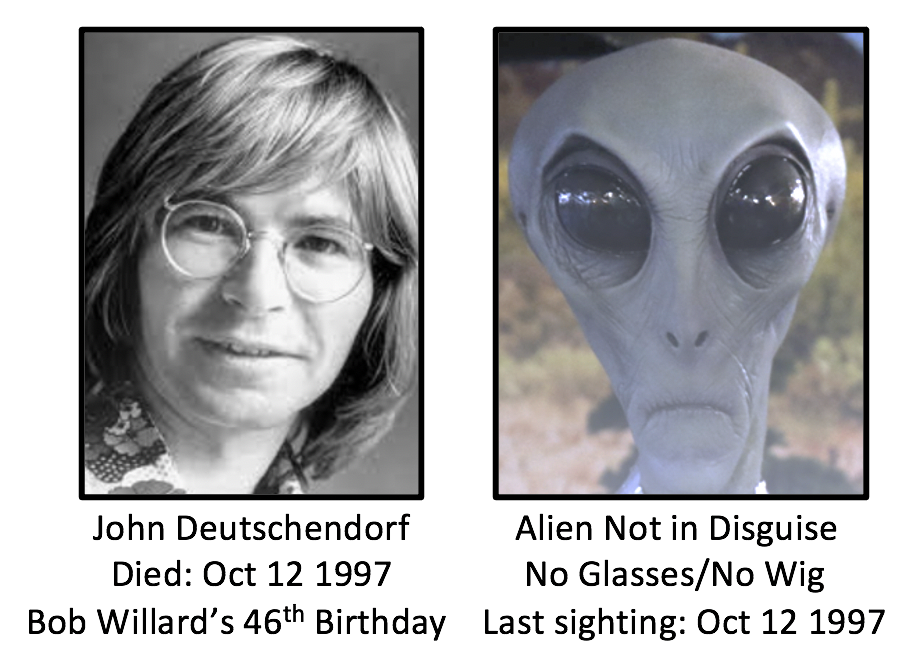
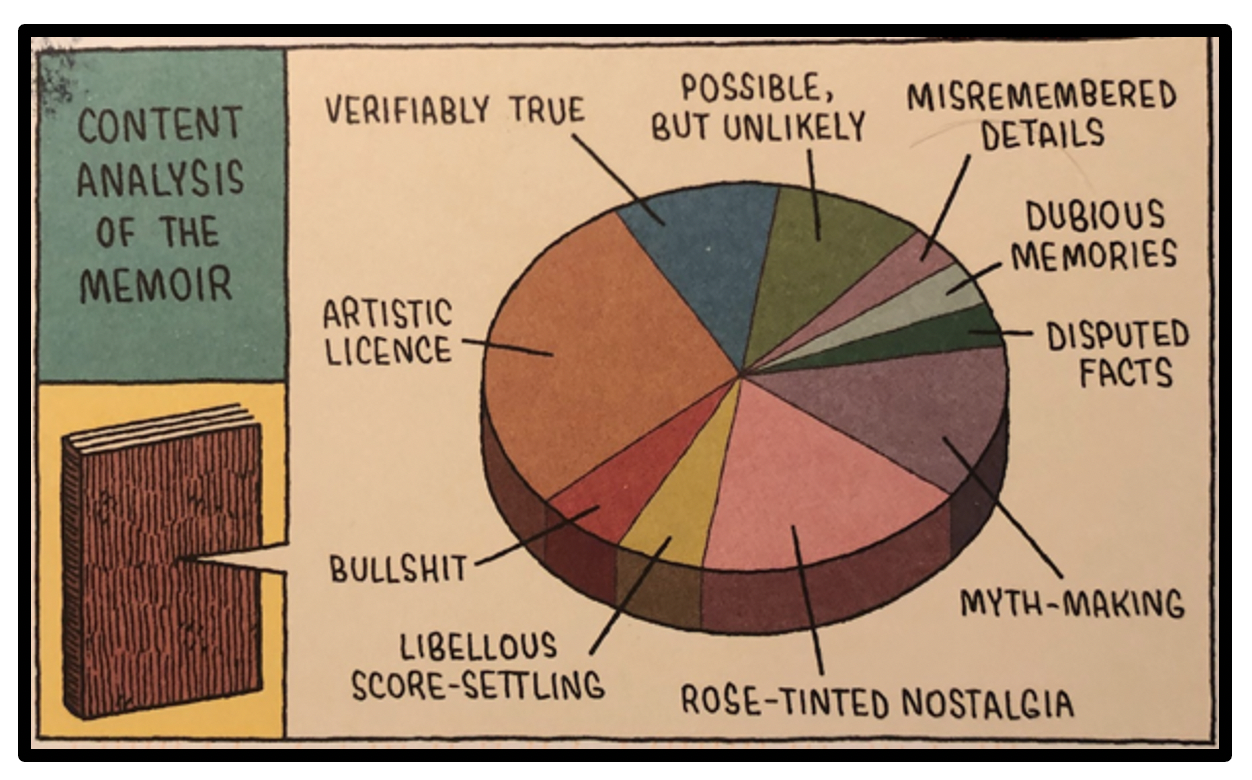
 Cantations