From the Bob Willard Collection, Volume 4
August 25, 2020
The Vietnam War was televised nightly in the late 1960s and early 1970s. It was horrible. I didn’t want to even think about Vietnam, and it wasn’t a topic that generated enthusiasm from any of my friends. Individually and collectively we didn’t think it was a good idea for the United States to be there. And we felt it was absolutely absurd to believe that natural rubber had anything to do with it. Some official reports alleged that a significant reason for the war was to militarily ensure the continued supply and perhaps over-supply of natural rubber exporting to the United States of America; the product used in sink stoppers, pacifiers, Playtex and prophylactics, also known as rubbers. And about 3,000 other uses at the time. We entered Grade 12 in September of 1968, when the conflict’s flames began licking higher and burning hotter and coming closer. We were all approaching draft age, soon. One in particular had already arrived.
But rubber wasn’t religion which mankind had waged wars over forever and ever and ever. And it wasn’t black crude oil. Rubber wasn’t heavy water (D2O), either; a critical compound for atomic bomb research, for cooling reactors, and the primary reason Germany invaded Norway at the beginning of World War II. Norway had the only heavy water producing hydroelectric power plant in the world at that time. And rubber didn’t have the intrinsic value of large underground gas deposits. Rubber isn’t even rice. You can’t eat it.
Rubber is an extract tapped from rubber trees that happen to grow well in Southeast Asia. Yet polymer scientists even knew then, in the late 1960s and early 1970s, how to make synthetic rubber, which wasn’t equivalent to natural rubber in many applications, but go to war over rubber? And rubber isn’t nature’s heaviest element – uranium. Rubber is more like Dubble Bubble gum. Not even Bazooka-standard.
There was a much larger explanation given to rationalize arming the United States military to engage in battle in South Vietnam. It was to stop an expansion of Communism into Southeast Asia. It was called the domino effect and the idea had been around for a long while. President Eisenhower introduced the theory in 1954. North Vietnam was already a Communist country and bordered China, another Communist country that became so in 1949 following Chairman Mao’s revolution. The theory described South Vietnam becoming the first next country to fall to Communism; the first domino to fall. Then there would be a second, maybe Cambodia or Laos and a third and so on… tenth… twentieth… a hundredth. Democratic countries or Republics being forcefully converted to Communism was viewed as an existential threat to the United States, democracy, apple pie and free elections.
It didn’t take long after the constant nighttime bombardment of news blasts from Vietnam for it to become known as the ‘living room war’ or ‘the television war’. The distant discordance became the keynote of American politics. Film shot in Vietnam of forests burning and people burning and explosions and crying children and chaos and bombs and mud and debris and of the dead mouldering in the soil was flown to Tokyo daily from where it was transmitted via satellite into American living rooms each night with pounding kettle-drum beats by broadcasters primarily on NBC but also on ABC and CBS. It didn’t seem like it would ever stop. The war filled the cracks and fractures of our minds, where it took up an unwanted residence, like a parasite.
The first Vietnam Selective Service System lottery was televised December 1, 1969. It felt even more horrible than the war. The war raged on the other side of the planet. But the Selective Service System (SSS) draft lottery… that was home. That, too, was broadcast into our living rooms. But this was personal. The lottery decided who would be called up to get their head shaved and sent to boot camp for six-weeks. Boot camp graduates (sans diploma) received one-way tickets to Southeast Asia; two-ways weren’t provided because no one knew who would fly home sitting upright with a securely-clasped military seatbelt while holding a filled canteen, a meat sandwich, salt and a paper napkin vs who would be lying horizontal in a hastily assembled wood box draped by an American flag in the cargo section six feet below in the frozen bowels of the plane.
The SSS lottery specifically determined the order as to who gets called up first, and then second, and third and so on… tenth… twentieth… a hundredth. The order of being called up, a person’s draft number, hung in the balance based on their birth date. The sooner your birth date was drawn out of the cylindrical drum, the more likely you would be called up to serve. The first Vietnam War lottery applied to those males born beginning January 1, 1944 ending December 31, 1950; men between the ages of 19 and 26. Girls and women of all ages didn’t have to worry about the draft. The military wouldn’t shave their heads. Girls and women only had to worry about friends or husbands or brothers or fathers or uncles or lovers or neighbors getting killed or maimed for life. That’s all they had to worry about. Men were in a boat to hell and women were in a different boat to hell.
Let’s be clear. The lottery existed because it was an unpopular war and Uncle Sam couldn’t find enough eager hands frantically waving, ‘Take me. Take me. Please! I want to be in a war.’ There weren’t any lines of volunteers banging on the doors of the enlistment buildings like there had been in WWII. And you couldn’t pay or bribe someone else to take your spot which was popular with the rich during the Civil War. People weren’t carrying signs that said ‘Save our Rubber Sink Stoppers’. The SSS settled it all based on birth dates instead of grade point average. Colleges cared about grade point average. The military draft didn’t care about how smart you were.
The method chosen to implement the lottery was intended to make the draft selection process random. The military minds that designed its execution confused random with equal. But random and equal aren’t the same thing. The process was simple and maybe what you’d expect: 366 birth dates were printed on 366 pieces of paper which were placed in 366 identical plastic blue capsules and those 366 plastic blue capsules temporarily hid the future for over 2,000,000 American males. Congressmen and specially selected invitees would pick one capsule at a time out of a 30” tall Plexiglas-looking clear cylinder and the date enclosed was announced on national TV. Twenty six December birth dates were drawn in the first 195 leaving only five December dates drawn beyond number 195 (five of the next 171). Why is 195 important? Because that is the highest number called to service from that first draft on December 1, 1969. November birth dates were the second quickest month to be snatched out of the drum.
The blue plastic capsules were poured into a drum one month at a time, with November and December being the final two months added. Spinning the drum slowly kept the capsules together as they cascaded evenly for an hour. The drum, as it turned out, had been spun too slowly. November and December remained at the top of the military draft soup, like last-second hand grenades thrown on top prior to serving.
So, once the first Vietnam draft lottery ended, males born in December for the seven years beginning in 1944 thru 1950 had a 3x greater mathematical chance of being called to service than grade four arithmetic would average, had the process been truly equal. The hullaballoo and haranguing that ensued forced a change in the system for the following year’s draft in the summer of 1970. This time, two drums were filled with the same identical blue capsules: one was choked with birth dates and the other with numbers for each day of the year. The systemic bias found in the first lottery was corrected. The July 1, 1970 summer draft was again televised and would affect all of my classmates, including me.
 Steven Wade Irwin lead off our class with blue plastic capsule #39 picked in that first draft on December 1, 1969. Steve attended University of Colorado in Boulder for at least two years and may have gotten a 2-S Student Deferment beyond that. Whatever happened, Steven escaped unharmed but had his own tour of duty working for years and years in Saudi Arabia. Reports suggest he lives in Arizona back in America. Welcome home, Steve! Would love to hear all about it. I have been told that Steve has written quite extensively about his time in Saudi Arabia. The issue is getting our hands on it and applying our eyes to it. It would be a great read for all of us who grew up with Steve. For all of us that continue to care about him and only wish him the best of everything.
 Bob Willard was next, #70. The second of our neighborhood October babies did not draw a good draft number. But Bob, perhaps for a diversion, had smoked some weed, and joined a group of four classmates that decided to join the Navy, to enlist, in the Spring of 1970, prior to the July 1 lottery. Two months before he’d draw #70! He flat out flunked his physical due to excessive weight, including an inability to walk steadily, and alarmingly elevated blood pressure. Classification: 4-F. But that’s a BINGO. Nice job, Bob. Died from cancer complications on March 15, 2020. RIP brother. I will take our lifelong friendship to the grave, as did you. As Bob often prophetically said: No one gets out alive!

It must be catalogued and chronicled at some point, so I may now be permitted to detour to a small event and inject it here. While in Jr. High School, our Assistant Principal, Mr. Boardman, had an impressive and ominous array of wooden paddles displayed on the wall of his Assistant Principal’s office on the second floor of the school. Some paddles were of notable thickness and they came in different colors. The boards, or paddles, entailed more purpose than just an artistic wall arrangement, impressive though they may have been to the casual admirer. Each paddle fit into the palm of the right hand of Mr. Boardman such that he could wrap his sausage fingers around them securely and comfortably and swing them easily with menace. He used them to give unruly students a reminder as to the rules and regulations of young adulthood. Many of the paddles had holes bored through them so that they moved through the air more quickly and more easily. The arsenal on the wall may as well have been the heads of American elk or wild boar. One could have been a grizzly bear. It was the thickest of all the paddles. Another paddle was dressed with a red fox hanging down from it including the narrow bullet head, its sharp teeth and black reflective taxidermy eyes. There was no carcass. No entrails. Being a devoted fly-fisherman, the wall paddle hangings may have matched the character of the man more so had they been Rainbow Trout, Brown Trout or Blonde Carp. Mr. Boardman was actually a kind, genial man who loved fishing that in this sometimes-other life was forced to don the burlap head covering of the axe-man swiping the head off of a sinner. It’s not who he was; it’s just what he did.
Many paddles were gifts of Thank You given to Mr. Boardman from students of bygone years. Many had been made in Mr. Adams’ wood shop: Eastern black walnut, White oak, Silver maple. But those were decorative, like the hard candy Valentine hearts we gave out in elementary school, with words of love seared into them. They weren’t typical of the hardworking paddles Mr. Boardman used to ‘dust off’ students that required personality realignment. The ‘dust off’ paddles were legendary. As was the pain they inflicted. His paddle of choice lived in the top right drawer of his over-sized Philippine mahogany desk and was within easy reach when the situation demanded.
If you were caught doing something bad at school: sassing a teacher, pulling a pigtail, swearing, bringing razor blades to class, things of that nature, you were told to ‘Go see Mr. Boardman’. He’d tell you to bend over, and he’d give you a smack on your rear, in his office, and back to class you’d go. Unless you were constantly sent to see him, and earned the designation as a ‘frequent’. Over the three years of junior high school, Bob Willard and Mr. Boardman became very fond of one another, and were on a first name basis. Bob was the only one of our group allowed to call Mr. Boardman by his first name, David. Not out of disrespect… but out of familiarity. Once a student became a ‘frequent’, his stature elevated, and upon each successive visit, that student would meet Mr. Boardman downstairs, in the boys’ large bathroom after school. There was enough room down there for Mr. Boardman to employ a full wind-up, with the room’s echo announcing each collision, like the report of gunfire on the battlefield. The ‘frequent’ were allowed to run around the row of eight stalls, howling after each blast, and return to the starting line, for a repeat. Then, whack! And again, it was off to the races, allowing the hot spot to cool slightly.

Bob was up to 35 ‘Sundays’ for each after school basement bathroom visit by the time we graduated from 9th grade, late May, of 1966. That wasn’t a record, but it was close. ‘Sundays’ were full, extended-arm swings with wallet removed from your back pocket. 35 was good enough to earn Bob 2nd Place in our class. Only Tai Jessup received more ‘Sundays’ than Bob per visit, 42. I confess that I don’t know what happened to Tai as he was no friend of mine. He may have gone to Vietnam. I do know he lived down the block from Wayne Matsuda, who we will meet shortly.
 Joe Mark: drew #73. Just three selections after Bob, and also not a favorable draw. Joe was one of the four classmates that drove with Willard to our local draft board headquarters, on Stout Street, in downtown Denver to join up, to enlist. Joe passed his physical with flying colors, unlike Bob, and became a Navy pilot after graduating from Annapolis, in 1976. Joe was the only classmate that was accepted by the board. One, Bill Jent, had a curvature of the spine, and the fourth, Greg Boyd, was also rejected. But Joe went on to a long, distinguished military career. Flew P3C-Update II aircraft tracking enemy submarines in the North Atlantic. Says he never killed anyone. Thank you for your service, Joe. Joe’s birth date is the same as Steven Wade Irwin, but Irwin was born in 1950. Joe? 1951, typical of our class.
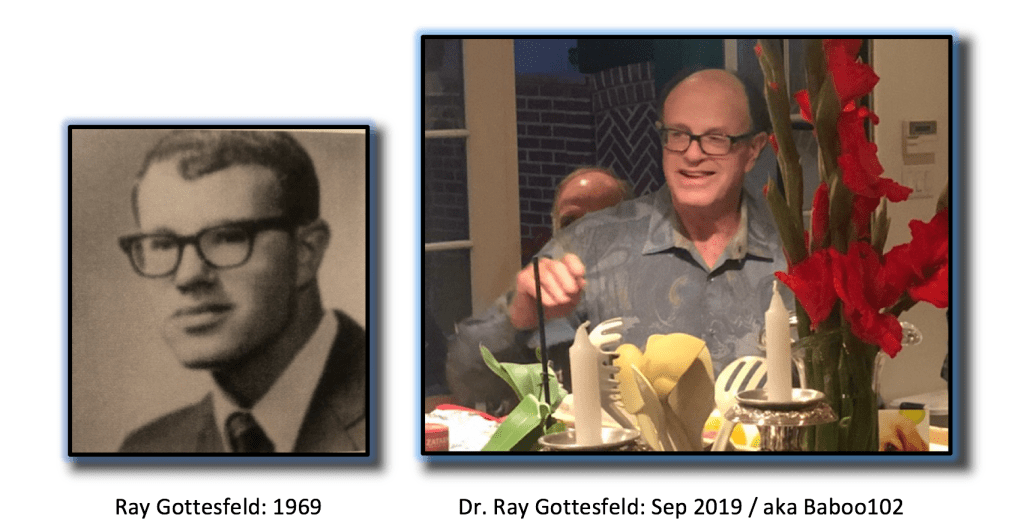
 Ray Gottesfeld: drew lottery number 90. Class Valedictorian, resident smart-guy, resident nice-guy. Ray got a 2-S Student Deferment while attending Dartmouth College as an undergraduate where he Majored in Religion and then on to medical school at the University of Pennsylvania. Ray has been a distinguished OB/GYN in Denver for 40+ years. Ray professionally spread a scar-preventing butterfly band-aid on our nine-year old son’s forehead, in the parking lot of Box Canyon, near Durango, Colorado 20+ years ago. Hadn’t seen Ray for a decade, and he just showed up when we needed him. It is off duty caring that characterizes Ray even now. Thanks, Ray. Thanks, Baboo102.
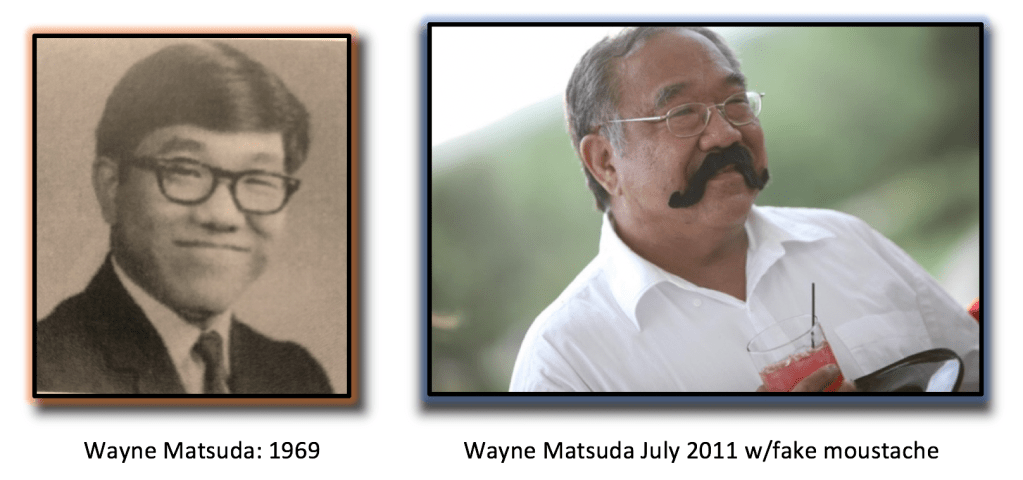
 Wayne Matsuda: #156. Not the Class Valedictorian but could have come closer with more tutoring from Ray. All-around smiling personality, and a spirited Hide and Go Seek champion – opponents just could not find him. We think he just kept going home to eat. Plus, his front doorbell either had a loose wire, or was purposefully pillow-muffled indoors, during games, so his parents wouldn’t hear it ring, answer the door, and say ‘Hello. Oh, yes, Wayne is right here. Would you like to come in?’. Wayne would have been an excellent advance scout on any battlefield, but we all preferred that he stay home, inside safe soundproof walls. Good trumpet player… sat in the last row next to Dennis Blum his entire career: the two tooters. Sometimes, for fun, they would turn the sheet music upside down. One Christmas holiday band performance, we were playing Noel, and they were playing Leon. Wayne got a 2-S Student Deferment. The typical drill… avoided all the problems. But 156 was not a great number. It worked out for Wayne, and we are happy about that. So is Wayne.
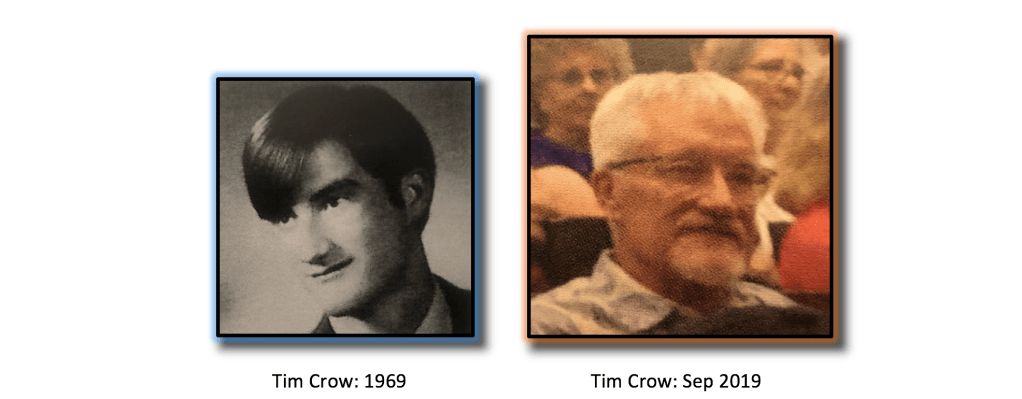
 Tim Crow: #201. Tim landed a possible borderline number. He chose the 2-S Student Deferment route at UNC, in Greeley, Colorado, attaining a teaching degree. Escaped military service altogether and should have been on their track team, because this guy could fly down the racing lanes. He just ran faster than everyone else, by a lot. It was kind of comical. Jerry Houlihan was another kid that was fast, but not like Tim. They were the two fastest, but smart money would go to Tim. Tim also held the school triple-jump record, for years. Got married and had 2 kids (boys). Now retired in Oklahoma City with his new reading toy: a Kindle Paperwhite. ‘See Spot Run.’ Tim taught elementary school for a long time. Las Vegas for 22 years. South Bronx in NYC for 9 years. OKC 3 years. His mom, Lucille, made the best French toast when we were growing up… will never forget the powdered sugar. Tim is a lifelong friend that I love dearly. Whenever the phone rings, I’m there for him. No explanation needed.
 Ben Kempner: #239. Ben landed #239, considered at the time to be almost completely safe from being called up to serve. The war was likely to pass right past Ben. But no one knew how it would play out. That being the case, Ben played the game perfectly, got his 2-S deferment while attending University of Denver. Majored in Psychology but continued on, grabbing an MBA, also at DU. Met his wife-to-be, Adria, at DU. Went on to an exciting profitable long career at IBM as a Director of Marketing, living in Olympia WA and Connecticut and Massachusetts and more. Also in Asheville, North Carolina. Married Adria in 1975. Now fully retired in Las Vegas, NV where state taxes are low, like zero; but the reason for moving there was Adria’s love of desert and hiking.
One of Ben’s current hobbies is genealogy, both personal, looking for ancestors, building a family history… and for friends. It took him only minutes to locate the grave stones, and pertinent information, for two of my own grandparents, and an uncle, and an aunt. Has become a much closer friend of mine with frequent conversations, comparing notes, with Willard now moved to the side line by his own dirt nap; not that Willard was ever the blockage that kept Ben and I from knowing one another. Ben was one of those kids that shot up in height between 11th and 12th grade – late growth spurt. I’m still waiting for mine. I am proud, and happy, to have made the connection with Ben after a lifetime of watching him from the shadows, from across the hallway, or from behind the flag poles.

Our next graduate knows a few somethings about guitar. And the first one he ever held, smelled, strummed, picked and apparently cherished, was mine. It was a Sears Silvertone. The year was 1962. The location was my basement bedroom. The young lads name continues to be….
 Bill Frisell: And he received #319 in the pull. Lucky bastard, and forever one of my closest friends. Ya, Frisell! Went on to study guitar… became a famous award-winning composer and musician. Frisell performs everywhere on the planet, and is revered internationally. He deserves every bit of the recognition. Walking through a long tunnel, a few years ago, connecting a remote parking area to the town center of Ravello, on the Amalfi Coast, in Italy, I sensed I’d pass a poster advertising Bill Frisell and his band, at some point, stapled on the long inside wall. And there it was. Didn’t surprise me to see it, and I didn’t have to look hard to find it. Italians love Bill Frisell. As do I. As do I.
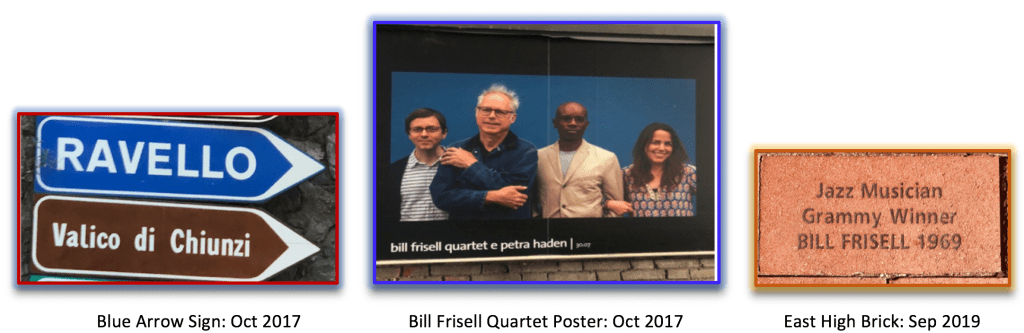
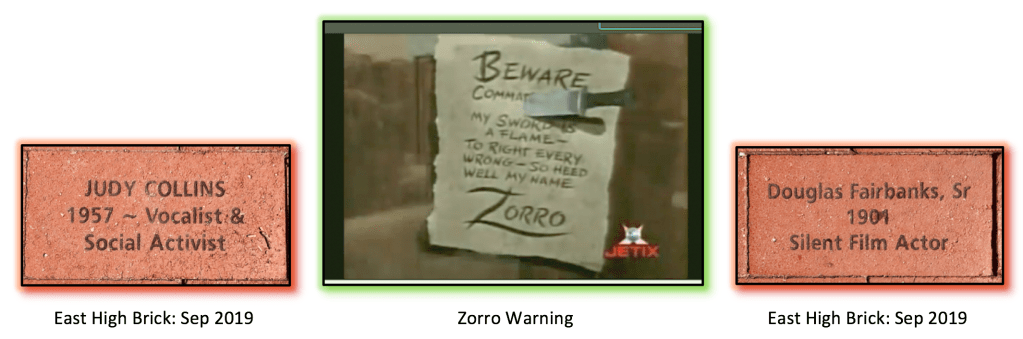
Bill even has a fancy red brick with his name etched into it, cemented into the walkway, in front of East High School, along with other famous East High graduates, like Judy Collins (singer/songwriter), Jerome Biffle (1952 Gold Medal winner in Helsinki, Finland for Long Jump of 24’ 10”), and Douglas Fairbanks (swashbuckling film star, and Hollywood icon, who was actually expelled from East for cutting the school’s piano wires, but we are free-minded, and include him, because he was Zorro, and a lot more. Douglas Fairbanks started performing at Elitch Gardens summer stock theater in the late 1890s. He started United Artists movie studio, in 1919, along with wife, Mary Pickford, Charles Chaplin, and Director DW Griffith. In 1927, he was the first Hollywood star to have his hand, and footprints, placed in wet cement, in front of Grauman’s Chinese Theater, and later became the first President of the Motion Picture Academy of Arts and Sciences. Died of a heart attack in 1939.
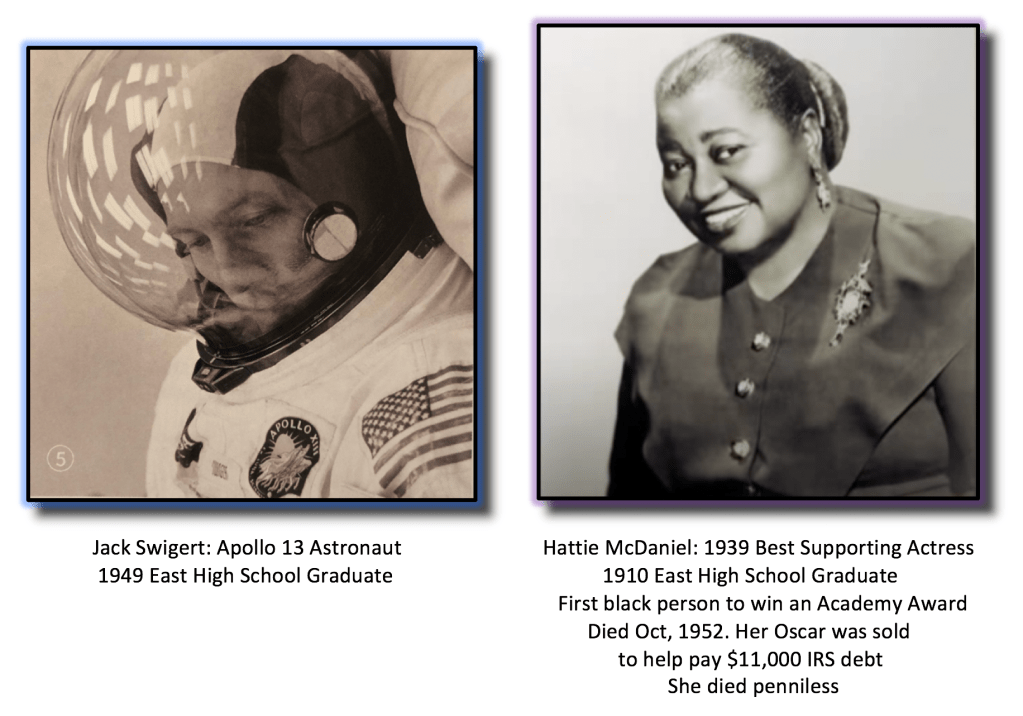
The list of names goes on and on and you may not have heard that Mamie Doud (aka Mamie Eisenhower, Ike’s wife) graduated from East High School. You might remember Mamie from her unforgettable quote: ‘Ike runs the country, and I turn the pork chops’. You don’t remember that unforgettable quote? I didn’t either. Never heard it before. Maybe once. I ‘think’ I heard it. I’m not sure. Did I? I can’t remember. Mamie became our East High School First Lady. Marilyn Van Derbur was our Miss America… first Miss Colfax (as she was known) who then became 1957 Miss Colorado (as she was known) climaxing as 1958 Miss America wearing her crown. Jack Swigert, Apollo 13 astronaut graduated from East. So did actress Hattie McDaniel, ‘Mammy’ in the 1939 Best Picture Gone With The Wind. She was the youngest of thirteen children born to two slaves in 1893. She became the first African American to win an Academy Award. She won Best Supporting Actress over Olivia de Havilland, nominated for the same award, also for Gone With The Wind.
There were a lot of graduates from East High School that became famous, including Pam Grier, aka Jackie Brown. But she might not be the most famous Grier. That distinction may belong to her uncle, Rosey Grier, defensive tackle and original member of the Los Angeles Rams Fearsome Foursome. He’s also one of the men that bearhugged, and wrestled, Sirhan Sirhan to the ground after he shot RFK, on June 5, 1968 in a ballroom, in the Ambassador Hotel, in Los Angeles. Robert Kennedy died the next day, reclassifying the murder attempt as an assassination. Rosey Grier was a bodyguard for RFK during his Presidential run, in 1968, and was protecting RFK’s wife, Ethel, that day. Here’s what Ted Kennedy said of RFK, his brother, at his eulogy:
‘My brother need not be idealized, or enlarged in death, beyond what he was in life; to be remembered simply as a good and decent man, who saw wrong and tried to right it, saw suffering and tried to heal it, saw war and tried to stop it. Those of us who loved him, and who take him to his rest today, pray that what he was to us, and what he wished for others, will someday come to pass, for all the world. As he said many times, in many parts of this nation, to those he touched, and who sought to touch him: ‘Some men see things as they are, and say why. I dream things that never were, and say why not.’
Hello darkness my old friend….
Sad and glorious times.
 Gary Buckstein: Another fellow October-baby received lucky #332 in the lottery. It didn’t take Gary long to figure he wouldn’t get drafted with that beauty of a number, so he went 1-A almost out of the gate, didn’t get called up within the one-year eligibility that a 1-A classification afforded and built a very successful business in Arizona selling and servicing microscopes. Gary was our Napoleon… short, but a fearless fighter whose conquests continue back home in Colorado happy at retirement age with his wife, Tere, who had dated Steven Wade Irwin prior to dating and then marrying Gary. That is the extent of my knowledge surrounding that. Ask Gary.

 Dennis Blum: His German ruby-throated professional-caterer, delicatessen-owner loving awesome mother, Alice, screamed aloud like a pumpkin puree at high whistle and was understandably thought to have passed out when she was alerted that her little Denny had drawn #365. The very last plastic blue capsule ceremoniously captured brought the curtain down, closing the show. Our birth year, 1951, had no leap, no February 29… so 365 was it. Denny landed an impossible double contorted flip, quadruple pike, inverted somersault earning the perfect score of 10.0. It was the best report card he’d ever receive, until meeting Lynn, his bride from Iowa some years later. Congrats, Baboo101. July 7th was the final pull on the yoke and what a winner you are, still! You always were and continue to be one of my best friends. I value our friendship immensely. As you know. I look forward to staying at your house when I visit Denver. The upstairs room in the back overlooking the manicured yard on one of Denver’s finest streets with a parkway in between dividing east traffic from west. It is another lottery won by you, my friend. One of Denver’s greatest streets.

Me: #17. No joke. #17. The 2 ½ inch white strip of paper with October 25 printed in Helvetica Bold was stuck to the draft board behind the television circus as the 17th plastic blue capsule drawn.
I applied for and received a 2-S Student Deferment for the first few years while attending college like many of us, but #17 beat over my head like a wartime metronome and would come to performance if and when the deferment ran its course and terminated. No one knew how long the Vietnam War would last. None of us with low numbers knew how long the sharp sabre of the selective service would stab at our throats. Our side, the good side, the United States of America side, the greatest country in the world side, wasn’t winning. Neither side in the Vietnam war was strong enough to crush the other.
There were protests in the streets and in front of capitol buildings and lots of anti-war songs written and drugs became more available and experimental. There was a strong movement against the war that targeted Richard Nixon, but the war still raged… it was still on TV all the time. Every night. It was quite obvious that I was going to have to deal with the #17.
As the war bolstered and college graduation neared, I measured these options:
#1: Have my big pals Bob Willard and Randy Guber tackle me forcefully at the same time from opposite directions, damaging my knees. Would they do it? Would it work? Was I serious?
#2: Go to Canada? Then what? Never see anyone, again? What do people do in Canada?
#3: Go for a 4-F Classification due to extreme club feet at birth and very early ages of my life
#3 seemed the best choice, allowing for numbers 1 and 2 to remain undesired back-up plans. So, I contacted my doctor to ask him to write to the local draft board about my club feet; how I wouldn’t be able to hold up to the marching and the pressure and I’d be a drag on my platoon if I had active duty. My doctor, however, was also my father. The bias could not be camouflaged. But my father had always been my doctor and it is he who had literally given me the ability to walk at all. At birth, both my feet faced almost entirely backward. I’d been awarded to an orphanage where he was the orthopedic surgeon taking care of me until he and my mother adopted me at 19 months young. It took just over two years for my father, my doctor, to turn my feet around. Now he had to save my life again… in a different way.
The draft board directed me to come in for a physical. They wanted to bear witness and measure my malady. The staff member at the draft board recorded my height and weight and took my blood pressure. Then a doctor in military clothes stuck a scope down my throat. The light he shined up my nose revealed nothing. He asked me to drop my pants, turn my head and cough as he checked for an exposed intestinal loop called a hernia. Sadly I had no loop that he could locate.
And then he looked at my feet and read the letter my father had written and looked at my feet some more. There were lots of checkmarks on the form which meant I had a lot of good things going for me, which weren’t the results I was hoping to receive. But the orthopedic surgeon specialist for the draft board wasn’t ‘in practice’ that day, so they arranged for me to be put up in guarded hotel room overnight to return the next day, when their orthopedic surgeon was scheduled. After a conversation and a bit of waiting, I was told I was allowed to go home with instructions to return the next day for physical #2, this time with their orthopedic surgeon. If I didn’t return, I was told I would be arrested, court marshalled and strung up.
When I went back, I didn’t have to do anything. It was quick. The orthopedic surgeon never looked at my feet. He read the letter from my doctor and issued me a 4-F Classification paying homage to my father, whom he knew well and respected greatly. My father had been his teacher at CU Med School and taught him to become an orthopedic surgeon, not seven blocks from where I grew up.

The Falling Dominoes Theory that East High School’s Mamie Doud’s (Eisenhower) husband, President D.D. Eisenhower, warned about in 1954 turned out to be far-seeing. Following the Paris Peace Accords in 1973, which ended the United States’ involvement in the Vietnam Conflict while promising the release of U.S. and other nation’s prisoners of war, both Cambodia and Laos fell to Communism in 1975.
The Sears Silvertone guitar Frisell cradled in his hands for the first time in my basement bedroom was a beginner’s inexpensive instrument. He didn’t know how to play it. He’d never played a guitar before. He didn’t know what he was doing. I had no idea the attachment and connection that moment brought to him. Frisell didn’t say a word about it then, but he’d tell you now that it was ‘the magical beginning’, and I would add, ‘of his incredibly stunning future’.



 Cantations
Great as usual.. Never new most of the draft numbers.. I remember watching it on TV.
LikeLike