From the Bob Willard Collection, Volume 2
June 24, 2020 First Edition
Denny Blum, aka Blum, was one of the only Jewish kids that was in our grade at Teller Elementary on 11th Avenue and Garfield Street in Denver. The years spanned 1956 to 1962, bookending the standard K-6.

Denny was a good student and as such the expectations of him were always high. His assignments were competent and on time. Test scores were routinely above 90. Gentleness, helpfulness and generosity were noted on report cards. Attendance was exemplary — interrupted just once on Purim to help with last-minute emergency catering. And Alice, his good, kind and wonderful mother, made sure Denny vas zent to schkool clean un ze morgen. Denny vas a goot kid. And ve all agreet.
‘Denny, dat you schrubt unside und outside da ears?’
‘Yes, mom,’ was the honey-lavender reply as the front screen-door quietly clicked shut behind him.
Other than a few days of scare in 4th grade, an alarming tuberculosis concern that disappeared when further test results were returned negative, all signs were positive for Denny. Indeed, his attitude was always positive. Years later, with the normal accumulation of life experiences, uncertainty occasioned his demeanor, but that was no different from any of us.
To be fair, Denny may have benefitted had he practiced his trumpet a little bit more for Mr. Fredricksons’ 5th grade band class, particularly in advance of the 7:00p May concert.
The dimly lit auditorium was scatter filled with parents anticipating our performance. Some parents had high expectations and sat up front. Others, more knowledgeable, chose seats farther back in the darkness and shadows. They had already been entertained by mis-toots and squeaks during last minute practicing at home the night before.
The parents of Bill Frisell beamed in the center of row C. Both rows A and B were roped off and not available that evening. No explanation was provided… or needed. We all knew it was because of the heavy rains. I saw the school janitor working there all day. He admitted that he could not promise results.
Frisell was usually our first chair clarinetist. He practiced his technique a lot, so much so that the acid in his fingers began to dissolve the chemical coat compound applied to his clarinet keys. I didn’t even know that fingers had acid on the inside of them but Frisell’s decaying clarinet keys was proof.
Denny Blum’s mother and father took aisle seats farther back than Bill Frisell’s parents. They squeezed into Row N, next to the side door auditorium emergency exit.
From on-stage I watched Mrs. Blum make sure that if opened, the door wouldn’t set off any alarm bells.
All three finger buttons on Denny’s trumpet looked fine. No evidence of corrosive finger acid. There was no overuse. Denny made sure of that. In fact, all the finger buttons looked brand new. It was just Frisell’s clarinet keys that couldn’t hold up.
After carefully corking all five clarinet pieces together to assemble his instrument, Frisell followed Mr. Fredrickson onto the auditorium stage for the 7:00p spring concert, leading all other band members to their metal folding chairs partially hidden by music stands.
Wayne Matsuda carried his shiny cornet proudly stuck under his arm and took his ranked position chair next to Denny. Wayne’s cornet was quite a silver dazzler as shown in the snappy picture of Wayne busting out of his shell and holding his dazzler below.

That’s the exact cornet that Wayne tooted into Denny’s ear throughout every band class for over six years. Well, except on the day that Denny was absent due to the Purim catering emergency. More and more, the notes that Wayne tooted matched those printed on the sheet music.
But it wasn’t just Wayne. Practicing the trumpet was not Denny’s forte, nor his fortissimo, and many of us were happy for him when he shut his trumpet case’s brass locking clasps one last time. It happened years later. We called it ‘Blum’s Finale’.
Denny’s last horn bloop preceded a collision when Denny was racing up the stairs in grade 11 in the back hallways of high school and ran full steam into a descending Mr. Tagliavore, our band teacher.
Their bodies collided and their chests made contact and they head-butted each other. There was blood coming from Denny’s nose and red-faced Mr. Tagliavore looked like he got run over by a milk truck when he came into the classroom a few minutes late. His shirt wasn’t even tucked in. Denny said it happened at a turning corner in the stairway and there was never much disagreement about that.
Mr. Tag over-reacted and sent Denny to the school principal’s office where Denny denied premeditation and argued against any malice. Denny called it an accident. He was rushing up the stairs to make band class so as not to be late.
He explained that he was coming from the Honor Students seminar for all nine public high schools in Denver that was being hosted in our own school’s auditorium. Our school’s administration had been the ones to hand pick Denny to represent East High at the assembly.
There was no prior school record of misbehavior of any sort from Denny. Yet when suggested, he agreed to quit the band. And so it was. I knew he had been contemplating it beforehand. So, Denny no longer tooted his golden horn and Wayne lost his music stand partner. They had shared music stands every day in school for years.
It was only natural that Denny and Wayne bonded early on. Some kids bond over four square and hopscotch. Some over tootsie rolls. It was always easy to bond over tootsie rolls. That’s an easy bond. Not a strong bond, particularly. The tootsie roll bond is not a lasting bond. Denny and Wayne bonded over sheet music and music stands. They were a tooting duet for a long time.
A classmate of Denny’s and another Jewish student attending Teller Elementary was me. I observed Judaism to a far lesser degree of dedication than Denny. I guess it just didn’t hold my interest. I didn’t understand religion or god or even Purim. I still don’t. I never investigated Purim and have no current plans to do so. Haven’t read about it. I had no appreciation for Ester nor Haman, and thought Haman was an incredibly ugly name that projected evil. Herman Melville didn’t begin Moby Dick, ‘Call me Haman.’
I didn’t build a sukkah for the Jewish festival called Succot as Denny had done (I helped a tiny fraction but it was Denny’s sukkah). Denny was proud of his sukkah following its construction completion. Dennyt was a real cutie. So was his sukkah.

He smartly seared big block letters like A, B and C into the corners of the four-by-eight wall boards for easy reassembly in future years.
I didn’t practice playing dreidel to develop any sort of reliable dreidel skills. Dreidel is part of the Jewish holiday, Chanukah. Dreidel was never my sport. I never built one out of clay. I don’t think that even Denny ever built a dreidel out of clay, no matter the rhyme.
Instead of sukkahs, I built tree houses in the sturdy limbs of the Chinese poplars on the parkway along the side of my house. I also built sheds in my backyard. Both the tree houses and the sheds were large enough to sleep up to four kids.
But I didn’t build them by myself. Bill Frisell and Bob Willard, and Tim Crow and Charlie Wagner, and Miles Kubly and Denny Blum all contributed their blood and toil to the overall construction of the tree houses and the sheds. A drop of Frisell’s blood here and a small splat from Charlie and Miles over there. That didn’t stop us.

We patrolled back alleys pulling red and black wagons searching for lumber stashed behind neighborhood garages. Willard, Frisell and I hit the jackpot when we came upon a garage packed with old, beat up lumber. Most was not usable. But there was enough.
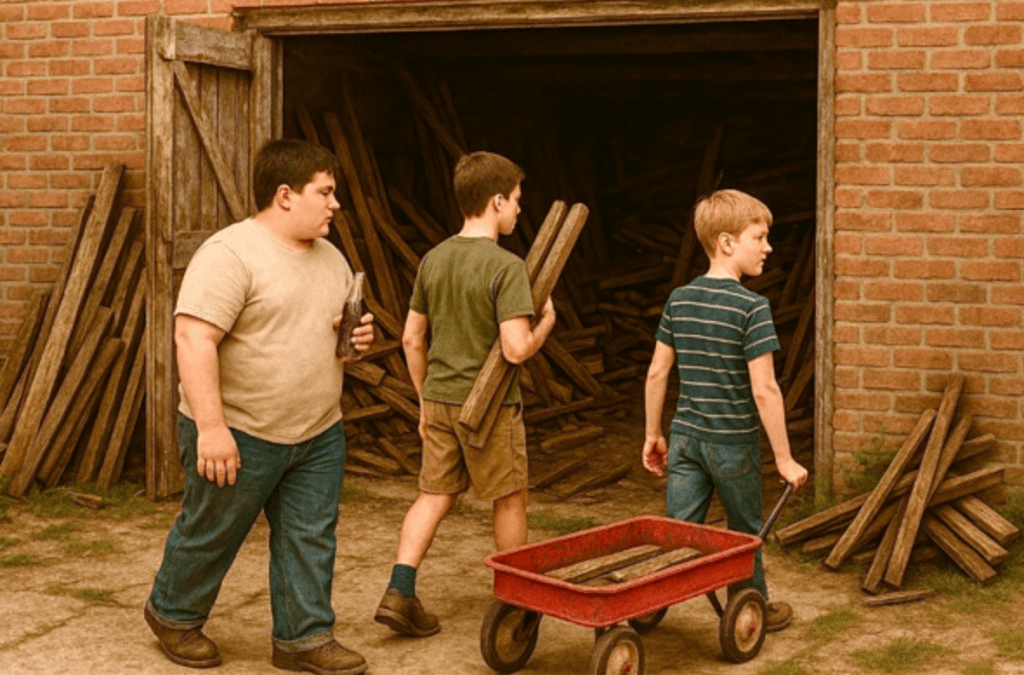
We pounded common nails and finishing nails, and roofing nails and thumbs. We used rip saws and crosscuts, and coping and hack. When we lifted an un-opened roll of roofing paper from the inside of a garage two blocks away, we knew the inside of our shed would remain dry from spring and summer afternoon thunderstorms.
A few of us shot bb’s from slingshots at cars below from one of the tree houses. We also tacked two Playboy magazine centerfolds behind Mexican rugs hung on the interior walls in the backyard shed. I had heard, and Frisell confirmed, although Willard said his father told him it wasn’t true, that we could go blind looking at Playboy magazine centerfolds, but we were hopeful it wouldn’t go that way as we repeatedly pulled the Mexican rugs away from the walls. One time we pulled the Mexican rug away from the wall the whole day.
The door to the shed was a clever makeshift drawbridge that any of us on the inside could pull up by an attached knotted rope. The design included the ability to lock anyone out that we deemed unworthy or unwelcome. Margie Samuelson was an old floozy that lived three houses down the alley and she came over to see it. She didn’t even know about the shed until I told her about it once when I was caught having to visit her and her older mom in their living room.
The day Margie Samuelson dropped by to see the shed, to go up the drawbridge and actually peek inside, was the day that the Mexican rug had pulled away from the wall leaving the Playboy centerfolds fully exposed. I know she saw them. She looked right at them. She didn’t say anything but she had a different kind of manner when she’d trap me visiting her in her living room with her mom. I don’t think she ever brought her mom over to see them. I don’t think her mom could even leave their house.
Bob Willard, or Big Bob as he deserved to be known, clamored for us to use #10 screws in our tree houses and shed construction efforts, but screws were too difficult. And not fun. Hammering was fun. Pounding nails was rewarding. Turning screws required too much oomph, required more time, and none of us had developed that wrist strength. Except for Big Bob. He was our neighborhood’s Larry Mondello. The rest of us were Theodore Cleaver and Whitey.
Big Bob was bigger than everyone else in the neighborhood. He was the first kid to get calves. He could kick a soccer ball 2x farther than next best. It was never close. Big Bob won the 1st Place Ribbon for Long Distance Kicking at the Teller Elementary Outdoor Athletic Class Competition each year. The ribbons were as blue as a Colorado sky in summer. Below is Big Bob practicing his kicking a year earlier. He could already pound the ball.

Everyone called the competition the TEOACC. Not really. No one called it that. Letter abbreviations weren’t as prevalent back then as they are now. We have always had make-sense abbreviations, of course… take for example saying ‘U.S.A.’ instead of saying ‘United States of America’. ‘U.S.A.’ is three syllables. ‘United States of America’ is nine. That is what functional abbreviations do. They shorten the expression. Make it quicker. Simpler. Easier to say.
I never understood abbreviating World Wide Web (three syllables) with ‘www’, since ‘www’ requires nine syllables of speech. It is an obvious failed abbreviation. Be that as it may, Teller’s athletic class competition was a real big day each year. We all looked forward to it. We could hardly wait. Our excitement crescendoed days before the annual spring competition and maintained peak level until the final ribbons were handed out to the winners.
There were lots of competitions: throwing softballs (both distance and accuracy), high jumping, standing broad jump, running broad jump, timed dribbling around orange-colored cones, free throw shooting, batting — how many hits you got before your third strike and my favorite, home runs. Frisell was my primary competition for home runs. Sorry, Bill, enjoy your red 2nd Place ribbon.
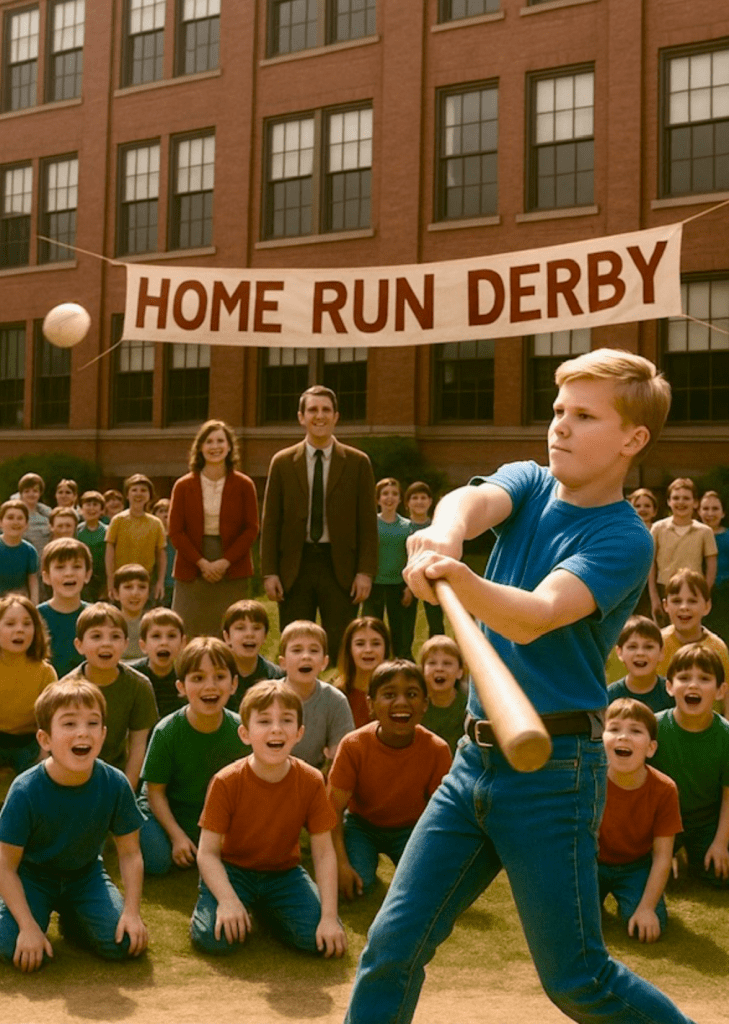
Also included in the annual spring sports gala was every race invented by man, including three-legged. No one could out-perform Tim Crow in the races; the rest of us were competing for 2nd Place.
As for the kicking skills, Big Bob ran the table. You’d lose the soccer ball in the sun’s glare trying to follow its height and arc. We laughed when the teachers who were standing as distance markers realized the soccer ball was flying high over their heads, even after they’d already moved back for insurance. Big Bob always out-kicked the teachers. He was our Hercules.
Steve Irwin was another kid in our class but he didn’t live in our immediate neighborhood. He grew up directly across the street from Teller Elementary, which was three short blocks and two long ones from my house. The red brick house Steve grew up in faced the large oak doors that were the main entrance to the school. He had an older brother who was a lot older than any other kids older brothers or older sisters. His brother was so old that I only saw him once. He looked like a 50’s beatnik with his reddish hair in a comb-back double swirl like a Mr. Frostee’s strawberry ice cream cone.
Steve’s father was old, too; a doctor that lived someplace else. And Steve was also older than any of the rest of us. His birthdate was in December, 1950; whereas the rest of us were born in 1951. Another classmate, Joe Mark, shared the same birthday as Steve, but Joe was born in 1951.
We didn’t realize at the time the advantages that one additional year of age guaranteed, but Steve was more physically developed than any of the rest of us. Noticeably stronger. He had a bicep. Nobody ever wanted to argue with him. He had that bicep. He had a reputation, too. Based on his bicep. He could pound you because of his bicep.
Then in the summer of 1963, Steve Irwin was the first kid in our class to sprout hair in his nose. I didn’t know noses could have hair. Steve was just a few months short of 13 years old when the first sprouts appeared. The rest of us were still only 11 years old or 12. Steve had a real nice nose other than that. It was a way better nose than mine. Mine got broken and was never properly realigned. Steve’s nose hair took me aback a tiny bit, I can’t lie, but I still would have opted to have his nose over my crooked honker. I had already figured out that I might be getting my nose clogged with hair someday, too.
Steve got everything first in our class; of course, biceps and nose hair, but also a drop in his voice and an Adam’s apple, and later a driving permit, a driver’s license and the legal age to drink 3.2 beer.
Steve signed my 5th grade class yearbook with the following poem. The yearbooks were handed out on the Last Day of 5th Grade:
Doesn’t it make you angry.
Don’t it get your goat.
When you’re in the bathtub,
And you can’t find the soap?
What???
OK. I get it. We were kids and didn’t know much about poetry. Other than the fact that it had to rhyme… which technically, Steve’s poem didn’t do.
But it was sort of shocking that Steve showed interest in it. Like he was older than us.
I wasn’t thrilled to have that written in my 5th grade class yearbook for the rest of my life until I keel over and die. Why did he write about taking baths? Was Steve still taking baths at his age? Shouldn’t he have been the first kid in our class to graduate to showers?
Steve was the first kid to show an interest in writing and poetry. Maybe there was a sign in there regarding his future.
I was generally afraid of him, and was afraid I’d have to say something nice to him about what he had written in my yearbook if we came face to face on that last day of school. All I could think to say was:
‘Thanks for signing my book. Cool poem. Did you write it yourself?’
What did you think I was I going to say?
‘Do you have an eraser?’ The guy would have killed me if I said that.
But I didn’t say anything to Steve because I was able to dodge him those last few minutes. While everyone else was talking and having fun on that Last Day of 5th Grade with their yearbooks passed around, I spent a small amount of my time keeping an eye on Steve Irwin’s whereabouts.
When I saw him leave the school and go across the street, up three stairs and disappear into his house, Frisell and I left the school together after the rain had stopped to go home for the summer. Earlier chronicles described Frisell’s deft rescue of the paper boat floating down the gutter, rushing with rainwater, toward the storm drain on the corner.
We all advanced through the grades together as a class and as friends. Big Bob got a job in 9th grade working at the Red Barn on Colfax Avenue. The Red Barn was a step down from some of the other hamburger joints, like McDonalds. They called it an alternative. We called it inferior.

Colfax Avenue was the longest commercial street in America and still clings to that honor. There were no houses on Colfax Avenue. No apartments. Just one lousy business next to another lousy business with an occasional hang-out restaurant and a few movie theaters that we liked.
Colfax Avenue was fifty miles of an unstitched open wound, mostly populated with pustulating patronages lining both sides. Uneven gutters, cracked sidewalks, liquor stores with broken neon, strip clubs flickering small red bulb lights positioned as women’s nipples, worn out gas stations run by shady characters who smeared your windshield and took your money. It was just one seedy business after another lining one long scar called Colfax Avenue. Everyone just called it Colfax.
We’d argue over whether or not Colfax was better than Tijuana. It didn’t matter to us that Colfax was a street and Tijuana was a city somewheres in Mexico. All we really knew about Tijuana was a that it had a ‘j’ that you pronounced as though it were an ‘h’ and that it was a seedy town. The comparison seemed valid.
We compared lots of things to Tijuana. It was an ongoing argument. None of us had ever been to Tijuana but that didn’t stop nothing. One kid would take one side of the argument and the other kid would take the other side of the argument and like all arguments back then, the end was when one of the two arguers would challenge:
‘You wanna bet?’
‘Yeah. I’ll bet! How much?’
‘A quarter.’
‘Okay.’
A handshake cemented the deal but nobody ever paid up. Bets meant nothing. But that didn’t stop us from making them.
One short term ‘oasis’ on Colfax was the Red Barn burger joint because Big Bob took a job there. He could lift the heavy big kegs of fat and lard into the overhead cooking bins for the french fries that typically only older high school kids had the strength to handle. His hours didn’t extend into the night because he was still a kid. It was more of an after-school job that lasted a couple hours.
But Big Bob’s employment didn’t last long at the Red Barn. His boss caught him sneaking sesame seed bun double cheeseburgers with onion rings and cherry cokes to his friends out the back door. His release was a sad day but Big Bob just laughed it off. No big deal.
Big Bob wasn’t the only one that took a job in 9th grade. I had been working off and on for a few years for Denny Blum’s parents. His father, Peter, and aforementioned good and kind mother, Alice, had a successful catering business. A Jewish catering business that was permanently housed in the basement of the BMH Synagogue kitchen facility.
If there was a bar mitzvah planned or even a girl’s bat mitzvah (rare), it was a safe bet that Peter and Alice Blum were catering it. They had a monopoly. They often hired part-time help because they didn’t want full-time staff just sitting around eating the profits. If allowed, I, alone, could scarf down five cheese blintzes with blackberry jam and powdered sugar in the blink of an eye.
I had been a constant visitor to Blum’s house on Steele Street. Denny was one of my best friends. I knew Blum’s parents almost like they were my own.
Denny’s bedroom was painted a curious electric orange and his grandmother lived at the top of the stairs in the updated attic. The basement handled the ping pong table, and everywhere else there were shelves filled with jars of beets and carrots and gefilte fish next to boxes of matzah and soda crackers and cooking ingredients.
They had one million Sterno cans in their basement. So much Sterno that you thought the house could blow up if anyone lit a match. They had kosher plates and regular plates. Stacks of glasses here and seltzer water in cases over there. Boxes and boxes of Styrofoam cups and plastic forks and spoons and knives. Their house was a grocery store and a hardware store in one.
It was fun working for the Blum’s. Real fun. After a while I felt like I was an important contributing member of their catering business. I proved I had value and was a hard worker. And I showed I could anticipate problems and did whatever was necessary to avoid them.
Plus, earning a few bucks didn’t hurt, either. With Big Bob fired from the Red Barn, we were all left to pay for their oatmeal burgers that they called ‘All-Beef’. So we stopped going to the Red Barn. We were McDonald’s fans. Well, mostly for the McDonald’s french fries. And their chocolate shakes. I also liked the root beer at A&W as well as their teen burger. But A&W fries didn’t hold up to McDonalds.
One of the weeks in early October there was a huge Bar Mitzvah coming up: six hundred-person sit-down dinner with multiple courses. It was an enormous event. It would tax the Blum’s capacity like no other Bar Mitzvah that came before it. It took a few weeks to plan it… and days to prepare it. You couldn’t just cook for six-hundred people on the same day.
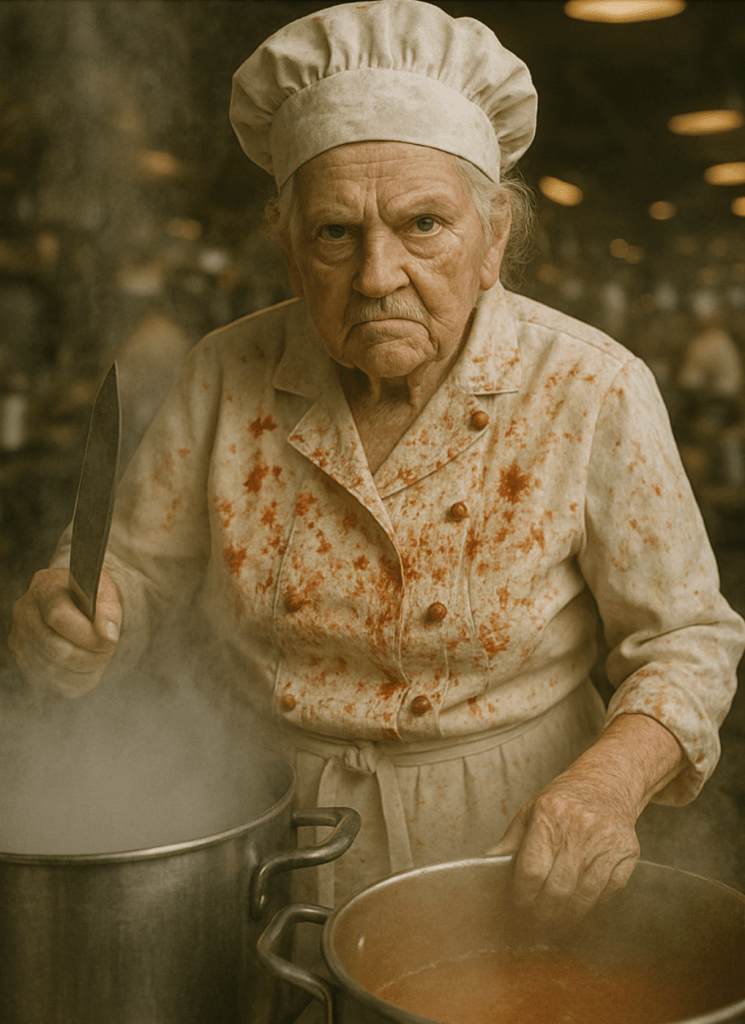
Mrs. Apple, an old lady that always looked angry, was Peter Blum’s main cook. Her nickname was Crabby Crab Apple, but we never called her that to her face. Peter was the head chef, trained in Europe. Peter Blum planned the meals. It was Mrs. Apple’s job to execute the plan.
Mrs. Apple was the head of the kitchen. What she said goes. Period. End of story. She stirred the bubbling cauldrons and ran the flames high up the sides. She shook knives at anyone that got in her way, and at whatever poor souls that offered any cooking suggestions.
Even Peter Blum avoided Mrs. Apple and gave her a lot of space. He kept his distance. He was afraid of her the same way I was afraid of Steve Irwin. Everyone was afraid of Mrs. Apple. Maybe Denny wasn’t afraid of her. She had her limits and knew that if she cut the head off of Peter’s delicate Denny, there would be consequences. She treated Denny nice.
The upcoming huge Bar Mitzvah-to-beat-all-other-bar-mitzvahs required more part-time hired help than usual. Many of Denny’s classmates came to the rescue, including me and Steve Irwin. Steve was a good worker but he wasn’t Jewish. He respected the situation and agreeably positioned a standard six-panel black yarmulke on his head. He looked sheepish for the first time; almost like an equal. He didn’t look tough at all wearing that yarmulke.
Being a neo-veteran of the business, Mrs. Blum asked me to help manage Steve. I felt good about that directive. Made my chest stick out farther even though I weighed 114 pounds and didn’t have much chest to stick out at that time.
The huge Bar Mitzvah ceremony started at 11:00a and lasted a little more than an hour. Then another half-hour passed just to get everyone seated around the large, round dinner tables, each with individual centerpieces of bright ribbon and cut flowers.
Forty-five minutes later and the appetizers had been cleared, and the salads had been served and eaten. Their plates and silverware were removed. Many guests requested new cloth napkins. The dishwashers, including me, worked at Mach speed. Everything was humming. It had to. The penalty would be facing Mrs. Apple. No one wanted that. No one ever wanted that.
The first main course was well into delivery. There were lots of servers. We never really knew what Denny’s job was in all this. But we knew it was a cushy white-collar job that paid more than what the rest of us got paid. Denny was smart enough not to let on what kind of hourly dough he was getting. My guess was that he was was being paid in the two’s; like $2.10 per hour. I once saw his good and kind mother slip a $10 bill into his white shirt pocket.
Crabby Crab Apple’s kitchen was hot with steam rising everywhere. She was focused and overwhelmed and the swinging doors were kept shut to keep the banging and the shouting and the overall kerfuffle down to a manageable muffle. This was the biggest Bar Mitzvah in the history of bar mitzvahs and no one was going to get in the way of Mrs. Apple.
In the basement of the synagogue were three large walk-ins. ‘Walk-ins’ are what they call those extra-large refrigerators in the back rooms of butcher shops and in the basement of synagogues. They are large enough contraptions that you could walk into one with a friend or two and have a conversation. One of the walk-ins in the BMH synagogue basement had a lock and chain on it so no one knew what was in it and it wasn’t used for this particular Bar Mitzvah.
A second larger walk-in was loaded with racks of chickens already cooked and cut up into halves and wings and thighs and breasts. No necks. Jews usually don’t eat chicken necks.
Also stuffed in this walk-in were cold cuts including deli-grade pastramis, Hebrew National® salamis, and Kosher corned beefs. There was a huge vat of Jewish dill pickles on a crate on the floor. Also refrigerated were cut flowers and beautiful bouquets. Those were the ingredients housed in just the second of the walk-ins.
The last walk-in was my favorite walk-in to patrol. It was filled with desserts. Not big desserts like big cakes and large pies. They were desserts that would fit in your hand, no bigger than a palm-sized horny toad. This walk-in had hundreds of desserts that could flop over or collapse if not kept at proper temperature.
On one of my patrol walks by the dessert walk-in, I noticed that the door was slightly open. Being an experienced caterer by now, I knew that an open walk-in refrigerator door could be disastrous. If the temperature inside rose too high, the desserts would become plunged pudding and the family paying the bill for the Bar Mitzvah had not ordered pudding. So I opened the walk-in door a little farther to peek inside to make sure that the pastries were okay and to make sure I didn’t lock anyone inside when I pushed the door shut.
To my amazement, inside was some old Colfax Avenue bum who had wound his way down the alley to the synagogue, descended the stairs to the lower kitchen, and walked smack into the huge Bar Mitzvah walk-in refrigerator that housed the hundreds of desserts.
He was eating one of the strawberry tarts with his right hand! I saw him take a bite. And in the other hand was another strawberry tart. I could not believe my luck. I’d caught an actual villain. I could close the door and trap him but just at that moment Steve Irwin walked by. I silently gestured for him to hurry over to me.

Putting my finger to my lips, I whispered, ‘Hey Steve, there’s some old bum in here eating one of the desserts. Run upstairs and tell Mrs. Apple. She’ll know what to do. I’ll stay down here to keep an eye on him in case he tries to escape. He might even try to eat more of the desserts! Quick. Hurry!’
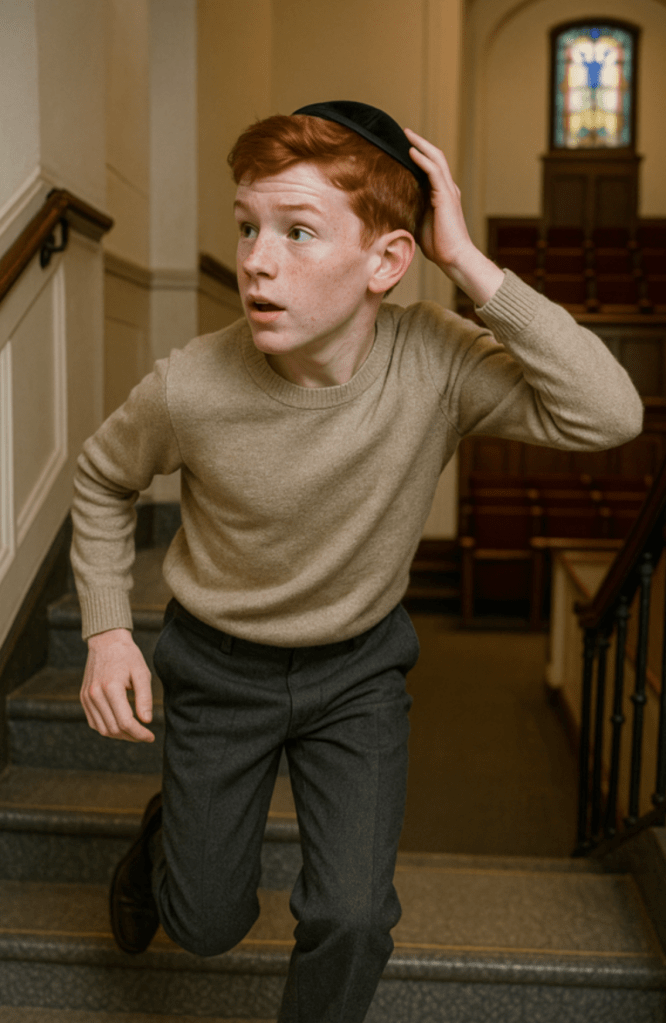
Steve screwed up his face for a fraction of a second and then took off running up the backstairs, securing his standard six-panel black yarmulke to the top of his head with his left hand. Steve was a natural right-hander, solid in the outfield, but in this instance he used his left hand which I didn’t realize until this picture was developed in the photo lab. He secured with the hand that steadies the grocery bag. Mrs. Apple’s bustling kitchen was just a few feet around the corner.
It was only seconds later and then I heard screaming and lots of commotion. It intensified. And then intensified even more. I knew that we really had nailed this one. Mrs. Blum would probably give me an hourly raise. Probably not to Denny’s level, but still. Maybe I’d get a bonus. Maybe I’d be offered how ever many desserts I wanted. Maybe I’d be allowed to take an extra Ginger Ale home. Maybe good and kind Mrs. Blum would sneak a $10 bill into my shirt pocket and wink. The possibilities were endless.
Just then, Steve came flying back down the stairs, five at a time, again securing his standard six-panel black yarmulke to the top of his head. Actually, he literally slid down all the stairs at once. He ran up to me, red-faced and enraged.
‘You set me up!’
‘What are you talking about? Didn’t you tell her?‘
‘Yeah, I told her. I told Mrs. Apple that some old bum is eating the desserts in the walk-in. She almost cut my head off. That old man in the walk-in is HER HUSBAND!’
‘Wow.‘
Sometimes trying to do the right thing doesn’t work out the way you envisioned. That’s a life lesson right there.
I was able to convince Steve that I didn’t set him up. I truly thought the old bum in the walk-in just wandered in off the streets, uh, alley. I kinda knew he wasn’t supposed to be there because he wasn’t wearing a yarmulke. Steve calmed down within a minute or so. The anger drained from his face. The corded muscles in his neck relaxed. His shaking subsided. He seemed tamed.
It must have been the standard six-panel black yarmulke… the only explanation. It just sucked all the aggression right out of Steve’s body.
Yarmulkes are The Great Equalizer; the secret shield. Samson’s lover, Delilah, didn’t need a servant to cut off his hair while he was sleeping to sap his strength. She just needed to bobby pin a standard six-panel black yarmulke to the top of Samson’s noggin. Samson could have kept his hair! Delilah didn’t know. History can’t blame her.
Yarmulkes were fairly new back then, I guess. I’m not a yarmulke historian. You’d get a better answer from Denny. But I know something about them from observation.
If you need to control the aggression in a room, pass out standard six-panel black yarmulkes to all attendees. Moods change instantly. Expectations retreat. Confidences plunge. People become less critical. Less focused. Less demanding. Everyone feel a little bit oogie on the inside but not in a warm, pleasant way.
Yarmulkes keep everyone unsteady and off-balance, and self-conscious and embarrassed, and quiet and hidden. No one sits up straight when sporting a yarmulke.
Yarmulkes force slouching. It’s the Jewish way. You should see my brother when he is wearing a yarmulke. Instant slouch. Undeniable. And he walks slower. Like with shame.
If you anticipate a possible tense situation, then the one foolproof preventative measure is to pass out yarmulkes in advance. It does not matter what the possible tense situation might be. Yarmulke salve is universal, and blind to religiosity. Give them to the invited. Hand them to the Christians. Pass them out to stragglers – the wanderers, the lost, the unfortunate. Throw in a couple white ones like cantors wear. Party planners go nuts when they see a clean white yarmulke. Especially ones with no schmutz that come with a silk lining.
And consider serving blintzes at high-brow company meetings; everyone likes noshing.
Noshing goes hand-in-hand with yarmulkes. As 96 years old Rabbi Kauvar gurgled through the liquid corner of his mouth after he was awakened at the close of the huge Bar Mitzvah while resting up on stage in the big chair next to the torah closet: ‘A blintz without a yarmulke is just eating. But a blintz with a yarmulke, that’s noshing.’

And then Rabbi Kauvar’s head dropped forward and bobbed on the end of its neck pole and he began to snore as the congregation rose in unison, left their seats, and headed for the blackberry blintzes followed by the six-hundred person sit down dinner.
We, the workers behind the scenes, the thankful keepers of the kitchen, were all waiting in anticipation. It was going to all go very smoothly. It had to. You can ask Steve Irwin what happens when it doesn’t. But give him a yarmulke first.

 Cantations