From the Bob Willard Collection, Volume 1
August 5, 2025 Second Edition Enhanced
The last day of public elementary school in Denver in 1962 was May 31st. It was a Thursday. Excitement for summer vacation had started weeks earlier of course, and reached crescendo a week before that last day. It’s all anyone could talk about. Or think about. Or wish for. It was all-consuming.
The instant the kids finally stepped onto the school grounds that last school day, they could not contain themselves. Broad elastic smiles stretched across their faces. The girls seemed more jumpy and giggled more, too. The boys acted goofier than normal. ‘Did you hear that Vesa’s parent’s dog had puppies?’
Stepping onto the school grounds was odd in the sense that it was the only day of the school year that you didn’t want to play on the playground… you wanted to get into the school and get this going. You wanted the last day to begin and for the clock to keep ticking away. The playground offered nothing that day. It was more of an impediment. An obstacle in the way of getting inside.
Not even the perpetually frowned, tight-lipped sourpuss face Bobby Vesa could contain himself on the last day of school. He had a smile. That’s right. Not even Vesa could contain himself. And yet being a constant sourpuss is what it meant to be Bobby Vesa; it was his best thing. Yah. We all heard on the playground that his dog ejected a litter that morning. A bunch of miniature schnauzers fell out. Who cares? Were we supposed to focus on a litter of schnauzers on the last day of school?
In seven hours, at 3:20p, the school year would be over. Every grade from kindergarten thru 6th would be done for the year. We had been waiting and not patiently. We were unruly. More than the usual kids were unruly. But it didn’t matter now. Summer vacation was about to happen. Finally!
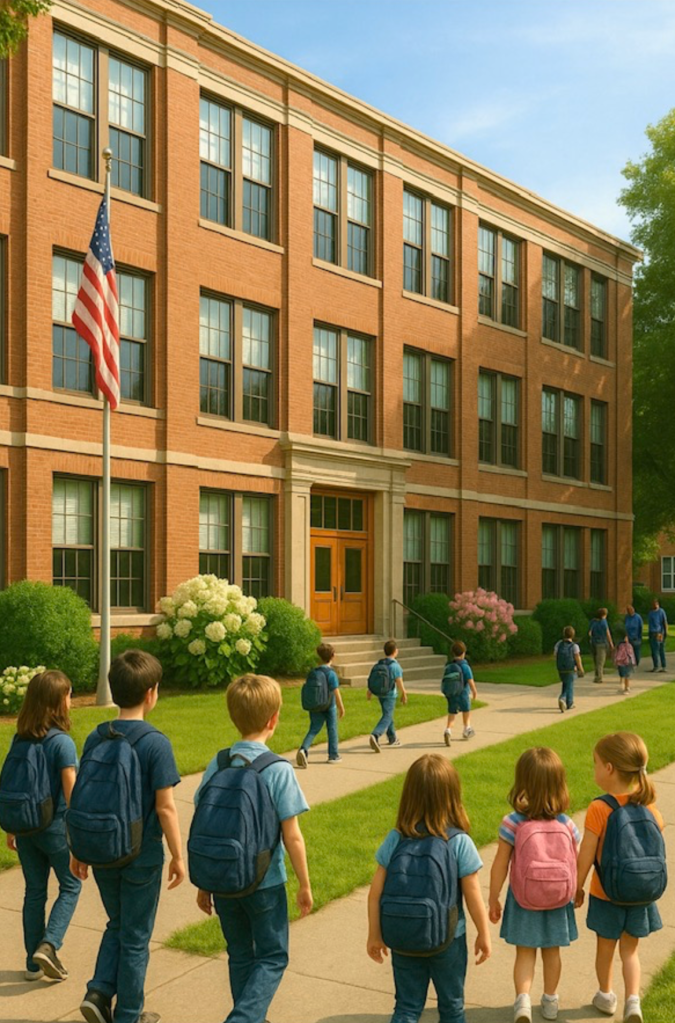
Henry M. Teller was a handsome, wide, three-story tall red brick elementary school. It spanned nine of the twelve houses directly across Garfield Street. We counted.
Most of the Garfield Street houses across the street from the school were constructed of similar red brick to what built the school. There were a few blonde brick houses sprinkled in, too. But red was the dominant color on the street. Garfield Street was a red brick street, all in all.
Shade trees lifted green canopies that capped both sides of the street: Chinese poplars with fan-shaped waxy leaves, blooming wild ash, and thick-trunked oaks with caterpillars climbing up the bark.
If you ventured inside the school, you’d see that the height from floor to ceiling measured at twelve feet. The twelve foot hallways running down the center corridors on each floor ran parallel to Garfield Street and carried on for what seemed like forever… and kept right on going.
You couldn’t see it from the middle of the school, but at the far, far ends those central hallways turned 90º and continued. It was a large school, even for 5th graders eager to become 6th.
Peeking into the classrooms that last day revealed squirming students of all ages bouncing uncontrollably in their seats. Teachers had their hands full trying to maintain order. It was impossible to sit still! It was always impossible to sit still on the last day of school.
Kids watched closely as the second hands on the clocks tick, tocked, tick, tocked, tick, tocking, tick, tock… Counting. Waiting. There was an expectant constant rhythm.

Meanwhile outdoors, clouds covering the Rocky Mountains and stretching out into Denver’s desert plains darkened the morning sky. Black and dark gray thunderclouds poured down the face of the Front Range. It was an atmospheric attack. The clouds fisted together, and lightning shot back and forth. Like black death, the sky gathered into a fierce storm. You could watch it happen from the school. Rain would be coming. Heavy rain. Lightning flashed continuously, unchecked.
It wasn’t long before an atomic thunder rattled the windows of the school library and gym. It also rattled the windows in Mrs. Joy’s music room. A tuba fell and crashed onto the tile floor. It was Robert Latham’s tuba. No one else played tuba. Just Latham. The storm had descended.

Latham was a kid who was one year younger than the rest of the kids in our grade. He was supposed to be in 4th grade. Not 5th grade, like us. That’s what his age said. But it wasn’t safe for the kids Latham’s actual age to play with him on the playground. He wasn’t any good on the playground with kids his own age. He was too big.
Tetherball presented a special danger when playing against Latham. One of the smaller kids in his 4th grade class almost choked as the tetherball cord began swirling around his neck. Mr. Brown, our johnny-on-the-spot gym teacher, saw Latham smash the yellow rubber tetherball and witnessed the noose forming around Terry Reagan’s fragile pencil neck. Mr. Brown rushed to save Terry’s neck from breaking. Okay. Mr. Brown was only couple feet away when he witnessed what was happening. But he still saved Terry Reagan’s life. And he saved recess for all the rest of us, too.

Mrs. Caldwell, our principal, was a middle-aged spry woman and was immediately notified of the close playground catastrophe. Willard said it was a near beheading. I saw a different kid run into the school to tell Mrs. Caldwell. Big Bob Willard pointed out that there could be murder charges brought against Latham, the youngest such trial in the city’s history, and by extension, Big Bob said that Teller Elementary school officials could be charged, too. It seemed unlikely and a bit of a stretch to me, but it was still an astute, albeit an incorrect, observation.
Principal Caldwell snapped an impromptu meeting with Mrs. Fink, the trusty assistant principal that sat right outside Principal Caldwell’s office, and Betty, our school nurse, who’s office was also connected to the principal’s office.
Nurse Betty was Red Cross approved which allowed her to wear the white hat and the white canvas tennis shoes. No one else in the school wore a hat. Some of the lunch ladies wore a hair net, but I never saw a hat being worn by anyone other than Nurse Betty.
Just being honest, to me she seemed unnecessary. Like a luxury the school didn’t need. I mean, no one hardly ever went to see her for anything. Although I did, twice. There must have been a law saying a school must have a Red Cross approved nurse on-site during class time hours.
I visited Nurse Betty’s office once in our 5th grade year because of stomach bugs. It was early October. Turns out Nurse Betty actually had a bed in her office! Right there. A bed. Maybe I should call it a cot. It looked like a bed until I really looked at it. I guess she just got tired during the day even though she looked younger than my mom and my mom didn’t need to lie down in the middle of the day.
I sat on the rear-end of Nurse Betty’s cot for about five minutes and then I told her that I was feeling better, and that the cot worked great, and that I should get back to class. The cot was actually terrible. It’s why I left. It was higher than my bed at home so my feet couldn’t touch the floor even with my shoes on, and it wasn’t comfortable. She said I could get under the covers and that was unsettling. She felt my forehead and looked up at the fluorescent lights while she was doing it and said I could go. She knew her craft, I guess.
Following the emergency tetherball meeting between the trio of female legislators, the surprise conclusion came out that Latham would be joining our 5th grade class starting the next day.
‘There’s no way they’re gonna let a kid get beheaded by a tetherball rope,’ exclaimed Big Bob Willard.
And he was right. Big Bob Willard didn’t do his homework all the time. Mostly, he didn’t take school seriously. But he knew a lot of stuff.
Even in 5th grade we had pride in our school and didn’t want some bad news about a kid’s death on the playground spreading around and out into the community. Yet some of us were conflicted about that and thought it might be cool to go to the school with an actual playground murder as part of its history. Personally, I wasn’t conflicted at all. I was all into the murder angle. So was Willard.
The next day, when they moved Latham up to our grade, grade 5, the teacher’s explained that Latham was ‘big-boned’, which we took to mean ‘fat’, and so he was a danger to the smaller 4th grade kids. They also said that his tests were good which all of us knew was horse hockey. Kids know other kids better than the teachers know the kids. Latham’s test weren’t good. They were never good. He’s not even in my grade (or wasn’t) and even I knew Robert Latham’s grades weren’t good. Big Bob’s grades weren’t good either, but Big Bob knew a lot of stuff. Latham was just kind of a zip and couldn’t test his way out of a paper bag with instructions and practice.
But Latham didn’t mind any of the critiques and criticism of him on that year’s last day of school. He was still beaming having just won the ‘Congress Park Hot Dogs and Campfire Beans Eating Contest’ four days earlier at the ‘Congress Park Hot Dogs and Campfire Beans Eating Contest’ festival. The annual event was held in Congress Park for the fifth year in a row. Hence the name.
Some of the other parks didn’t even have a hot dog and campfire beans eating contest. Cheesman Park didn’t have one. And Cheesman Park was supposed to be a top park. Better than Congress Park, anyway. Crestview Park on the other side of Colorado Blvd also didn’t have a hot dog and campfire beans eating contest. And like Cheesman, Crestview Park was also highly rated.
Just Congress Park had the festival. We were told we were special, but Congress Park was an obviously low ranking Denver park. Probably, and I say this with no enthusiasm, Congress Park was the worst park in Denver. Small. Courted by busy streets on two sides. No lights. No sundial. No swings or playground area. No sand. Had a pool. A small vanilla pool with small towels handed out. Showers dripped. But we did have the ‘Congress Park Hot Dogs and Campfire Beans Eating Contest’ festival for our fifth year.

There were balloons for sale at the ‘Congress Park Hot Dogs and Campfire Beans Eating Contest’ festival that cost five cents. If you wanted it inflated, turning it into a balloon, it cost another two cents. Basically a balloon cost 7¢. Pennies had value. They were an important currency.
Pre-K little kids up to kindergartners were given balloons for free. Pre-K and kindergartners didn’t normally have pants pockets unless they were real advanced pre-k’s or kindergartners. Those were far and few between. I never met one. Not in our neighborhood. But also the pre-k’s and kindergartners didn’t have money. And they couldn’t count. And they’d cry if they didn’t get a balloon and ruin the festival that was meant to make us feel special. That was Big Bob’s explanation why the pre-k and kindergartners were given balloons for free. It was a believable, make-sense, thinking-man’s sound explanation. Somewhat of a surprise to come from Big Bob. But Big Bob always knew how to think. I knew that. I knew Big Bob real well. He was like a partner of mine. We made each other laugh and neither one of us would back down to a dare.
Balloons weren’t the only things for sale at the ‘Congress Park Hot Dogs and Campfire Beans Eating Contest’ festival. Cans of pop were also for sale. The cans were kept in a big ice bucket the size of a Shetland pony’s trough. They weren’t called ponies back then. They were Shetland ponies. They were kinda like the miniature Schnauzer of horses.
The lady running the canned pop stand just let you grab your own can right out of the trough. Whatever you wanted. Coke. Black cherry. Orange. Grape. 7-Up. Bubble Up. Root beer. They had a real decent selection. That’s for sure. Though they didn’t need both 7-Up and Bubble Up in my opinion. Everybody knew it and seemed to agree. Nobody said nothing. There was no complaining. Big Bob wanted cream soda but they didn’t have any. Big Bob was bummed about that. He always acted a bit like being superior, but I knew that was his way of protecting his frailties and deep down shame.
The circus-like festival food line gave out peanuts at the colorful lemonade stand with colorful lemonades. And snow cones, which didn’t last long in the heat. If you asked for more cherry flavoring on your snow cone they’d just say to move along: ‘Next in line.’
The lady running the canned pop stand who allowed me to get my own pop was the first time that an adult that didn’t know me trusted me to do the right thing. It was memorable… and surprising. I may have grabbed two pops and only paid for one. Trust guaranteed my honor. That went noticed. So that’s how the world works. On a trust system.
Of course, hot dogs and beans were also available from a concession stand right next to the pop stand. The full ‘Congress Park Hot Dogs and Campfire Beans Eating Contest’ festival combo, which included a can of pop, a hot dog on sesame bun (or plain), and a small Dixie plate of Heinz campfire beans – cost 25¢.
Each order came with a plastic fork and two packets of French’s yellow mustard. You didn’t need to bring your own fork from home. It’s all part of the festival’s motto: Leave Your Forks at Home. They were organized. They used what they called a ‘plan-ahead’ strategy and you could see it working.
But in addition to the cherry flavoring for the snow cones, they were cheapskates when it came to napkins, handing out just one napkin per order even though we were messy kids. We didn’t know how not to get messy holding a Dixie plate full of beans while juggling a hot dog and a pop and a couple mustards and a snow cone. The kid right in front of me in line got mayonnaise all over himself before even paying. I didn’t even see the mayonnaise. Who needed mayonnaise? You can’t hand out one measly napkin to a kid.
Latham choked down 11 hot dogs and consumed five plates of campfire beans to take 1st prize. He didn’t have to pay for any of it. Food came free to the contestants, just like the pre-k’s and kindergartners. He wasn’t even full but he didn’t look happy.
Winning the ribbon meant nothing to Latham. He won the same contest last year. He was just practicing for the big hot dog contest up in the mountains later in the summer. The overnighter.
Then, just about ten seconds after Latham received his 1st Place blue ribbon for the second time in two years, his face turned purple and then he leaned to his left and barfed onto more than a couple of feet of the newly assembled ceremony stage. He stood frozen on the brand new awards ceremony stage built for the ‘Congress Park Hot Dogs and Campfire Beans Eating Contest’ festival.
Latham didn’t even try to get off before he barfed. At least it didn’t look like he did. Parents turned to one another and wondered why he hadn’t moved away first. It turned out that the ‘Congress Park Hot Dogs and Campfire Beans Eating Contest’ festival’s new awards ceremony stage was a one-time use only. Some ladies seemed ashamed and were shaking their head at Latham.

To his credit, Latham didn’t get any hot dog juice or campfire bean remnants on anybody. Just himself. A little on the front of his shirt and a little more than that on the toes of his white Keds. He wasn’t wearing good shoes or anything like that. There was no dress code for being a contestant in the ‘Congress Park Hot Dogs and Campfire Beans Eating Contest’.
That’s enough on Latham. He wasn’t really part of our gang to be honest. But the next guy was my best friend.
Bill Frisell was a neighbor of mine who lived only five houses up Cook Street. That was my street, too. He was my best friend since 2nd grade when he and I started walking to school and back home together everyday. We did everything kids do together growing up.
We played. Competed. Had sleep overs. Drilled holes in wood. Hammered nails in trees. Sawed. Built stuff. Figured out the world. Did a lot of other stuff. Cracked jokes. Talked about the Rainwater family and whatever in the world had happened there. Stole candy. Counted VW bugs, convertibles and busses that drove by on 8th Avenue. Ate at each other’s houses a gazillion times. His mom, Jane, made real good schnitzel. She also made fricassee. Mostly no one else made that. Frisell and I bought baseball gloves together. Bought baseball cards together. Bought brownies. Played in band. Went to tons of movies and stuff. Rode bikes. Trick or Treated. Bought slingshots. Shot bb guns. Got shot by bb’s. Got haircuts on 8th and Colorado Blvd. Watched sports on color teevee. Watched Bonanza on Sunday night. Climbed trees. Had the same pediatrician. Did tons of alley hunting. Thumbed through MAD Magazine. Liked DC Comics over Marvel, til we didn’t. You name it, we did it.
Frisell ordered a baby alligator from the inside back page of MAD one time and it was when the thing got delivered to his house that his mom found out. We were playing Parcheesi in his basement at the time of the delivery. I had the red pawns and was drinking a Duffy’s pop. Frisell controlled the black pawns but he wasn’t drinking nothing because he said he had a sour stomach. We both already had two pawns reach home. That’s when the doorbell rang and Frisell ran up his back stairs but his mom was already at the door holding the red alarm box.
The baby alligator came in a red alarm box that had small holes drilled into it. Frisell carried the box straight to his room. You could see the baby alligator motionless in the box and then Frisell opened the box and shook the thing out onto his bedspread. The thing was about five inches long nose-to-tail and it was green and prehistoric. Once it landed on the bedspread, it kept mechanically opening its mouth and closing it like that was all it knew how to do. It didn’t make any noise. It was silent. That was that scariest part. The prehistoric silence of the thing.
Frisell’s mom said he was allowed to keep the baby alligator for an hour and then he had to flush it before his father got home. That’s what she said. I heard it. Frisell said, ‘But mom’, and then got a look and stopped.
The cover of the red alarm box that the reptile came in said ‘No Returns’. I watched the baby alligator wiggle to avoid going down the bathroom pipes but then it disappeared. Frisell didn’t get that attached to it in an hour. He didn’t give it a name or anything.
Frisell and I both played clarinet. So did Charlie Wagner. Denny Blum and Wayne Matsuda? Trumpet and cornet. Wayne’s eye glasses improved his ability to get the notes right.
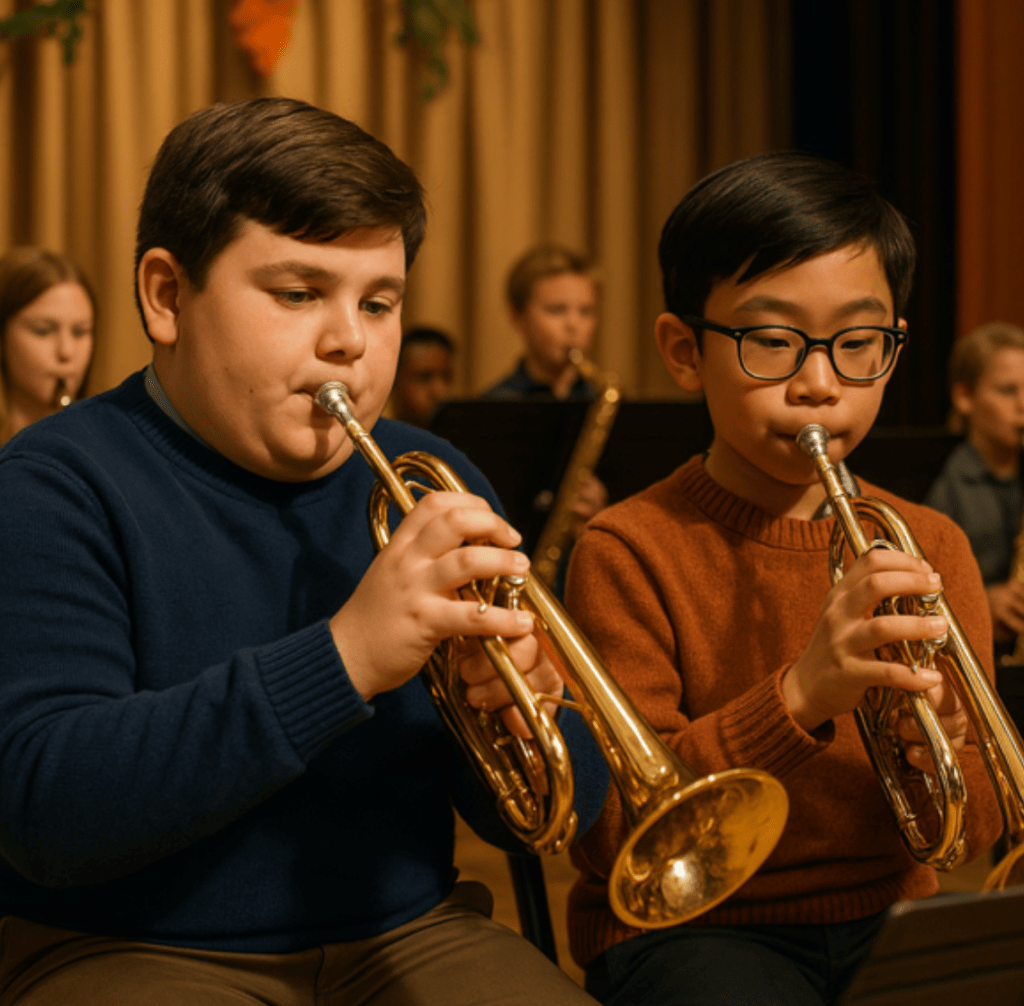
Frisell was better at playing 16th notes on his clarinet than anyone in our class. Including me. Even back then. We both tried out for Citywide Band and when we checked the results of the tryout tacked onto the messy cork board that had tons of handwritten notes plastered all over the place, both our names were included in ink. We had both made Citywide Band! But still, he could run 16th notes on and on and on. Like forever. I could only do 16th notes in small batches.
Frisell was awarded 1st chair in Citywide Band and I was assigned to chair #5. Which was fine since chair #5 was at the start of the 2nd row of clarinets on stage, right behind Frisell and his 1st row fancy-schmancy clarinetists. At least I wasn’t buried deep into the woodwind section behind the Citywide Band bassoon players. They had three! One of the bassoonists was bigger than Latham. If I had been assigned chair #4, I’d be invisible. I’d never know I was there. I was fine with chair #5.
The guys were sitting at lunch on that last day of 5th grade.
Frisell said: ‘Greg Jones told me that he watched cartoons in Mrs. Somma’s English class. I have her English class next period. It be amazing to just watch cartoons on the last day of school.’
Big Bob Willard the expert piped in: ‘Yeah. I know. It was a double feature: 15 minutes of Bugs followed by 16 minutes of Porky. And then she has to rewind the cartoons for the next class.’
Frisell to Big Bob: ‘How do you know about the cartoons? You don’t have Mrs. Somma until period six.’
Big Bob: ‘Linda Hart told me yesterday that they were gonna do it. I guess Mrs. Somma is getting old. Maybe those big black things sticking out of her neck are killing her. I’d prefer 30 minutes of straight Porky. You can keep your Bugs.’
Frisell: ‘You mean 31 minutes. 15 minutes and 16 minutes is 31 minutes.’
Big Bob: ‘Hell, I’d take 25 minutes of Porky over whatever her class has to offer!’
And there it was.
Big Bob was the first kid in our neighborhood to swear at school. It started with the ‘h-e-l-l’ word right there and then: Teller’s lunchroom the Last Day of 5th Grade in front of me and Frisell and the other guys and the lunch ladies. He didn’t use the ‘f’ word or the ‘s-h’ word that many people assumed would have been the case with Big Bob. He started his career using the ‘h’ word.
Big Bob was a lifelong close friend. I had a bunch of them. Crow. Kubly. Blum. Charlie Wagner. And, of course, Frisell.
Big Bob was my go-to Cub Scouts partner in crime. He was a trouble-maker at school and a trouble-maker in Webelos. Trouble followed him around. He had cherry bombs and M80s hidden in his sock drawer at home when he was seven. I had one old Black Cat at nine and I was afraid it would blow my fingers off.
Big Bob was also the first kid in our neighborhood to learn how to light matches. Sometimes he’d show off and light the whole matchbook while still holding it. I thought he was playing with fire, so to speak. And he could light wooden matches on his pants like we saw real cowboys do in the movies, even though he couldn’t do it every time.
Then… a flash of lightning and another explosive thunder reverberated outside. The storm was real close now. Aimed right at us. The Last Day of 5th Grade crept by under such weight and atmospheric conditions. Lightning flashed repeatedly. The wind began to heave and the flag on the flagpole fluttered straight out before Mr. Brown courageously scampered and took it down. American flags weren’t supposed to get wet. It’s bad for the country or something like that. I never really got it.
At the lunchroom table next to ours, I heard tow-headed Billy Snyder cry out, ‘It’s going too slow!‘. Meaning the last day was advancing at a snail’s pace. Billy talked a lot in social studies, mostly out of turn, usually interrupting someone else, and never realized that no one ever cared what he said. There was a group of stupid kids in our grade and he was part of that group. Sometimes Big Bob would join them. But that’s because they lived right on his block and around his house.
Big Bob didn’t live on the same block as me and Frisell. He lived a few blocks over. He couldn’t help it that he lived on a block filled with idiots. That’s where his parents lived.
I heard that Billy Snyder’s plan was to grab the attention of the girls after the last day of school by doing wheelies up and down Garfield Street on his shiny green Stingray bike. Billy Snyder wasn’t much of a student. No. He was much less than that. Big Bob would say Billy Snyder was ‘dumb as a box of rocks‘.
One of the first expressions I ever heard came from Big Bob. I learned lots of expressions from him over the years. ‘Dumb as a box of rocks‘ was my introduction. I’m not saying he invented that expression. And I’m not saying that he invented any of his expressions. And I’m certainly not saying that he said he invented any of them. But he had a lot of them. They were his weapons. They were his swords.
Even so, I couldn’t do half the things on my own blue Stingray bike that Billy Snyder could do on his shiny green one. He was an aerialist on his green Stingray. He could have performed in a circus. ‘Dumb as a box of rocks‘, but he could have traveled around small town America sparkling costume jewels in a fancy circus suit. One guy’s toast is another man’s bagel.
We all really thought Billy Snyder could join the circus. What else was he gonna do? Well, it never came to pass. And he never did impress any of the girls to his advantage on the streets of Garfield that afternoon.
At the end of the 2nd lunch period, with all the hour hands pointing at 1:00p, those of us still in the lunchroom jumped at the sudden lightning flash followed by an explosive loud BOOM! And then a harsh downpour and deluge of banging rain and cold sleet.

The biggest storm of spring arrived in full force at Henry M. Teller elementary. Eight-foot long fluorescent ceiling lights spit and flickered and crackled, struggling to stay on. It was the first time that it ever rained on the last day of school. And it was a deeply dark, cold, shivering downpour. A deluge.
The sky was normally sunny and the air warm for each of the five previous last days of school. As Denny Blum encapsulated years later:
Leaden clouds hung low.
The storm thrashed violently outside until 2:20p; savagely pelting the windows with raindrops the size of water balloons, rebounding off the sidewalks, shining the streets to reflection, and forming pools in the playground sand pits. Then, like magic, the storm softened and mushed, and moved slowly to the south and to the east. The sky lightened in cadence with the school’s ticking clocks. The storm was moving away much faster than it had come.

Every kid had one more class period left to endure. Just fifty minutes more!
With blue eyes and brown eyes and green and gray eyes and probably a couple hazel eyes, too, each hypnotized on the classroom clocks, at 3:20p the final school bells clanged spiritedly up and down the long hallways. Right on time. It was deafening, and oh, so sweet.
As if we had practiced all year, every kid screamed out at the same instant ‘Summer vacation! Summer Vacation! SUMMER VACATION!! SUMMER VACATION!!‘ Teachers buried their heads to protect their ears.
Outside, directly overhead, the sun was a full chariot without cloud interruption.
In our hands, we each had our final report cards sealed in manila envelopes to be handed over only to our parents once we arrived home. We had done it before. Many times. We all knew the drill. And we all knew our individual situations…
With year-end reports clutched tightly, Frisell and I flew down the iron stairs from the 2nd floor to the 1st, and made our final 5th grade exit by bursting through the large double-wide front doors. It was those large, tall, heavy oak doors that faced Steve Irwin’s red brick house directly across Garfield Street.
The air outdoors was filled with the ozone rich redolence of the passing storm.
Most of us had similar summer plans… playing with our friends. Each day. All day. Beginning early when the doves cooed on the telephone wires and ending when the red and purple and white frosted tulips folded their petals for the night… and the street lights began to warm and glow.
Miles Kubly and Tim Crow were already outside when Frisell and I burst through the school’s heavy front doors. Together, the four of us quickly agreed to play softball at 9:30a on Teller school’s playground the next morning. Friday. June 1st. It would be our first summer activity! And a good one, at that. We divided up names of other kids to call to round out the lineups.
Immediately after cementing our agreement with Miles and Tim, Frisell and I passed the enormous pink and white snowball bushes guarding the school entrance. Glancing up at the drooping rain-soaked American flag, we tiptoed around the reflective ground puddles as we approached raging Garfield Street.
Lightning continued to spark silently in the distance, and thunder boomed and echoed distantly, and boomed even more distantly again.
The gutters on Garfield Street were still swollen with rushing rainwater heading down from 11th Avenue up to our left, to the storm drain near 12th at the end of the block to our right.
Suddenly, Frisell and I saw a paper boat racing wildly toward us down the raging gutter.
‘Hurry. Before it gets by,’ I shouted.

With a gifted natural agility, Frisell snapped the paper boat out from the rushing current. Together we unfolded the center-masted paper boat only to discover that it wasn’t simply a wet paper boat. No. It was more than that. Much more. Crafted with supreme skill, it was Big Bob Willard’s year-end report card folded up and heading to a watery grave.

There were unflattering grades in red ink on the inside of Big Bob’s paper boat final report card. Big Bob wasn’t even supposed to open it. It was for his parents to open. I didn’t open mine, even though I have to admit that I wanted to. Frisell didn’t open his, neither. Even though he told me he wanted to, too. Not a single 5th grader opened their sealed final report card except for Big Bob Willard. Everybody wanted to open their final report card… Big Bob did it. He was reliable doing things that other kids wanted to do, but didn’t dare do.
It didn’t take Frisell or me but a glance to realize the problem with Big Bob’s final report card. We carefully refolded it back into ship shape. With an abbreviated salute, Frisell bent down and gently placed the little schooner back into the raging torrent, returning it to its voyage toward the storm drain down on 12th Avenue, which had become a rushing waterfall that dove into the black darkness.
Jack and Thelma Willard never did see their son’s 1961-1962 Year-End Report Card. Nor did they hold in their hands an example of their son’s exceptional paper folding skills. It’s like Big Bob was a Popeye sailor. That report card boat was a beauty. I’d say Big Bob Willard could fold a piece of paper into as good a boat as anyone ever could.
And then, like each of the previous final days of school, Frisell and I walked home together, shimmying as far as we could on that low railing that followed alongside part of the sidewalk… anxious to play softball the next day.
On our way home, we stopped by the Madison Street candy store for the final time that school year and bought two Duffy’s Gabby Grape pops. Our usual after school imbibe.
I was told that in some eastern parts of the United States pop was called ‘soda pop’. Or just ‘soda’. Too bad for them.
I didn’t understand exactly what the ‘soda’ part was referring to. Then again, teenage kids working behind the counter that made root beer floats and coke floats and ruined the milk shakes were called ‘soda’ jerks. I instinctively knew that the ‘jerks’ part referred to the teenage kids. I recognized that ‘soda’ jerk sounded better than ‘pop’ jerk.
Some of the teenage kids that made the floats had red dots on their faces. It looked like they got the measles. But they didn’t have the measles. The druggist behind the candy display said they had pimples, which I guess is measles for teenagers.

After opening our Duffy’s Gabby Grape pops we turned out our pockets and bought a few candy bars. And one three-foot long rope of red Twizzler licorice. And a handful of Bit-O-Honey. Maybe two handfuls.
Frisell also bought one of those large 5¢ paraffin wax red lips. He took a bright shiny nickel out of his pocket to do it. It was a special nickel and his last nickel, too. Maybe it was his way of celebrating the last day of school. I didn’t know. I thought he was just wasting a good nickel. I mean, I knew he was.

Frisell ended up thinking so, too. He hadn’t had the 5¢ paraffin wax red lips more than a minute before he just chucked the thing in the trash. Gone. 5¢ waxy red lips thrown away. He had stared at it, put it in his mouth, bit down into the paraffin, made a mushy sour face, and tossed it into the trash. One toss, two points.
Neither Frisell nor I were surprised by Big Bob’s Year-End Result Card. We weren’t surprised he had converted it into a sea-faring boat. It epitomized Big Bob. Even as elementary school kids we admired Big Bob’s daring and we kinda admired his questionable deeds and his lack of shame and his constancy to go against the rules.
It had long been those things about him that never changed. He had his own way.
And still, he was one of us; a close friend whom we cared for if needed and loved deeply. He was family. It remains so six years after Big Bob began what he would have called his ‘dirt nap’.
That’s another Big Bob expression: ‘Dirt nap.’ That’s what Big Bob is actively engaged in doing now.
Make the expression your own. He wouldn’t mind. He’d like it.
Big Bob died peaceably at age 69 due to a cancer-ravaged body from a life of poor choices. He thought he would live to be 100. He came up short.
I was proud to be his friend.